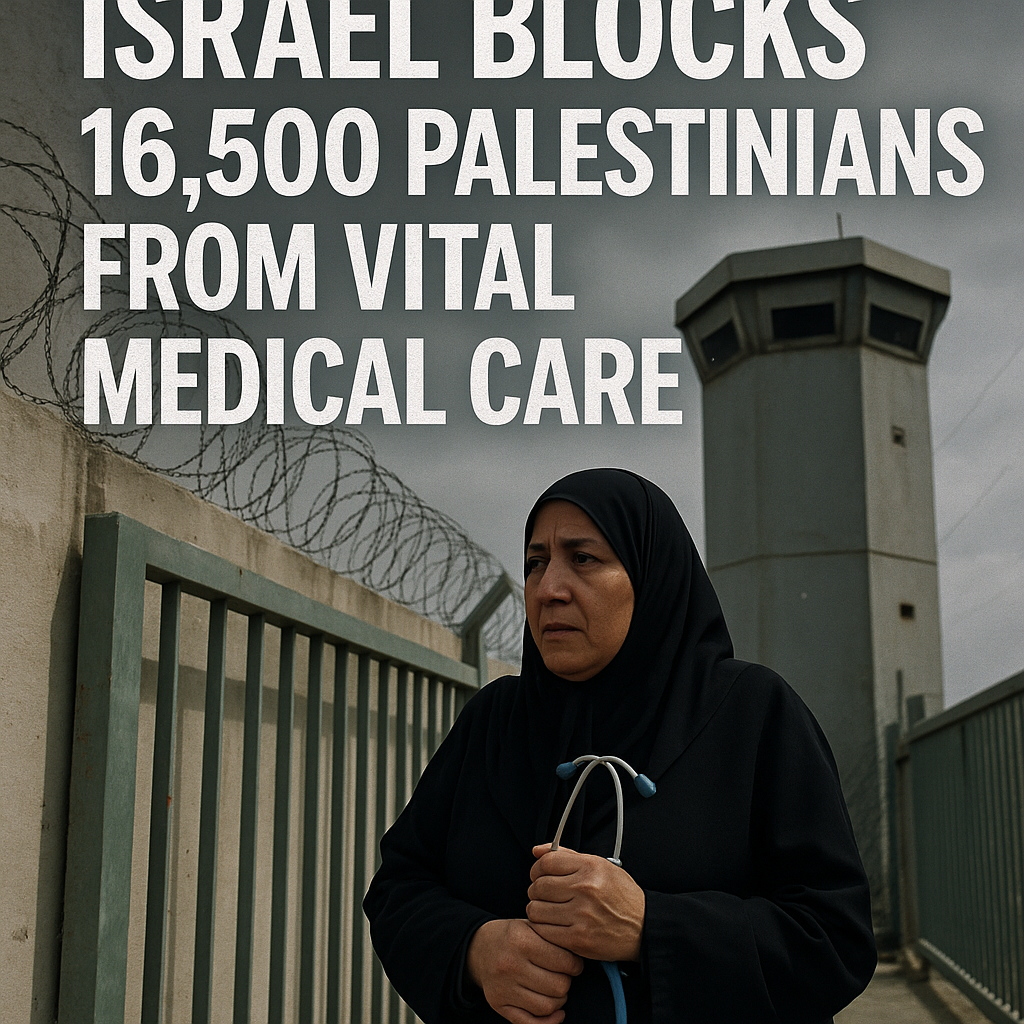
Israel Blocks 16,500 Palestinians from Vital Medical Care
Israel Blocks 16,500 Palestinians from Vital Medical Care
In recent developments, reports indicate that Israel is preventing over 16,500 Palestinians from accessing vital medical treatment. This has raised significant humanitarian concerns and sent ripples through the international community, triggering debates on ethical obligations and political ramifications.

Human Cost of Healthcare Restrictions
The implications of such restrictions are staggering. Access to healthcare is a fundamental human right, yet many Palestinians face barriers that extend far beyond geographical boundaries. According to Al Jazeera, these restrictions affect not just the patients in need of care but also their families who suffer as they navigate a convoluted system of permits and checkpoints.

Several families have expressed their anguish, having seen loved ones suffer due to delays or outright denials of treatment. This situation is further complicated by ongoing conflicts and the tension surrounding Israel and Palestine, where healthcare resources are already limited. The World Health Organization has consistently reported on the dire health conditions in Gaza, emphasizing that many patients require specialized treatments that are painfully difficult to obtain.

Political Dynamics and Healthcare Access
On the political front, the restrictions on medical care have been met with a mix of condemnation and justification. Some Israeli officials argue that security needs drive these policies, suggesting that allowing unrestricted access to services could be exploited for malicious purposes. They contend that stringent protocols are essential for maintaining safety, especially in a region marked by friction and violence.
Conversely, critics see this as a blatant violation of human rights. Activists and international organizations argue that prioritizing security over life-saving treatments fails to acknowledge the fundamental principle of humanitarian care. According to RT News, various NGOs have called for action, urging the international community to pressure Israel into lifting these sanctions, asserting that health should never be a bargaining chip in a larger political game.
Moreover, there is concern about the long-term implications these restrictions could have on the Palestinian healthcare system. Many hospitals already operate under extreme constraints. Every patient blocked from receiving necessary treatment can lead to complications, worsening conditions, and, in some cases, preventable loss of life.
Seeking Solutions in a Complex Landscape
While the gravity of the situation calls for urgent responses, the path forward remains uncertain. Various humanitarian organizations advocate for dialogue that not only seeks to ease restrictions but also fosters a peaceful resolution to the underlying conflict. They argue that addressing healthcare needs could serve as an entry point for more comprehensive discussions on human rights and security in the region.
Many believe that an international effort, possibly involving neutral parties to mediate, could facilitate dialogue focused on healthcare as a starting point for broader peace initiatives. Notably, successful mediation efforts have often included humanitarian considerations, demonstrating that even amid conflict, the shared human experience of health can unify disparate sides.
Yet, the challenge remains daunting. The deeply entrenched political disputes overshadow the issue, making it difficult for both parties to prioritize healthcare amid larger geopolitical considerations. For instance, while some groups advocate for a hardline stance to secure national interests, others push for a more conciliatory approach that prioritizes humanitarian needs.
In conclusion, the blockage of medical care for over 16,500 Palestinians is not merely a logistical issue; it embodies a complex web of politics, humanitarian rights, and ethical accountability. The voices of those affected must not be lost in the cacophony of political rhetoric. Moving forward, it is essential for the global community to push for solutions that prioritize human dignity and health, recognizing that access to medical care can be a step towards achieving more profound peace and understanding in the region.