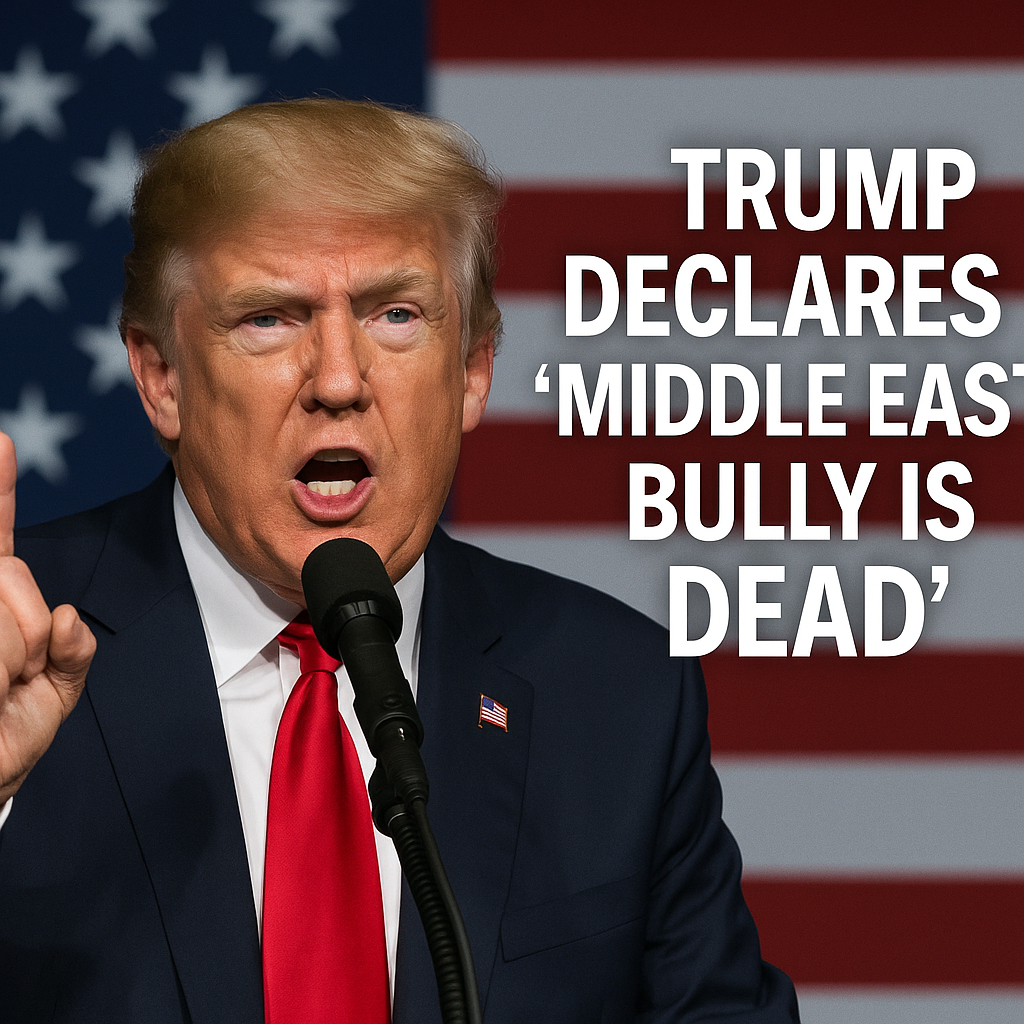
Trump Declares ‘Middle East Bully is Dead’
Trump Declares ‘Middle East Bully is Dead’
Former President Donald Trump has recently reignited discussions surrounding U.S.-Iran relations by claiming that a “Middle East bully is dead.” This statement follows a sequence of escalating tensions and diplomatic maneuvers in the region, particularly concerning Iran’s nuclear ambitions and its influence across the Middle East.

The Context of Trump’s Declaration
In response to what he sees as a failure of the current administration’s foreign policy, Trump’s comments underline his stance on America’s role in the Middle East, especially regarding Iran’s position as a regional power. He argues that the Biden administration’s approach has emboldened Tehran, reversing the tactical gains made during his presidency, primarily through the Abraham Accords. Critics of Trump’s assertions, however, contend that labeling Iran as a “bully” oversimplifies a complex geopolitical landscape characterized by historical grievances and shifting alliances.

Irrespective of these claims, Trump’s remarks have certainly amplified existing narratives regarding Iran’s aggressive actions and their effects on neighboring countries. Recent reports indicate that Iran has been actively flexing its military might in the region, raising alarms among Arab states and Western powers alike.

Revisiting U.S. Strategy in the Region
The pivotal question arising from Trump’s pronouncement is what strategy the U.S. should adopt moving forward. According to various commentators, a return to a hardline stance akin to that of the Trump administration may not yield the desired results. Instead, diplomacy and engagement are often preferred by analysts who believe that only through dialogue can long-standing issues be resolved.
For example, an article in Al Jazeera emphasizes that foreign policy should focus on multilateral conversations to tackle the Iranian issue, attracting input from regional players such as Saudi Arabia and Israel. This perspective contrasts sharply with Trump’s more confrontational attitude, which prioritizes showing strength and undermining Iran’s influence through sanctions and military posturing.
Divergent Perspectives on the Impact of Trump’s Comments
While Trump’s supporters laud his remarks as a strong stance against a nation they perceive as a threat, critics argue that such inflammatory rhetoric could escalate tensions further. An opinion piece from RT highlights how Trump’s administration’s “maximum pressure” approach contributed to increased animosity and instability, thereby questioning the efficacy of a similar strategy now.
Conversely, proponents of a robust U.S. stance against Iran contend that without pressure, Iran will continue to pursue its nuclear ambitions, affecting not just regional peace but global security. This divergence in opinions exemplifies the complexity of American foreign policy in the Middle East, where a single narrative cannot adequately encompass the multitude of perspectives at play.
What Lies Ahead for U.S.-Iran Relations?
As Trump’s declarations provoke further discussion on U.S.-Iran relations, the bigger picture remains shrouded in uncertainty. Political analysts argue that whether America retreats to a more isolationist policy or fully engages will significantly affect the dynamics in the Middle East. The ramifications of such strategies could include heightened conflicts or, conversely, a cooperative regional approach to shared concerns.
The current administration might benefit from lessons learned during Trump’s presidency, reevaluating how best to approach Iran without resorting to divisive narratives or strategies that may have proven counterproductive. A critical dialogue among all stakeholders could pave the way for more sustainable peace in the region.
Conclusion: The Complexity of the Middle East
Trump’s declaration of a “Middle East bully” being dead is more than a catchphrase; it symbolizes deeper rifts in the understanding of how to achieve lasting stability in a tumultuous region. With various approaches vying for consideration, it is critical for policymakers to navigate these complexities thoughtfully. As events continue to unfold, the road to a coherent and effective strategy remains fraught with challenges that will demand both wisdom and patience.
The unfolding situation will ultimately depend not only on political rhetoric but also on diplomatic efforts that recognize the multifaceted nature of Middle East geopolitics. Understanding different viewpoints and the historical context will be essential in forging paths toward potential resolutions that reflect the needs and aspirations of all nations involved.