
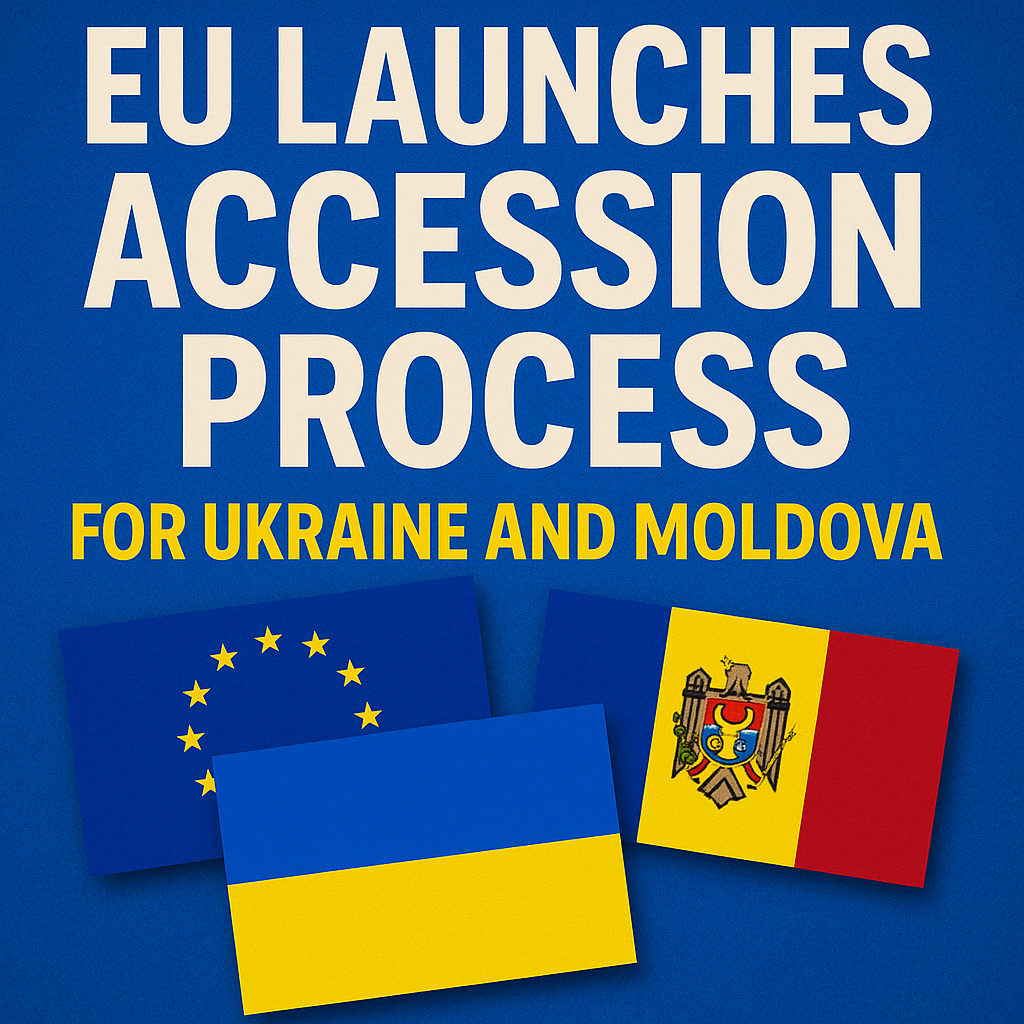
EU Launches Accession Process for Ukraine and Moldova
The European Union has officially embarked on the accession process for both Ukraine and Moldova, a significant decision that not only signifies political solidarity but also indicates a shift in Europe’s geopolitical landscape. This development has garnered varying responses from analysts and political commentators, revealing the complexity surrounding these nations’ potential integration into the EU.

Historical Context and Motivations
The initiation of the accession process comes against the backdrop of escalating tensions between Ukraine and Russia, particularly since the annexation of Crimea in 2014. Following Russia’s full-scale invasion of Ukraine in 2022, the need for regional stability and security has prompted the EU to act decisively in supporting its eastern neighbors. EU Commission President Ursula von der Leyen underscored the historical significance of this moment, stating that “their future lies within the European Union.” This reflects a broader EU strategy to extend its influence in Eastern Europe while countering Russian aggression.

However, while support for Ukraine’s and Moldova’s ambitions has increased, skepticism remains within some EU member states. Countries like Hungary and Poland have shown ambiguous stances, often prioritizing their national interests over EU unity. This duality highlights the complex interplay of national and regional politics in the accession process.

The Prospects of Accession
Economic and Political Benefits
The accession of Ukraine and Moldova could yield several benefits. Economically, both countries stand to gain from access to a larger market, investment influx, and the potential for structural reforms that align with EU standards. Ukraine, in particular, has been keen to adopt reforms in areas such as governance, anti-corruption measures, and economic diversification, which are prerequisites for EU membership and critical for long-term stability.
Politically, granting EU candidate status may bolster democracy and human rights within both nations. Current political reforms are often driven by the promise of EU integration, which has historically led to improved governance standards. Moldova’s Prime Minister Natalia Gavrilița noted that the accession process would aid in “freeing the country from external dependencies and consolidating our European path.” This sentiment reflects a shared aspiration among the populations of both countries to secure a future based on European values.
Challenges Ahead
Despite the optimistic outlook, multiple challenges loom on the horizon. Firstly, both countries need to fulfill stringent criteria regarding governance, economic performance, and the rule of law. Experts warn that the path to EU membership is often long and fraught with obstacles, citing the experiences of Western Balkan countries, who have faced delays and setbacks over the years.
Additionally, lingering geopolitical tensions, particularly in Ukraine, pose significant risks. The ongoing conflict with Russia complicates not only internal dynamics in Ukraine but also external perceptions of its readiness for EU membership. As analysts have pointed out, the EU’s support must also address security concerns, something that the ongoing military conflict exacerbates.
Divergent Perspectives
Responses from various EU member states reveal a spectrum of perspectives on the accession. While countries like Lithuania and Poland have actively advocated for Ukraine’s integration, others remain cautious. Hungary’s Prime Minister Viktor Orbán has expressed skepticism, citing concerns about overextension within the EU—echoing fears that rapid enlargement could dilute the union’s coherence and effectiveness.
On the other hand, EU officials and advocates argue that allowing Ukraine and Moldova to join would serve as a formidable counter to Russian influence, reinforcing the message that Europe stands united against aggression. This dichotomy presents a critical point of contention within the EU, challenging the balance between enlargement and cohesion.
Conclusion
The launch of the EU accession process for Ukraine and Moldova represents a significant turning point, emphasizing the EU’s commitment to supporting democratic transitions and stability in Eastern Europe. While the potential benefits are considerable, the journey ahead is fraught with challenges and divergent viewpoints among EU member states. As the situation evolves, the complexities of enlargement will demand careful navigation, ensuring that the process remains fair, equitable, and conducive to the long-term stability of both nations and the wider region.















