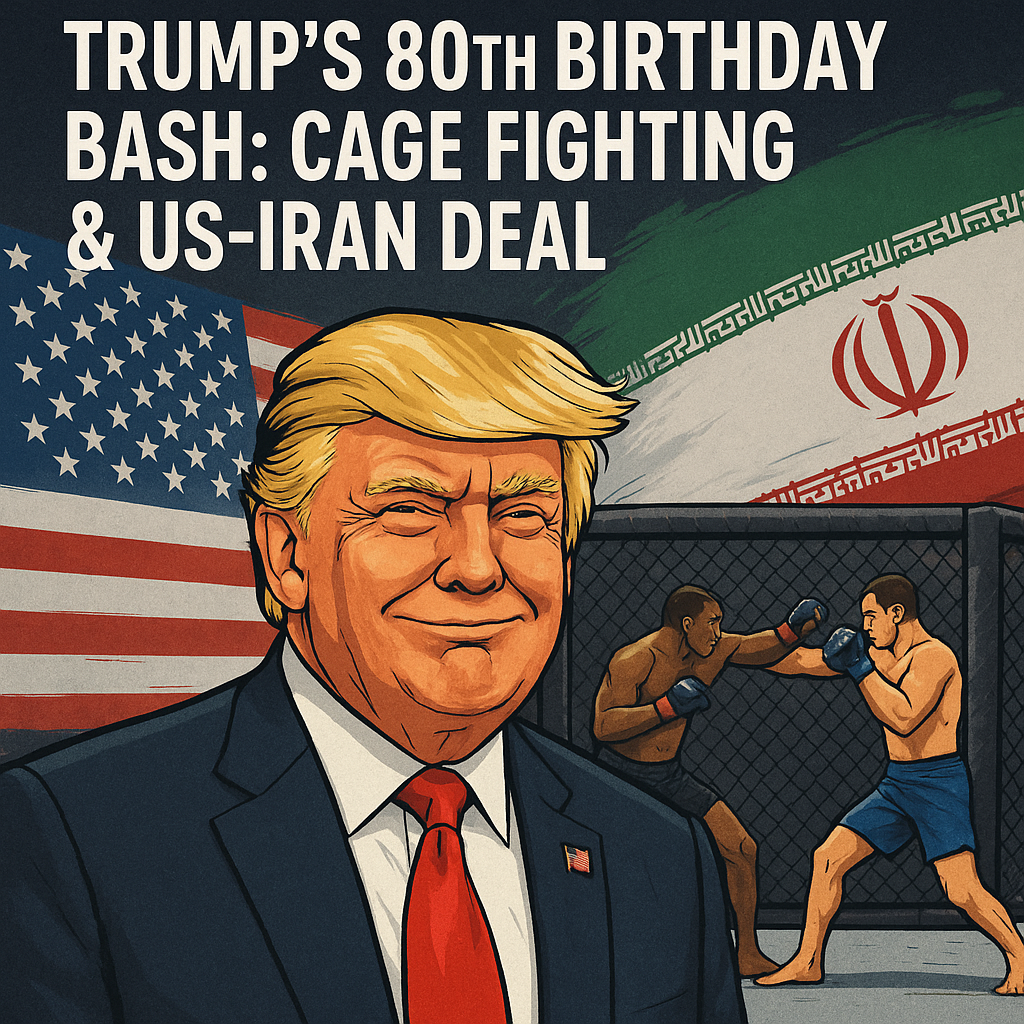
Trump’s 80th Birthday Bash: Cage Fighting & US-Iran Deal
Trump’s 80th Birthday Bash: A Clash of Celebration and Diplomacy
As Donald Trump celebrated his 80th birthday, the event culminated in an unusual spectacle—a cage fighting match hosted on the White House lawn. This bizarre juxtaposition unfolded just hours after a significant peace deal was brokered between the United States and Iran, highlighting the complex interplay of personal celebration amid geopolitical developments.

A Stark Contrast
The timing of the cage fighting event and the announcement of the U.S.-Iran deal created a striking contrast in narratives. Observers noted the absurdity of a former president engaging in a spectacle synonymous with brutality while the nation marked a diplomatic achievement aimed at easing tensions in the Middle East. According to Sky News, Trump’s birthday was celebrated with a gathering that saw various celebrities and public figures, but the inclusion of cage fighting elicited a spectrum of reactions, ranging from amusement to outrage.

Critics argue that such antics trivialize the serious discussions surrounding international diplomacy. The juxtaposition of personal revelry with a historic agreement reflects Trump’s contentious relationship with established norms. While many have lauded the U.S.-Iran deal for its potential to foster stability, they also express concern regarding the implications of a former president thumbing his nose at decorum.

The U.S.-Iran Peace Deal: Significance and Skepticism
The agreement between the United States and Iran is seen as a critical step towards resetting relations strained over the past several decades. Diverse sources such as Al Jazeera and RT have discussed the deal’s implications, framing it as a carefully negotiated compromise that aims at averting conflict and encouraging cooperation on nuclear programs and other regional issues.
However, skepticism remains prevalent. Analysts warn that trust between the two nations is fragile and that mere agreements do not guarantee implementation. The timing of these developments—Trump’s birthday party and the agreement—has led many to contemplate the wider narrative of American politics. Could this be a strategic distraction from Trump’s ongoing legal challenges? Or perhaps a calculated move to rally his base by aligning festive revelry with political undertones?
Public Reactions and Broader Implications
Public sentiment surrounding both events has been mixed. Some see Trump’s unique brand of entertainment as a refreshing diversion from the often-staid nature of political celebrations. Others, however, view it as emblematic of a troubling trend that places personality over substance in leadership.
The intersection of these two events—the birthday celebration and the diplomatic agreement—leads to an increasingly blurred line between political decorum and showmanship. Many commentators have noted this trend as indicative of a newer era in U.S. politics, where media spectacle often trumps serious discourse.
Understanding the implications of both the U.S.-Iran deal and Trump’s birthday celebration requires a nuanced approach. On one hand, the deal represents an encouraging step toward global dialogue. On the other, Trump’s antics could be seen as undermining the gravity of such achievements.
In a polarized political landscape, the dichotomy presented by these events also raises questions about the future of diplomacy in America. Will leadership embrace decorum to foster serious discussions, or will spectacle continue to dominate?
Conclusion: The Complexity of Modern Leadership
Trump’s 80th birthday bash, particularly with its inclusion of cage fighting, symbolizes a deeper trend in American politics characterized by entertainment value overshadowing substantive discourse. As the world watches the implications of the U.S.-Iran deal unfold, the necessity for serious engagement in diplomacy remains paramount.
While the cage fighting may have provided a moment of levity intent on galvanizing his supporters, it simultaneously risks trivializing the hard-fought negotiations aimed at fostering peace. The contrast highlights the complexity of modern leadership, where celebrations and serious geopolitical developments intertwine in ways that demand both introspection and critical analysis. This ongoing narrative raises essential questions for the broader political landscape as society continues to navigate the balance between spectacle and statesmanship.