
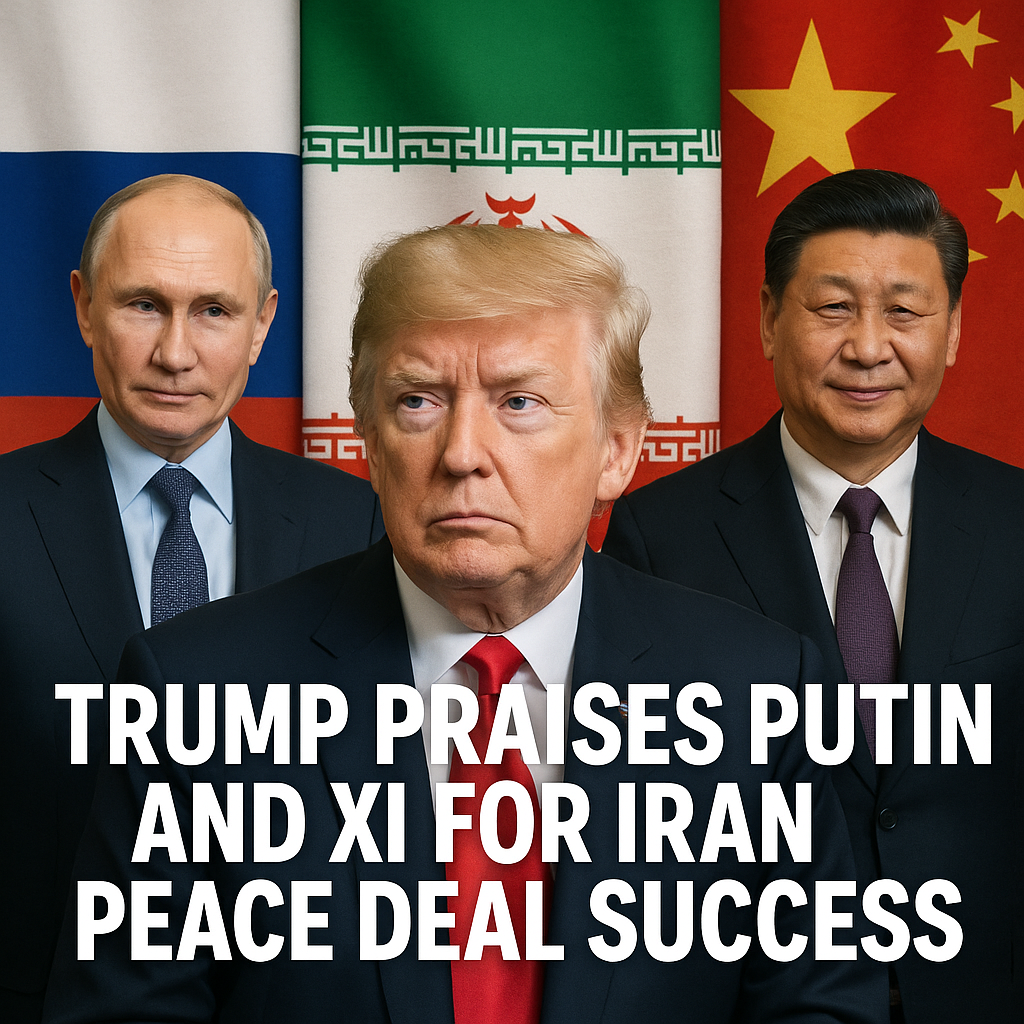
Trump Praises Putin and Xi for Iran Peace Deal Success
Trump Praises Putin and Xi for Iran Peace Deal Success

Former President Donald Trump recently commended Russian President Vladimir Putin and Chinese President Xi Jinping for their roles in brokering a peace deal involving Iran, signaling a shift in international dynamics that has piqued the interest of political analysts worldwide. This development not only highlights the complex relationships between these nations but also raises questions regarding U.S. foreign policy and its evolving relevance on the global stage.

The Significance of the Iran Peace Deal
The Iran peace deal, seen by many as a diplomatic breakthrough, aims to mitigate tensions in the region by promoting dialogue and cooperation among the involved countries. Trump’s praise for Putin and Xi reflects a broader geopolitical context where these nations seek to assert their influence, particularly in areas traditionally dominated by U.S. diplomacy.

According to RT, Trump highlighted the importance of this deal during a recent public appearance, effectively framing it as an achievement that underscores the potential for effective multilateral negotiations in addressing complicated issues. He suggested that the diplomatic efforts by Putin and Xi could offer a template for resolving other regional disputes while positioning these leaders as pivotal figures on the world stage.
Divided Perspectives on Diplomacy
While Trump’s endorsement of Putin and Xi’s efforts is striking, it is essential to recognize the mixed responses from various political factions and analysts. On one side, some view this alliance as a necessary counterbalance to U.S. unilateralism in foreign affairs, particularly in the Middle East. For instance, Al Jazeera reported that experts commend any move towards diplomacy that might stabilize a region fraught with conflict and tension. They argue that if the U.S. continues to withdraw from negotiations, countries like Iran will increasingly look towards allies like China and Russia for support.
Conversely, critics warn that legitimizing leaders such as Putin and Xi might undermine human rights considerations and encourage authoritarian governance. Commentators on platforms such as Sky News have raised concerns that these alliances could embolden oppressive regimes, complicating the delicate nature of peace negotiations in volatile regions. Consequently, there exists a stark divide in the interpretation of Trump’s endorsement—while some view it as pragmatic diplomacy, others see it as a disturbing validation of authoritarianism.
The Complexities of Global Diplomacy
The peace deal with Iran exemplifies the intricate web of international relations where the U.S. finds itself competing not just against states but also against shifting norms of diplomacy. With world powers like Russia and China stepping into roles traditionally held by the U.S., questions arise about American leadership. As political commentators observe, U.S. influence is waning in some geopolitical arenas, prompting a reevaluation of its strategies.
Moreover, the implications of this deal extend beyond just the immediate parties involved. The involvement of Putin and Xi may provide Iran with both economic and military backing, potentially altering the balance of power in the region. While Washington might still have leverage through sanctions and alliances with other nations, the efficacy of these tools may diminish if diplomatic frameworks continue to evolve outside of American influence.
Conclusion: Navigating New Norms
In reflecting on Trump’s praise for Putin and Xi regarding the Iran peace deal, it becomes clear how multi-faceted the responses and implications of this political moment are. It highlights a transitional phase in global diplomacy characterized by shifting allegiances and the controversial roles of established powers.
As the world grapples with these changes, it is necessary for analysts, policymakers, and the public alike to critically assess the outcomes of this and future agreements. The Iran peace deal, facilitated by leaders often at odds with American interests, may indeed serve as a bellwether for future international relations—one where collaboration may take precedence over conflict, albeit in a context fraught with ethical dilemmas and historical complexities. The unfolding narrative will be one to watch, as it not only influences the broader geopolitical landscape but also shapes the future trajectory of U.S. foreign policy.















