
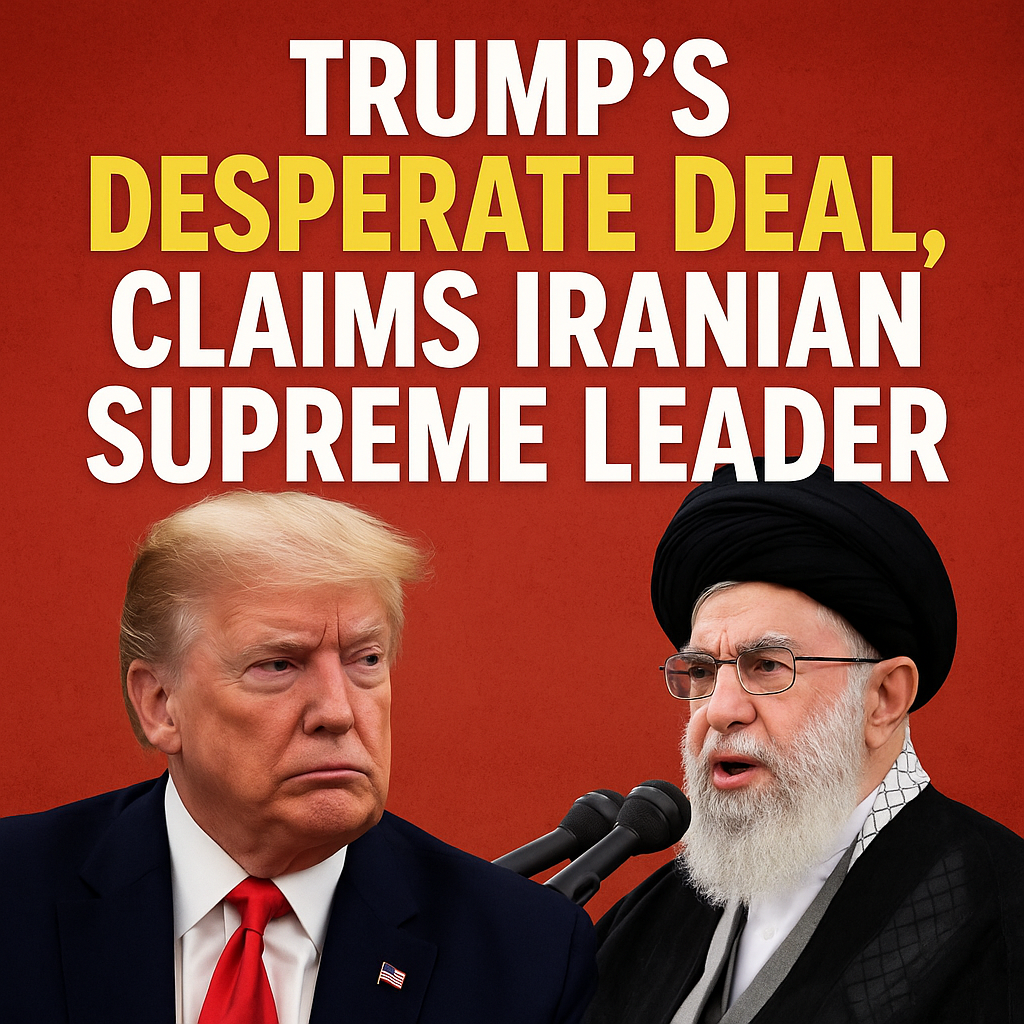
Trump’s Desperate Deal, Claims Iranian Supreme Leader
Trump’s Desperate Deal, Claims Iranian Supreme Leader
In recent discussions about international relations, a significant focus has been on the remarks made by Iranian Supreme Leader Ayatollah Ali Khamenei regarding US former President Donald Trump’s strategic maneuvers. Khamenei’s statements suggest that Trump’s latest overtures towards Iran are driven more by desperation than legitimate diplomacy.

The Context of Khamenei’s Contention
Khamenei’s comments stem from the geopolitical tensions that have characterized US-Iran relations for decades. Trump’s administration was marked by a withdrawal from the Iran nuclear deal in 2018, which has since escalated tensions between these two nations. The Iranian leader now perceives Trump’s recent approach as an indication of vulnerability rather than strength.

According to Khamenei, “Trump’s deals are driven by desperation. They are not made from a position of strength.” His assertion suggests that the pressure placed on the US economy—exacerbated by sanctions and diplomatic isolation—has forced Trump to rethink his aggressive stance toward Iran. This position reflects a broader sentiment among Iranian officials who view American diplomacy as inconsistent and reactive rather than proactive and engaged.

Diverging Perspectives on Diplomacy
Reactions to Khamenei’s statements reveal a spectrum of opinions regarding US engagement with Iran. On one side, analysts argue that perceived weakness could embolden Iran to further its regional ambitions, complicating international diplomacy. A recent article from Al Jazeera suggests that if Trump continues to prioritize economic negotiations over military posturing, it could lead to an easing of tensions, allowing for a possible realignment of Iran’s nuclear strategy.
Conversely, other experts remind us that any attempts at negotiations must be approached with caution. They argue that Khamenei’s dismissive view of Trump’s motivations demonstrates a miscalculation on Iran’s part. According to a report from Sky News, many in the US political sphere believe that any diplomatic overtures by Trump are merely strategic maneuvers aimed at recovering political capital domestically, rather than genuine efforts to resolve long-standing disputes.
The tension is palpable, as both sides grapple with the implications of potential negotiations. In a climate rife with skepticism, Khamenei’s dire interpretation of Trump’s intentions reflects a broader concern among Iranian leadership that any deal shall not favor them in the long run.
Analyzing Trump’s Approach
The nuance in Trump’s approach should not be overlooked. While Khamenei paints a picture of a desperate negotiator, some analysts posit that Trump’s methods might be pragmatic. The former president’s history has shown an inclination to leverage economic pressure as a tool for diplomatic engagement. The emphasis on sanctions has perhaps led him to rethink conventional diplomacy in favor of strategies that could yield immediate political benefits.
However, some may argue that such pragmatic approaches can often backfire. If Khamenei is correct in his assessment of Trump’s position, the result could be an attempt by Iran to hold out for better terms, thereby extending the stalemate rather than resolving it amicably.
Conclusion: The Uncertain Path Ahead
Khamenei’s assertions reflect deep-seated fears about US motivations and the potential for further conflict. As new developments unfold, it’s essential to consider the complex interplay of international relations where domestic policy, historical grievances, and geopolitical strategy converge. While Khamenei sees Trump’s overtures as signs of desperation, others interpret them as calculated maneuvers in a high-stakes diplomatic game.
It remains to be seen whether Trump’s dealings will lead to productive negotiations or if they signify a precarious moment in U.S.-Iran relations. Regardless, the landscape is undeniably fraught with uncertainty, suggesting that any path forward will require careful navigation and keen diplomatic insight.















