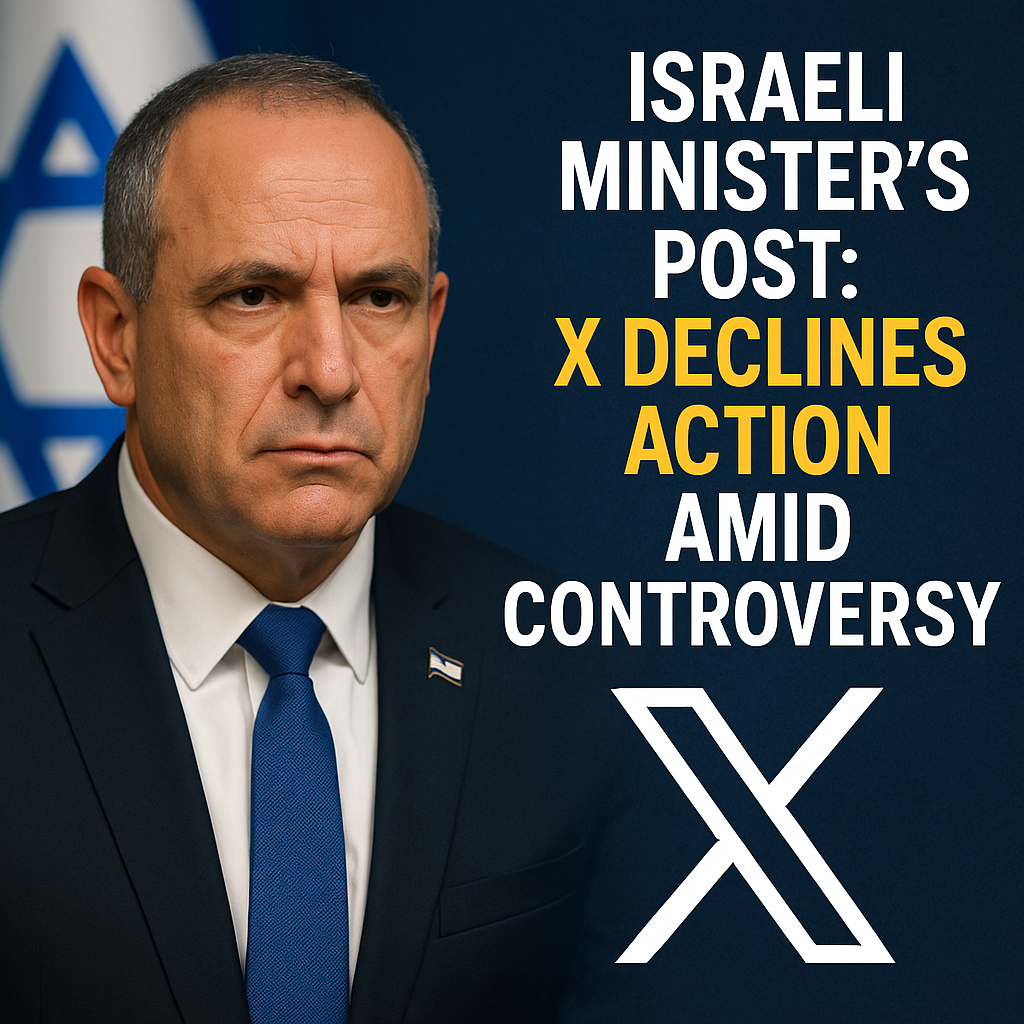
Israeli Minister’s Post: X Declines Action Amid Controversy
Israeli Minister’s Post: X Declines Action Amid Controversy
The tension surrounding the recent comments made by an Israeli minister has left many questioning the stability and future of diplomatic relations in the region. After facing backlash, X, the social media platform where the comments were shared, has opted for a non-interventionist stance, prompting discussions on free speech, governmental influence, and platform accountability.

The Weight of Words in Fragile Times
The Israeli environment is marked by a complex interplay of politics and media, where statements can inflate tensions or spark outrage almost instantaneously. Recently, an Israeli minister made controversial remarks regarding ongoing conflicts, specifically hinting at aggressive postures toward Lebanon. Sections of the public interpreted this as a call to action, raising alarms about potential escalations.

While some commentators have defended the minister’s right to express unpopular views, others argue that inflammatory rhetoric presents undue risks. For instance, reaction pieces from both RT and Al Jazeera highlight the challenges of balancing free expression with responsibility. Critics are emphasizing that such statements can exacerbate already fragile public sentiment and complicate international relations.

X’s Decision: A Neutral Stance
In the wake of these events, X’s decision to not take any action against the minister’s comments has sparked a significant debate about the platform’s role in moderating content. Proponents of X’s non-intervention policy argue that it upholds users’ rights to free speech, particularly in political discourse which has always been contentious and multifaceted. They assert that curtailing expression could set a precedent for further censorship.
On the flip side, there are concerns that allowing heated remarks without repercussions could embolden more extreme behaviors among users. Al Jazeera reported mixed sentiments from scholars and analysts, noting that the absence of moderation can lead to an environment where hate speech flourishes. This raises the question: when does the right to free speech breed harmful consequences?
Furthermore, the silence from X can be interpreted as a reflection of its broader strategy to navigate politically sensitive issues with caution. This dilemma puts platforms like X at a crossroads between allowing open discourse and managing the repercussions of potentially volatile content.
The Broader Implications on Public Sentiment
Public reaction to both the minister’s statements and X’s subsequent inaction illuminates the wider implications for society. Many members of the public are increasingly polarized, with some defending the minister’s remarks as expressions of patriotism, while others view them as incendiary and reckless. The division mirrors a greater cultural rift in how people perceive the complexities of regional politics and the power of digital communication.
While this specific incident may seem localized, it reflects broader themes in the global dialogue about governance, media, and the nuances of civil discourse. Touchpoints raised in multiple news sources indicate a growing frustration among citizens who feel that their voices are either suppressed or manipulated by political and corporate interests.
Navigating Nuances in Controversial Times
Ultimately, navigating issues of speech and responsibility in such a charged atmosphere is no easy task. Regarding the Israeli minister’s post and X’s refusal to act, a middle ground remains elusive. The dynamics involved illustrate how varied perspectives can coexist, even if they contradict one another.
Policy decisions made by social media companies and government representatives will continue to shape the landscape of digital discourse. Future engagement by X and similar platforms could warrant greater scrutiny as the consequences of their decisions affect public trust and social stability.
To summarize, the intersection of political speech and social media presents both challenges and opportunities for discussion. As we move forward, fostering dialogues that encourage understanding—a response to rhetoric that so often divides—will become increasingly important in bridging gaps within and between diverse communities.