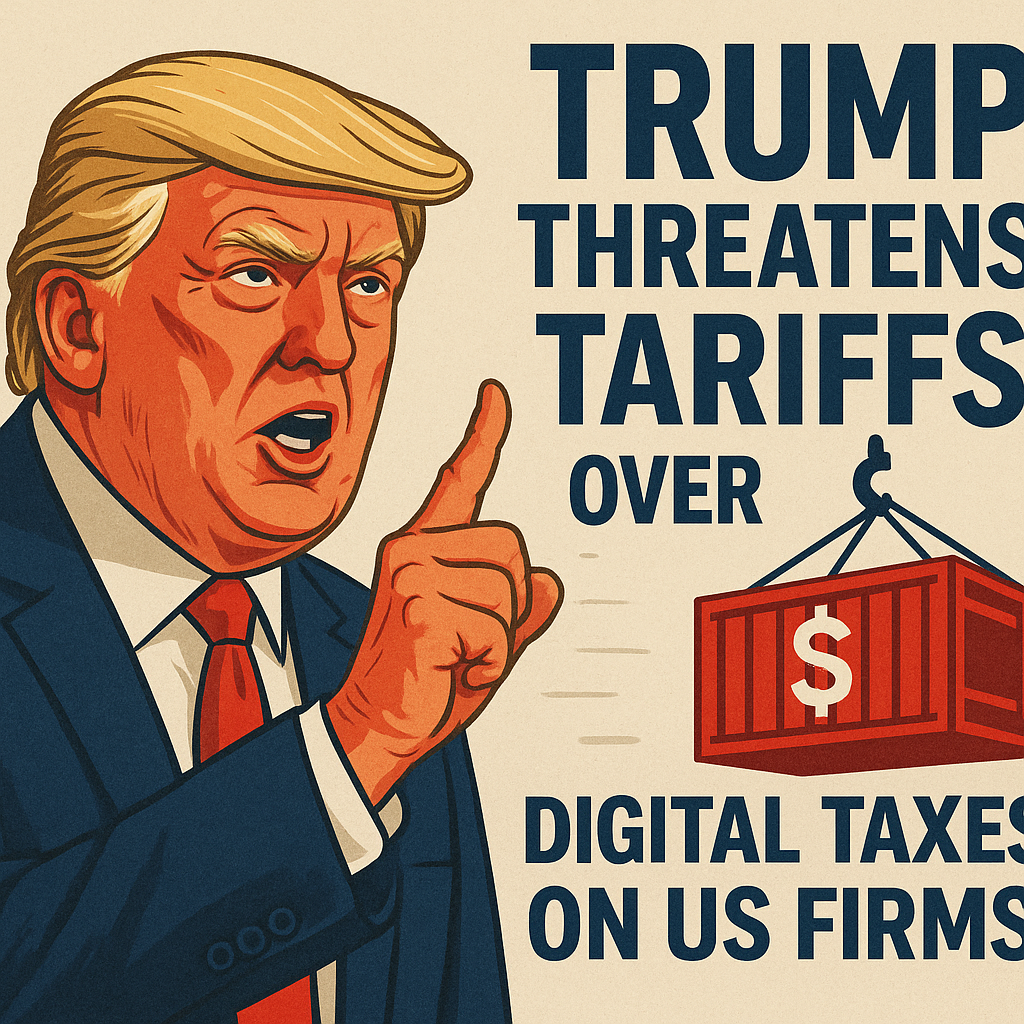
Trump Threatens Tariffs Over Digital Taxes on US Firms
Trump’s Tariff Dilemma Over Digital Taxes on U.S. Firms
In a rapidly evolving global economy, former President Donald Trump has reemerged on the political stage, threatening to impose tariffs on countries that apply digital taxes on American firms. This move raises significant questions about international trade dynamics and the future of global commerce, particularly as governments around the world seek to tax big technology companies more effectively.

Understanding Digital Taxation
Digital taxation refers to the increasing trend of governments imposing taxes on digital services provided by multinational corporations, often targeting firms like Google, Amazon, and Facebook. Many countries argue that these corporations significantly benefit from their markets without adequately contributing through local taxes. For instance, countries such as France and the UK have been at the forefront of implementing such taxes, which they claim are necessary to level the playing field for local businesses.

Proponents of digital taxes assert that they ensure fairness, providing critical revenue streams for public services. According to Al Jazeera, France’s digital tax was intended to generate around $450 million annually to support public services, especially essential in the wake of the COVID-19 pandemic. The thought is straightforward: if a company profits from a country’s resources and infrastructure, it should contribute to the local economy.

However, the potential backlash from the U.S. is palpable. Trump’s administration and many lawmakers express concern that these taxes unfairly target American firms and could lead to a trade war. The threat of tariffs is a clear message: the U.S. will not back down in the face of policies perceived as unfairly discriminatory against its companies.
Tariffs: The Double-Edged Sword
The former president’s assertions that tariffs could be enacted have polarized opinions among economists and policymakers. While some argue that tariffs could protect American interests and enforce fair international trading practices, others caution that such measures could backfire, resulting in higher prices for consumers and retaliatory actions from affected countries.
RT cites responses from various industry leaders who fear that tariffs could stifle innovation and competitiveness. These leaders contend that placing tariffs on countries levying digital taxes could disrupt not just American firms, but the broader tech landscape globally. It is notable that a balanced approach is critical; as much as the U.S. seeks to defend its interests, the global economy is interdependent, and unilateral measures can lead to strained relationships.
In this context, Trump’s stance appears rooted in a broader strategy to assert American influence in the global market. However, it also raises legitimate concerns regarding the future of international cooperation on taxation policies. The ongoing debates suggest that countries need to come to a consensus to avoid the pitfalls of isolationist policies.
Divergent Views on the Path Forward
The article via Sky News highlights that public sentiment regarding tariffs and digital taxes is mixed in the U.S. While some support a strong defense of American companies, others criticize the administration’s approach as potentially damaging in the long run. The crux of the matter lies in finding a way to balance national interests with the global community’s needs.
Different viewpoints have emerged in discussions among policymakers and economists. On one side, advocates for free trade warn that tariffs could provoke retaliatory actions, jeopardizing American exports and jobs. On the other hand, proponents of protectionism argue that allowing foreign countries to tax American companies without repercussions undermines national sovereignty and competitiveness.
Moreover, the ongoing challenges posed by digital economies—cross-border services, data privacy, and competitive equity—complicate the landscape. As more countries implement their own digital tax systems, the conversation around the need for an international framework becomes critical.
Conclusion
As Trump threatens tariffs against countries that levy digital taxes on U.S. firms, the implications could ripple throughout international markets. The debate on digital taxation captures a significant moment in global economics, where the interests of nations, corporations, and consumers intersect. While the U.S. government grapples with the reactions to these policies, the importance of a fair and equitable solution that respects both international dynamics and national interests cannot be overstated.
Navigating this complex arena requires a nuanced approach, with meaningful dialogue and negotiations at the forefront, as countries strive to balance modern tax needs with the realities of international trade relations.