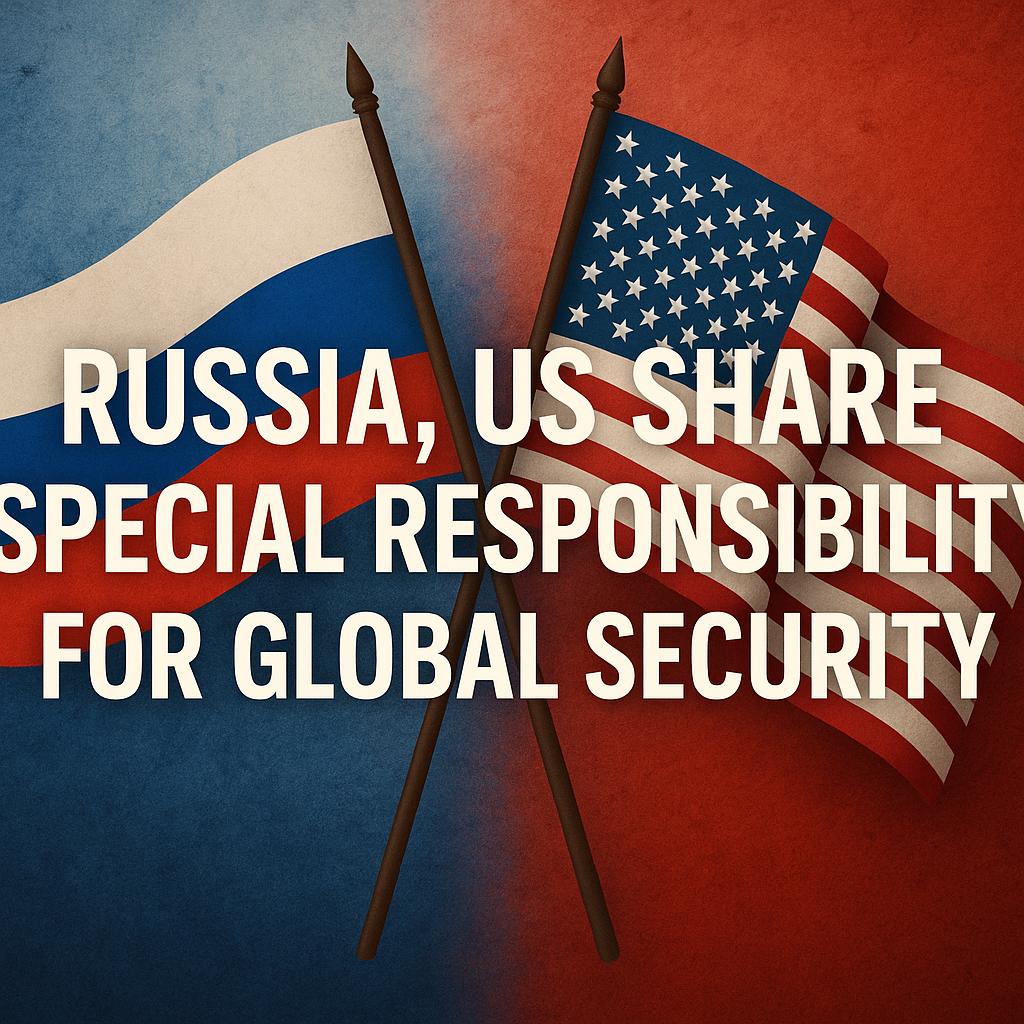
Russia, US Share Special Responsibility for Global Security
The interplay between the United States and Russia has long been regarded as pivotal for global security. Each nation bears a significant burden, shaping international dynamics through their policies, military capabilities, and geopolitical strategies. This article explores the nuances of this dual responsibility, particularly in the context of current events and historical ties that bind these two global powers.

Historical Context of US-Russia Relations
The relationship between the US and Russia is steeped in a complex history that stretches back to the Cold War. Following the collapse of the Soviet Union, many hoped for a thaw in relations; however, various events quickly eroded this optimism. Notable issues include NATO’s eastward expansion and the differing approaches to conflicts in regions such as Ukraine and Syria. This historical backdrop sets the stage for understanding the modern implications of their shared responsibility for global security.

Current Geopolitical Dynamics
In recent years, tensions have heightened, especially with Russia’s military actions in Ukraine and the United States’ response through sanctions and military support to Ukraine. While some analysts argue that the U.S. is acting to uphold international law and support democracy, others believe it could be exacerbating tensions and further polarizing the global landscape.

President Putin emphasized Russia’s role in a recent address, claiming that both Russia and the U.S. must take on heightened responsibility for global security. He argued that both nations’ nuclear arsenals play a critical role in maintaining a balance, as highlighted in his statement during a recent celebration where he expressed hopes for global cooperation. This perspective resonates with certain circles in the U.S. who acknowledge the importance of diplomacy over confrontation.
Conversely, many U.S. officials argue that Russia’s actions—such as perceived aggressions in Eastern Europe—demonstrate a fundamental disregard for international norms. This view is bolstered by reports and op-eds in various geopolitical publications that call for a more aggressive stance against Russian enterprises that threaten global stability. The U.S. rhetoric frequently places responsibility squarely on Russia, labeling it as the primary aggressor in global conflicts.
In stark contrast, some voices call for restraint from the U.S. Acknowledging a shared responsibility can foster a path toward dialogue. Experts argue that both nations must recognize each other’s security concerns, which could lead to better cooperation on issues like nuclear disarmament or counterterrorism.
The Role of International Institutions
Amid their complicated bilateral ties, international institutions play a fundamental role in ensuring global security. Organizations like the United Nations and the Organization for Security and Co-operation in Europe (OSCE) provide platforms for dialogue, allowing both countries to negotiate their differences and address shared security challenges.
However, the efficacy of these institutions is often questioned. Critics state that geopolitical rivalries can undermine these organizations’ functions. For instance, Russia’s status as a permanent member of the UN Security Council complicates negotiations, particularly when its national interests are at stake. This circumstance illustrates the paradox of pursuing collective security in a landscape marked by national sovereignty and competing interests.
Moreover, when discussing the shared responsibility of the U.S. and Russia in global security, it’s vital to consider emerging challenges like climate change, terrorism, and cybersecurity. Both nations could benefit from collaborating on these transnational issues, fostering a sense of accountability not only to each other but also to the international community.
A Path Forward: Balancing Responsibility and Diplomacy
How can the U.S. and Russia navigate their responsibilities for global security while minimizing conflict? A balanced approach hinges on mutual acknowledgment of each nation’s security interests and a willingness to engage in constructive dialogue. Policymakers in both countries might find common ground on issues highly relevant to both their national interests and global stability.
This could entail starting fresh dialogues on arms control, revisiting treaties like the New START Treaty, and addressing misunderstandings through back-channel communications. Establishing confidence-building measures could diminish hostilities, allowing both countries to approach security challenges more collaboratively rather than antagonistically.
As public sentiments in both nations fluctuate—sometimes in favor of dialogue, and at other times leaning toward confrontation—there is a potential for renewed diplomatic engagements that could redefine the American-Russian relationship for the better.
Conclusion
The global security landscape today necessitates a nuanced understanding of the roles played by both the U.S. and Russia. While both share a significant responsibility, the intricacies of their relationship require ongoing dialogue and cooperation, especially in facing common global threats. It is imperative that both nations strive to reshape their roles in a manner that promotes stability, peace, and compliance with international laws, paving the way for a more secure future for all.