
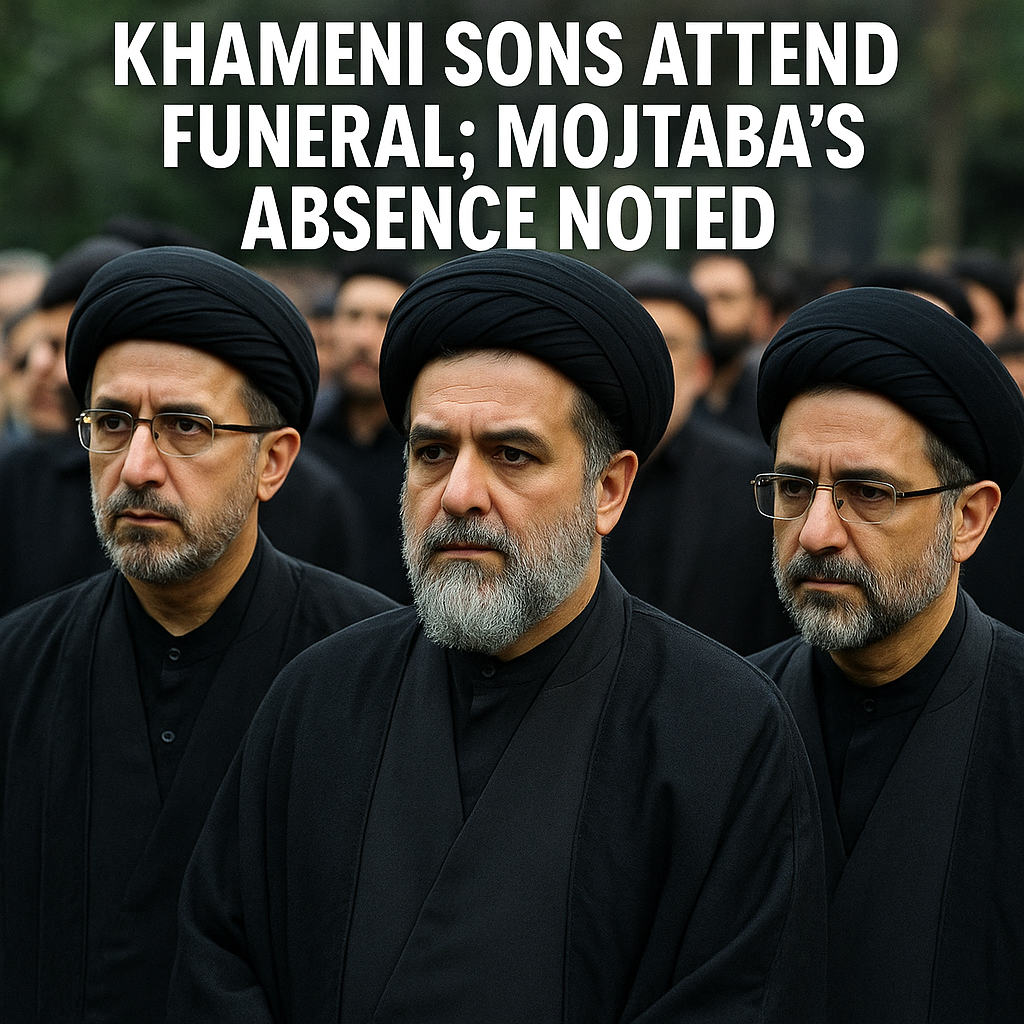
Khamenei Sons Attend Funeral; Mojtaba’s Absence Noted
In recent news, the funeral of Ahmad Khamenei, the brother of Iran’s Supreme Leader Ayatollah Ali Khamenei, stirred significant public interest partly due to the notable absence of Mojtaba Khamenei, a figure often seen as influential in Iran’s political landscape.

The Khamenei Sons: A Family in the Spotlight
The Khamenei family has long been pivotal within Iran’s political framework. The funeral, held on July 4, 2026, marked a somber occasion, bringing together many prominent figures where the presence of Ali Khamenei’s sons was keenly observed. However, it was Mojtaba’s absence that raised eyebrows, especially given his rumored ascent as a potential successor to his father’s powerful position.

Sources from Al Jazeera highlighted that Mojtaba Khamenei’s non-attendance seemed to have sparked speculation about the internal dynamics of the Khamenei family and the broader implications for Iran’s leadership. Analysts have pointed out that Mojtaba has been notably active in Iranian politics, having played roles in various strategic decisions and appearing publicly to bolster his father’s regime.

On the contrary, RT News provided a contrasting view, suggesting that the absence may not bear the serious implications many commentators envision. They posited that it could merely reflect personal or logistical reasons rather than any significant rift or political maneuvering within the Khamenei family.
Major Political Implications
The differing narratives emerge from a complex understanding of Iranian politics, where family dynamics often intertwine with public perception and power struggles. Mojtaba’s absence at a high-profile event such as this raises questions about potential shifts in loyalty and influence among Iran’s ruling elite.
Various analysts interpret this absence through various lenses. Some argue that Mojtaba’s noticeable non-attendance signals a distancing from overt dynastic succession shows, which could pave the way for other potential leaders emerging from within the Revolutionary Guard or other factions. Others assert that it reflects a more internal family dynamic, emphasizing a possible fallout between the brothers over differing views or strategies.
Observations from the Ground
Locals and political observers alike have reacted to the funeral, with many commentators offering profoundly different views on the implications of Mojtaba’s absence. Some local media outlets have echoed sentiments that denote a possible fracture in a tightly-knit family that has traditionally remained united in the face of pressures from both internal dissidents and external adversaries.
Social media channels have ignited discussions among Iranians, speculating on the potential ramifications for leadership transitions in Iran. The dialogue encompasses a spectrum of views, from those claiming that this indicates a weakening regime to those insisting it’s a strategic retreat from spotlight politics – a necessary tactic within a complex political landscape.
Much of the hope within the Iranian populace rests on changes in leadership style, methodology, or even ideology. With the looming specter of succession decisions, many are parsing through the absence and presence of key figures like Mojtaba Khamenei shedding light on a potentially changing atmosphere of governance in Iran.
Conclusion: Uncertainties and Future Considerations
As the dust settles from the funeral proceedings, the implications of Mojtaba Khamenei’s absence remain to be seen. While some source interpretations lean towards concerns of familial rifts and leadership challenges, alternatives propose a more benign explanation of personal choice.
What remains evident is that the conversations around this topic reflect a broader anxiety about the future of Iran and the directions its leadership might take. Observers will need to stay attuned to both the Khamenei family’s dynamics and to other potential emerging leadership figures as the narrative of Iranian politics continues to unfold.
In a country where the intertwining of politics and family can dictate power shifts, the next moves, particularly from figures like Mojtaba, will be closely scrutinized by both domestic and international audiences.















