
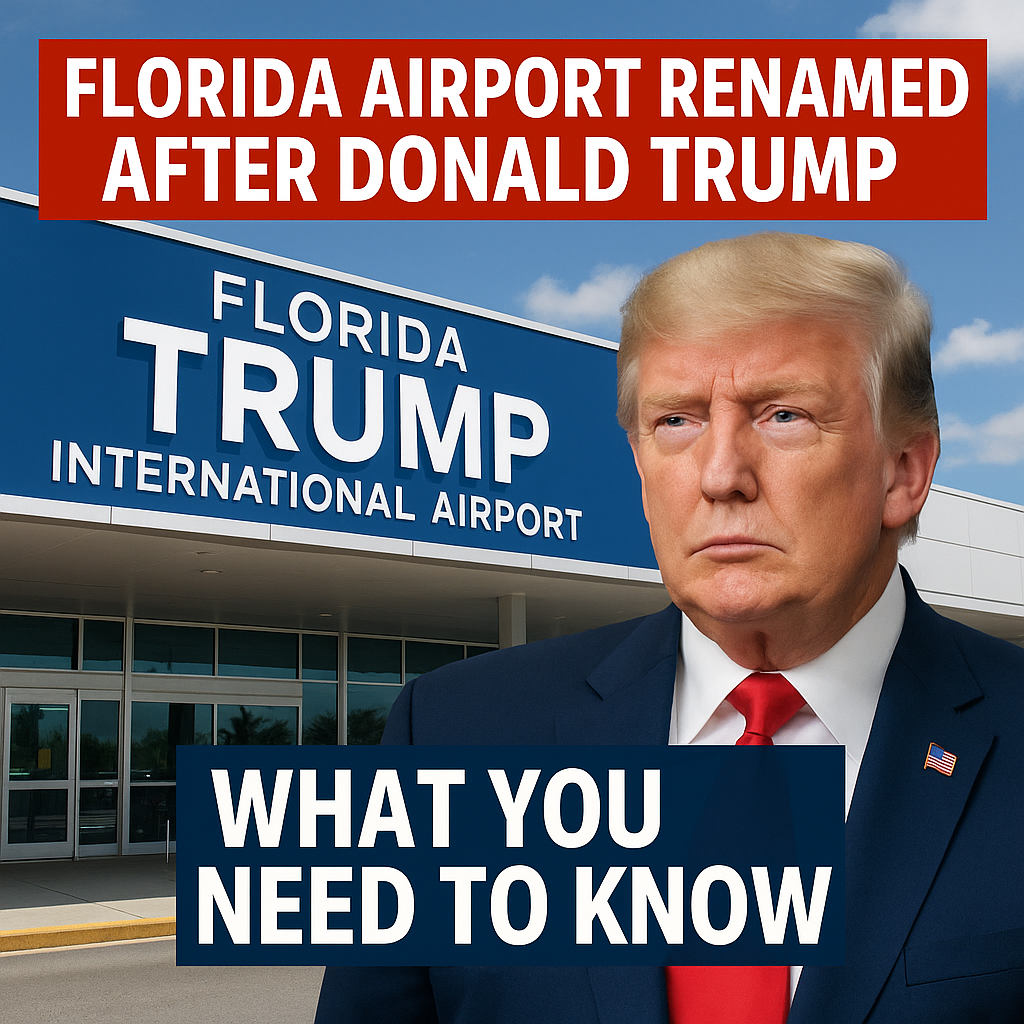
Florida Airport Renamed after Donald Trump: What You Need to Know
Florida Airport Renamed After Donald Trump: What You Need to Know
The recent decision to rename an airport in Florida after former President Donald Trump has stirred a mix of reactions and conversations across the political spectrum. The move is emblematic of the polarization surrounding Trump’s legacy, and this article delves into the implications of this renaming, as well as the context in which it has occurred.

Background of the Renaming
The renaming of the airport, once known as Palm Beach International Airport, to Donald J. Trump International Airport, was spearheaded by local officials and garnered formal approval. Supporters laud the decision as a fitting tribute to a prominent figure in American politics who has substantial ties to the region. They paint the renaming as a celebration of Trump’s contributions to the area, particularly in real estate and tourism.

Opponents, however, view the rebranding as a politically charged act that overlooks the controversies associated with Trump’s administration. Critics argue that the airport renaming does not reflect the values and opinions of all residents and that it reinforces divisions rather than promoting unity. This debate raises questions about how public spaces reflect private legacies and the extent to which political figures should be memorialized in community institutions.

Diverse Perspectives on the Renaming
The response to the name change has been far from uniform. Supporters of Trump argue that renaming the airport is justified given his status as a significant local and national figure. They cite economic benefits, asserting that Trump’s brand can attract tourists and businesses, thereby boosting the local economy. Local council members promoting the change emphasize that this decision honors Trump’s contributions to the area, including his role in developing various golf courses and resorts.
Conversely, political commentators have voiced concerns about potential backlash from constituents dissatisfied with the decision. For example, opposition groups have suggested that the rebranding could alienate voters who feel Trump’s presidency was marked by controversy and division. One resident, quoted in an article by Al Jazeera, mentioned, “We should commemorate unity, not division. This renaming sends the wrong message.”
This contrast in sentiment highlights a broader national conversation regarding the ways communities memorialize political figures. For many, the airport’s new name serves as a flashpoint for discussions about political loyalty and public sentiment towards Trump’s policies and presidency.
Implications for Local Community and Governance
The renaming of the airport raises broader questions about governance and representation. For officials who supported the change, the decision is presented as fulfilling a genuine desire of the local community to honor an influential figure. However, it also prompts reflection on how elected officials prioritize different factions within their communities.
Critics assert that local governments have a responsibility to be inclusive and to consider the varying perspectives of their constituents. As one commentator pointed out in a piece covered by RT, “Public institutions should reflect the diversity of views in our society.” This sentiment emphasizes that naming decisions should ideally encapsulate a collective understanding rather than privileging one faction’s voice over another.
Moreover, as civic bodies increasingly grapple with contentious figures from recent history, the case of the Florida airport serves as a microcosm for similar disputes nationwide. The decision concerning Trump’s airport name could set a precedent for how other communities navigate contentious legacies moving forward.
Conclusion: The Symbolism Behind the Name
The renaming of the Florida airport after Donald Trump is a complex issue that encapsulates the current political climate in the United States. While aimed at honoring a local legend, the move has sparked discord and debate on what such actions signify for community identity.
As the dynamics continue to evolve, the airport’s new name may become more than just a mark on a map—it represents differing narratives about leadership, nostalgia, and the need for inclusive governance. As communities across the nation weigh the legacies of their own figures, the discourse surrounding this airport renaming serves as a critical reflection on the balance between honoring history and acknowledging the diversity of viewpoints that exist within any society.















