
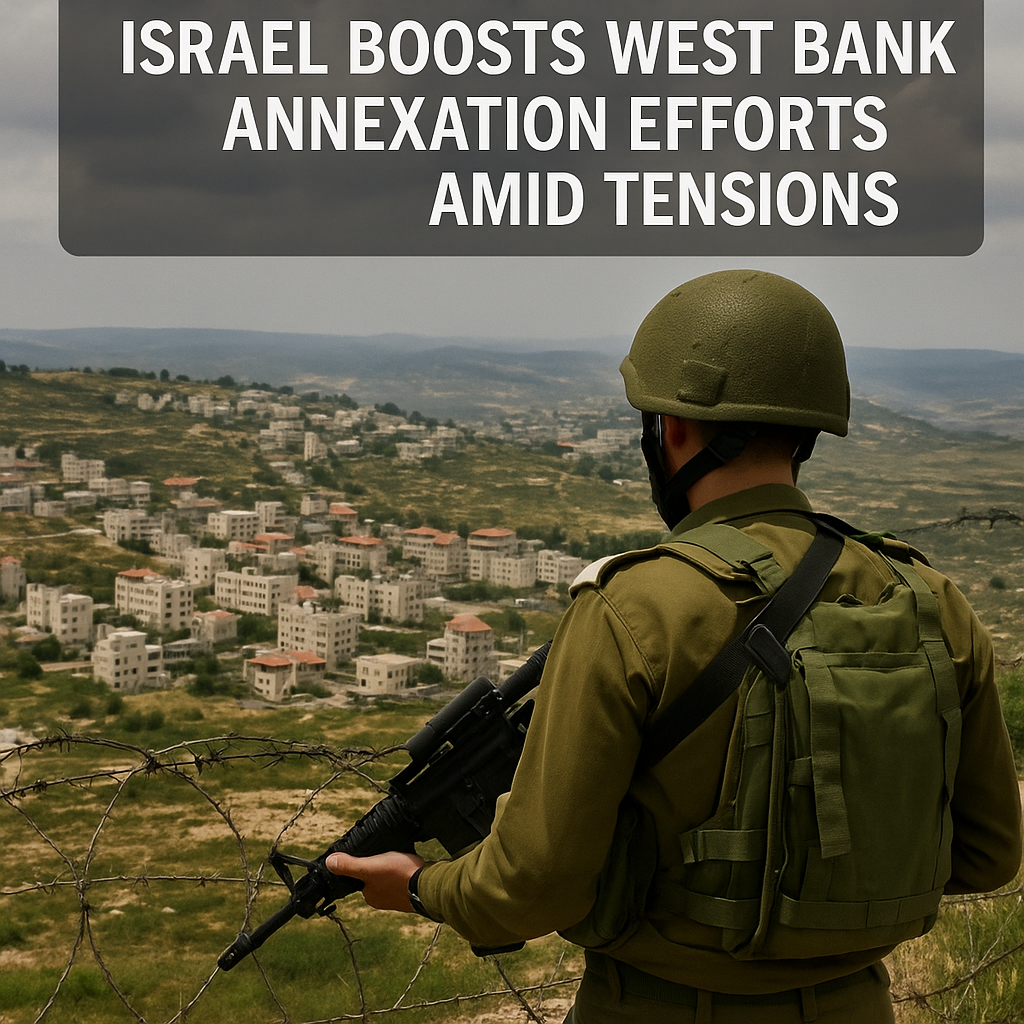
Israel Boosts West Bank Annexation Efforts Amid Tensions
In recent weeks, Israel has taken significant steps to expand its settlement efforts in the West Bank, a move that many analysts suggest could exacerbate already elevated tensions in the region. The Israeli government announced plans to expand existing communities and approve new ones, which critics see as a blatant attempt at further annexation and a violation of international law. This article delves into the implications of these developments, drawing from diverse viewpoints and factual data.

Growing Settlement Initiatives
The Israeli authorities have outlined ambitious plans to construct thousands of new housing units in specific areas of the West Bank. For instance, reports from RT indicate that the government anticipates adding approximately 10,000 new homes in existing settlements, a move framed as essential for Israeli security and economic development. Officials argue that these settlements provide a necessary buffer against perceived threats and bolster the Jewish state’s claim to historical land.

Conversely, this expansion has drawn sharp criticism from various fronts. Al Jazeera highlights voices from the international community who argue that such acts undermine the possibility of a two-state solution and violate the 1978 Geneva Convention, which categorically prohibits the transfer of an occupying power’s civilian population into the territory it occupies. This sentiment is echoed by Palestinian authorities, who have condemned the Israeli government’s actions as aggressive and obstructive to peace negotiations.

The Broader Context of Tensions
The current situation cannot be analyzed in isolation and must be viewed within a broader historical and geopolitical context. Over the years, the Israeli-Palestinian conflict has endured waves of heightened tensions, often catalyzed by actions perceived as provocations by either side. The current Israeli administration, under Prime Minister Benjamin Netanyahu, is characterized by a rightward shift in governance, which has emboldened hardline factions advocating for expanded territorial claims.
On the other hand, various Palestinian groups have reacted with protests and calls for international intervention. The escalation of tensions results not only from settlement policies but also from regular skirmishes and confrontations in areas like East Jerusalem and Gaza. As reported by Sky News, these confrontations often lead to casualties on both sides, further deteriorating relations and fueling cycles of violence and retaliation.
Varied International Reactions
Internationally, the response to Israel’s settlement announcements has been mixed. The United States, traditionally one of Israel’s staunchest allies, has expressed growing concerns regarding the expansion of settlements. Statements from the Biden Administration suggest that these activities could impede peace efforts, although concrete actions to address the situation have yet to materialize.
In contrast, countries such as Russia and various European nations have outright condemned the settlement expansions. They emphasize the need for a return to negotiations based on pre-1967 borders and have criticized the ongoing Israeli policies as violations of international law. The United Nations, too, has reiterated calls for Israel to cease its settlement expansion, labeling it an impediment to peace.
The Future of Israeli-Palestinian Relations
As Israel pushes forward with its plans, questions remain about the long-term implications for Israeli-Palestinian relations. The expansion of settlements appears to create “facts on the ground” that complicate future negotiations. While Israeli officials maintain these moves are crucial for security, the continuous encroachment into Palestinian territories generates resentment and fuels radical sentiments, potentially fostering a more violent environment.
The persistent challenge lies in finding a balance between national security and the recognition of Palestinian rights. Without a political solution that addresses both sides’ needs, the cycle of violence is likely to continue. It is clear that a resolution must consider the complex historical narratives of both Israelis and Palestinians, alongside the urgent need for diplomatic efforts aimed at de-escalation.
As we witness these developments, it’s paramount for the international community to engage constructively, promoting dialogue and supporting initiatives that strive for lasting peace in the region. A multi-faceted approach will be essential to navigate the intricate web of claims, rights, and historical grievances that characterize the Israeli-Palestinian landscape.















