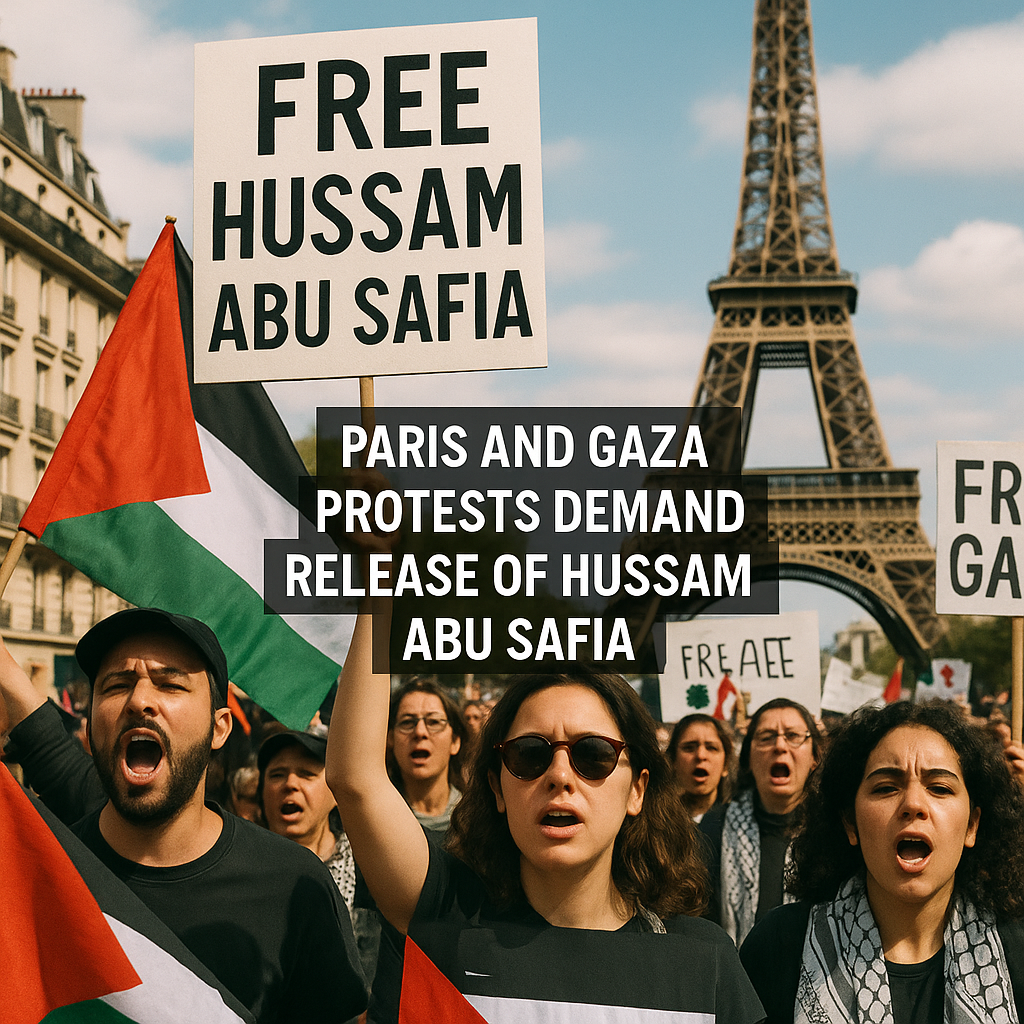
Paris and Gaza Protests Demand Release of Hussam Abu Safia
Paris and Gaza Protests Demand Release of Hussam Abu Safia
Protests in cities around the globe have drawn attention to the pressing issue of human rights, particularly in relation to the plight of Hussam Abu Safia, a Palestinian man whose detention has sparked significant outrage. The demonstrations in both Paris and Gaza serve as a poignant reminder of the ongoing conflict in the region and the complex narratives surrounding it.

Background on Hussam Abu Safia’s Detention
Hussam Abu Safia was detained by Israeli authorities under controversial circumstances that have since escalated tensions in Palestinian territories and abroad. Supporters argue that his detention lacks due process and has become emblematic of broader issues regarding human rights violations in occupied areas. Reports suggest that his arrest was part of a crackdown on political dissent and activism.

In Paris, crowds gathered to express solidarity with Abu Safia and to call for his immediate release. Demonstrators held placards demanding justice and highlighted what they perceive as systematic oppression of Palestinians. These protests in Paris were met with varying degrees of support and criticism. While many locals expressed sympathy for the Palestinian cause, others voiced concerns regarding public disturbances and the potential for violence.

Diverging Perspectives on the Protests
The protests in Gaza and Paris, while united in their demand for Abu Safia’s release, reflect divergent views rooted in their geographical and cultural contexts. In Gaza, rallies were intense and emotionally charged. Hundreds of Palestinians took to the streets, fueled by a sense of urgency and anger. As reported by Al Jazeera, the Gaza participants emphasized Abu Safia’s significance as a symbol of resistance against what they view as systemic injustices.
Conversely, the reactions in Paris were mixed. Some commentators on social media noted that while the protests serve a vital purpose in raising awareness, the methods and timing could be problematic. Given France’s historical ties to the Middle East, many felt that the protests evoke both a moral responsibility and a political conundrum. Accusations of antisemitism have also emerged, complicating the narrative and revealing the delicate balance activists must strike when addressing sensitive international issues.
The Broader Implications of Abu Safia’s Case
Abu Safia’s situation is not merely an isolated incident but part of a larger tapestry of human rights advocacy, conflict, and activism. Several human rights organizations have argued that his case underscores a persistent disregard for the legal rights of Palestinians. This sentiment resonates strongly among those who participated in the protests, who argue that systemic changes are required to ensure justice for all.
On the other hand, some argue that the protests may inadvertently dilute the complexities surrounding the Israeli-Palestinian conflict. Critics point to the risk of oversimplifying the situation into a binary of oppressor and oppressed, which can lead to increased polarization rather than dialogue. For many in the international community, it is essential to engage with these issues thoughtfully and promote constructive conversations rather than exacerbate tensions.
What Lies Ahead?
As the protests continue in both regions, the conversation about Hussam Abu Safia raises critical questions. Will his detention become a catalyst for further activism and policy discussions, or will it eventually fade into a background narrative overshadowed by other global events? The outcome remains uncertain.
Moreover, the interplay between public sentiment and political responses will likely shape the future course of events. Governments and international bodies may need to navigate a complex web of public opinion, historical grievances, and legal implications. Finding a balance that fosters dialogue while respecting human rights will be crucial in resolving not only Abu Safia’s case but the broader issues at play.
In conclusion, the protests demanding Hussam Abu Safia’s release encapsulate a moment of reckoning regarding human rights, political dissent, and social justice on a global scale. As citizens around the world continue to raise their voices for change, the demand for justice reflects a broader hunger for accountability and resolution in the Israeli-Palestinian conflict—issues that will require sustained engagement, empathy, and dialogue in the years to come.