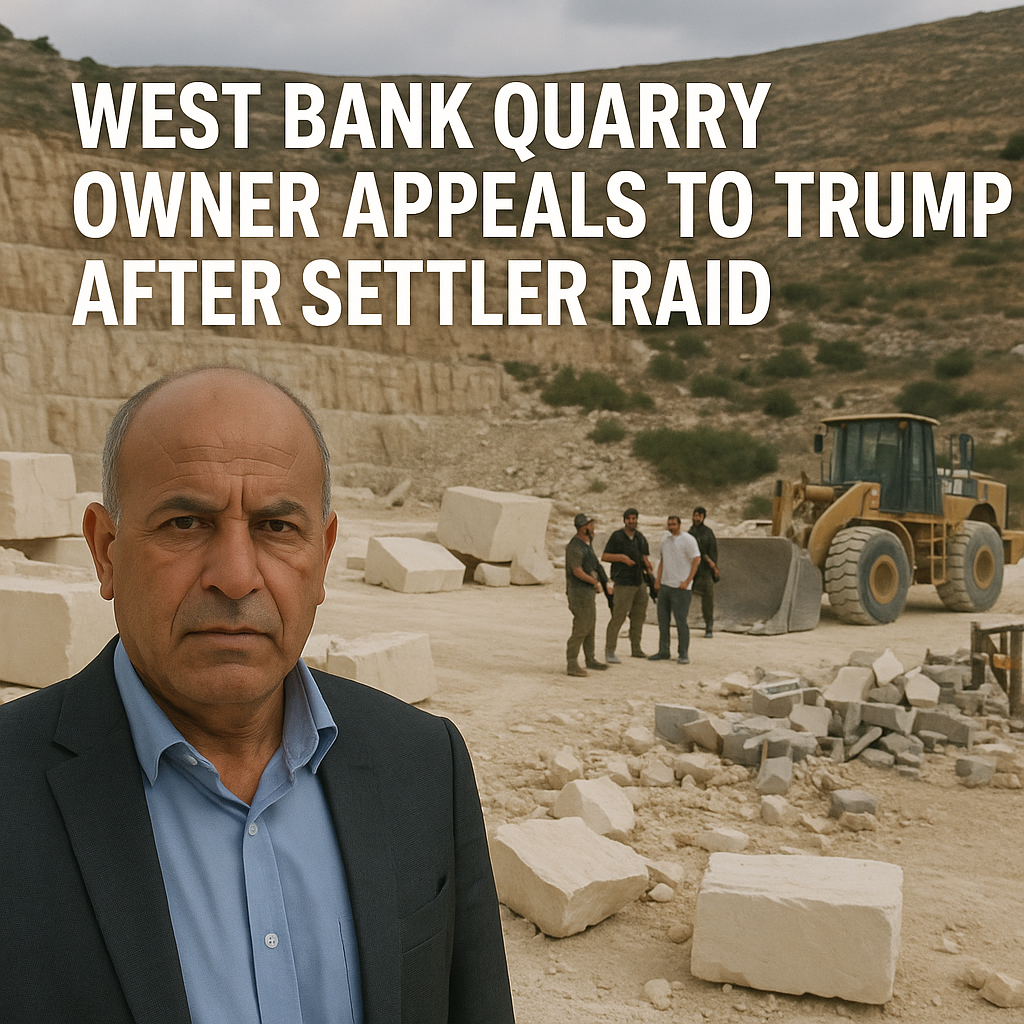
West Bank Quarry Owner Appeals to Trump After Settler Raid
West Bank Quarry Owner Appeals to Trump After Settler Raid
In recent developments, the owner of a quarry in the West Bank has made a public appeal to former President Donald Trump, seeking intervention after his business was targeted in a raid by Israeli settlers. This incident has sparked fresh debates about the implications of Israeli settlement activities in the West Bank, raising critical questions about property rights, security, and international diplomatic relations.

The Context of the Quarry Raid
The quarry in question, located in a contested area of the West Bank, has been a focal point for tensions between Palestinian residents and Israeli settlers. Reports indicate that settlers raided the quarry, causing significant damage and disrupting operations. The owner, whose livelihood is closely tied to the success of his business, claims that the raid was not just an attack on his property but a broader assault on Palestinian rights to work and prosper.

In an emotional plea, the quarry owner reached out to Trump, emphasizing his hope that the former president can leverage his influence to advocate for fairness and justice in these ongoing conflicts. This appeal underscores the complexity of the situation, wherein personal grievances intersect with international politics.

Conversely, settler leaders argue that their presence in the area is legally justified and necessary for security purposes. They emphasize a narrative of protection, claiming that increased tensions necessitate more fortified community practices. This reflects longstanding disputes over land ownership and jurisdiction in the West Bank, where historical claims are contingent on both Israeli and Palestinian narratives.
Diverging Perspectives on Property Rights and Security
The broader implications of the quarry raid extend into the realms of property rights and security concerns. Many Palestinian business owners face similar threats, often living in the shadow of settler militancy, which has increasingly gained the attention of international observers. These actions raise the fundamental question: who truly owns the land in contested territories?
Reports from Al Jazeera highlight that Palestinians reside in a jurisdiction where their rights to land and economic engagement are routinely undermined by ongoing Israeli settlement expansion. This is a sentiment echoed by various human rights organizations, which argue that systematic displacement of Palestinians has become a norm instead of an exception under current policies.
On the contrary, settler organizations maintain that they are reclaiming their ancestral lands, often citing historical connections to the area while dismissing claims of grievance from Palestinian residents. This perspective fosters a commendable narrative from their viewpoint, one that ties modern political movements to ancient rights.
Moreover, statements from figures in Israeli government circles reflect a mixed stance on settlement activities. While some officials advocate for continued expansion as a means of security, others recognize the potential for delegitimizing Israel’s international standing. The latter viewpoint cautions against actions that exacerbate tensions and endanger peace talks.
An Uncertain Path Forward
As the quarry owner’s appeal resonates, it highlights a layered conflict marked by historical grievances, legal ambiguities, and stark power imbalances. The complexities of these power dynamics raise skepticism about any quick resolution. With the former president’s response lingering in uncertainty, both Palestinian and Israeli citizens are left navigating a landscape fraught with risks and controversies.
International responses to such situations are equally divided. Some call for a more hands-on approach by prominent leaders to engage in dialogue and resolution, while others argue that sustained diplomatic pressure is required to ensure equity and justice. The global community is increasingly attentive to how these local instances reflect broader patterns of conflict and human rights violations.
In conclusion, the quarry owner’s plight encapsulates the broader struggle faced by many in the West Bank. Amidst ongoing tensions and contrasting narratives, the path toward understanding the complexities of settler expansion and the realities of Palestinian livelihoods remains fraught with challenges. As appeals for intervention echo into the corridors of power, the hope for a more just and balanced approach to this deeply entrenched conflict continues to be a distant yet vital aspiration.