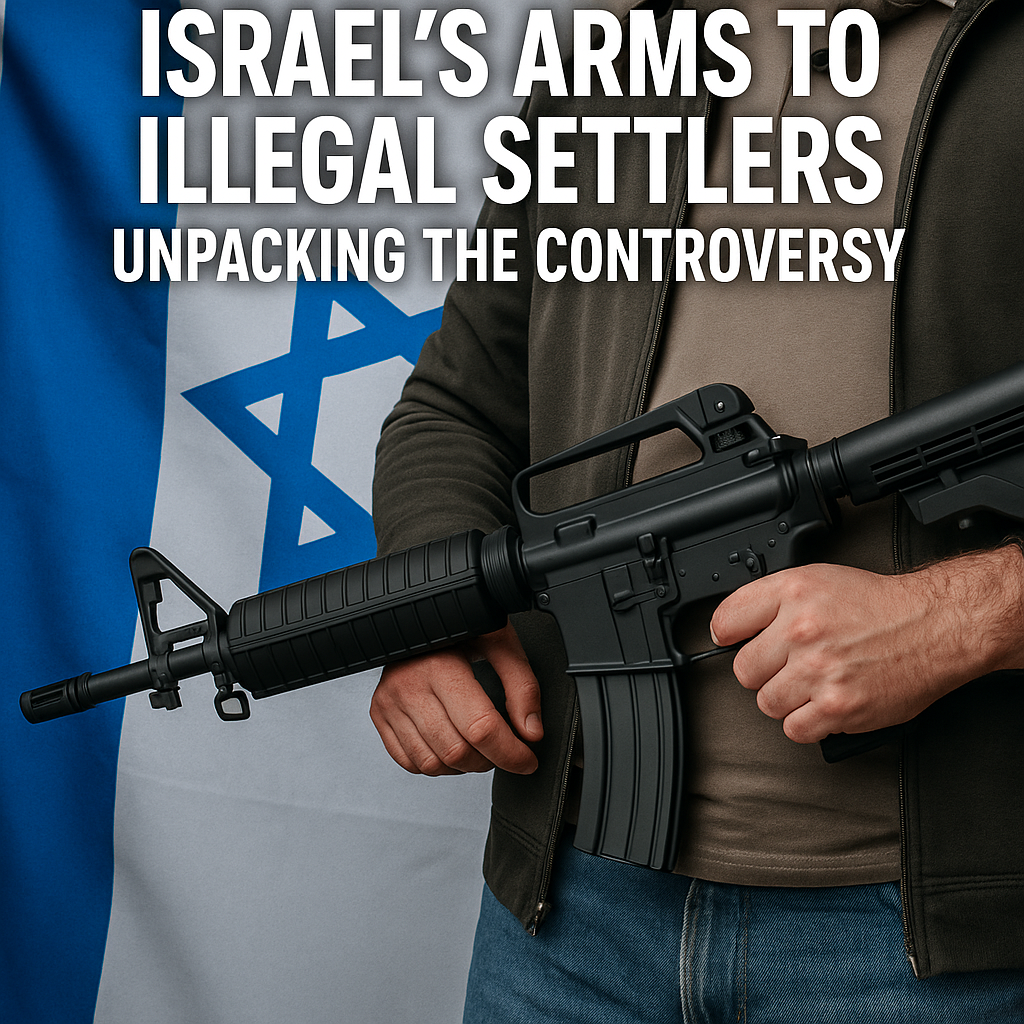
Israel’s Arms to Illegal Settlers: Unpacking the Controversy
Israel’s Arms to Illegal Settlers: Unpacking the Controversy
The issue of Israel arming illegal settlers in the West Bank has sparked significant debate, raising questions about legality, morality, and the broader implications for peace in the region. At the crux of this controversy lies the juxtaposition of security concerns against humanitarian rights.

Historical Context: Settlements and Security
Israeli settlements in the West Bank, deemed illegal under international law by many nations, have been a point of contention between Israelis and Palestinians for decades. These settlements are often viewed as obstacles to peace, complicating efforts to achieve a negotiated two-state solution. Israeli officials argue that the settlements, and by extension, the armed settlers, are essential for the security of Israeli citizens living in proximity to what they perceive as hostile Palestinian territories.

In a recent report by Al Jazeera, supporters of the Israeli government contend that providing arms to settlers is a necessary measure to protect them from potential attacks. The government has historically justified these security measures citing the ongoing violence and instability in the region. Critics, however, argue that the arming of settlers only exacerbates tensions and undermines efforts to resolve the conflict peacefully.

The Dual Perspectives on Armament
The controversy can be framed through two distinct lenses: the security rationale offered by the Israeli government and the counterarguments made by Palestinian representatives and human rights organizations.
From the Israeli perspective, as highlighted in various news sources, the arms supplied to settlers are seen as a deterrent against attacks from Palestinian militants. This position is further bolstered by reports of various violent incidents in areas with a high concentration of settlements. Israeli settler leaders assert that their communities are under constant threat, and therefore, the inclusion of firearms is viewed as essential for self-defense.
Conversely, critics of the Israeli government’s policy argue that arming settlers not only increases the potential for violence but also breaches international norms. They highlight numerous instances where armed settlers have been implicated in attacks against Palestinians, thereby reinforcing a cycle of violence. Reports from human rights organizations assert that this practice is deeply rooted in a broader strategy that aims to consolidate Israeli control over disputed territories. According to critics, the State Ministry’s involvement in arming settlers constitutes a flagrant disregard for the rights and safety of Palestinian civilians.
The Legal Grey Area
The arming of illegal settlers raises complicated legal questions. International law, particularly the Fourth Geneva Convention, prohibits an occupying power from transferring its civilian population into the territory it occupies. Consequently, the legality of arming these settlers is under scrutiny. Proponents of this armament often argue that security needs take precedence over legal stipulations, a notion that has drawn both domestic and international criticism.
Some experts argue that the enforcement of laws be on a case-by-case basis, stressing that while the legal frameworks can influence actions, they do not always dictate the moral imperatives at play. Inevitably, the prevailing legal discourse is complicated by the lack of consensus on both the status of the territories in question and the future of Israeli settlements.
The Bigger Picture: Implications for Peace
While the controversy over arming illegal settlers rages on, it must be understood within a larger context of peace efforts, regional stability, and international relations. The ongoing Israeli-Palestinian conflict is not merely a bilateral concern—it resonates across the Middle East and beyond, impacting diplomatic relations, humanitarian efforts, and global geopolitical strategies.
As various factions within Israel and Palestine advocate for their respective interests, the response from the international community has also been polarized, with some nations supporting Israel’s right to self-defense while others call for a halt to settler violence. At a recent international conference, several advocates for Palestinian rights urged for a reassessment of military supplies and economic support to Israel, arguing that these resources could be redirected towards a more peaceful resolution.
Ultimately, the question remains whether the arming of settlers contributes to long-term stability or fuels an ongoing cycle of violence. The impact of such policies stretches beyond the battlefield; it shapes narratives, influences public sentiment, and potentially determines the future trajectory of Israeli-Palestinian relations.
In conclusion, the issue of Israel arming illegal settlers is complex and multifaceted. It encapsulates broader themes of legality, security, and rights that persistently challenge any resolution to the conflict. As Israel continues to navigate this intricate landscape, the international community remains watchful, hopeful that dialogue may pave the way for a peaceful coexistence in the region.