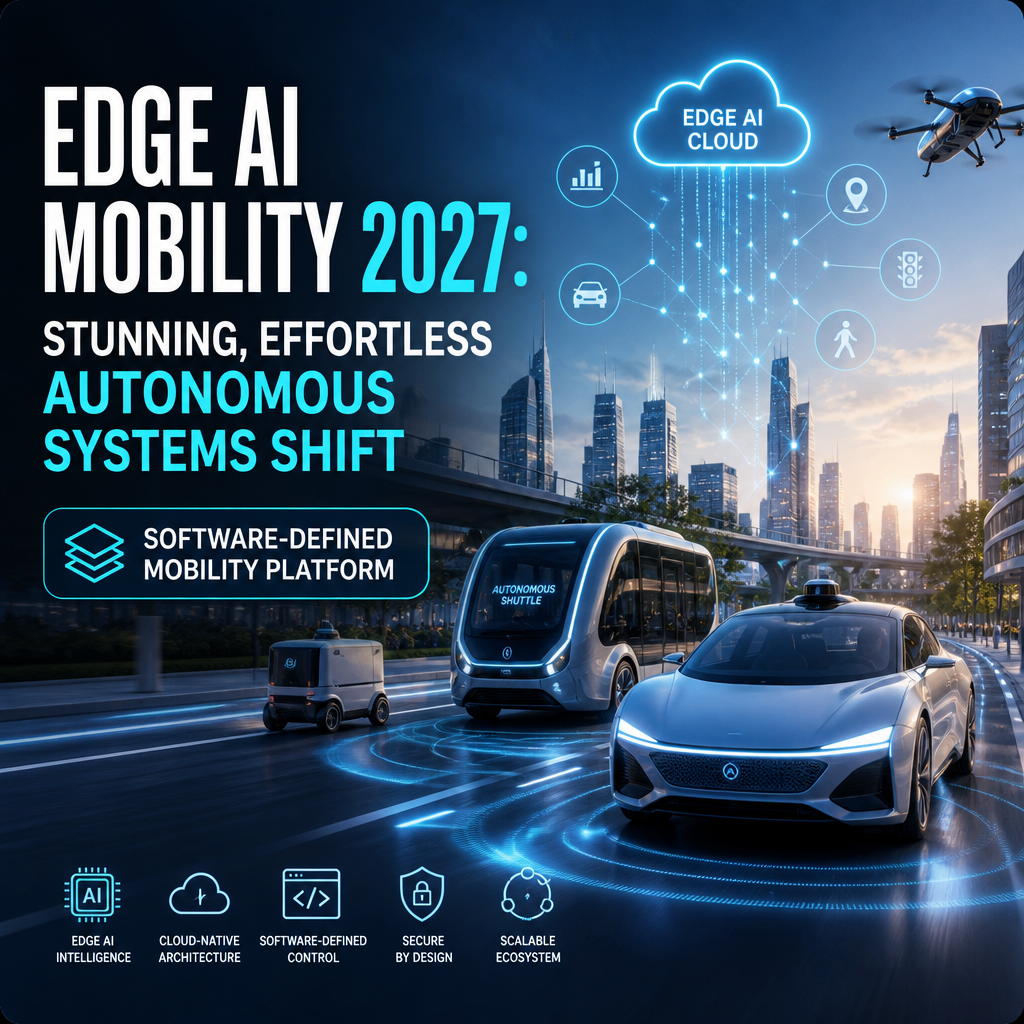
Edge AI Mobility 2027: Stunning, Effortless Autonomous Systems Shift
The software-defined shift is redefining what mobility means in 2027. Vehicles, robots, and connected machines are no longer limited by the hardware they were born with; instead, they are increasingly shaped by software, data, and continuous learning at the edge. This transformation is especially visible in the rise of edge AI and autonomous systems, which are pushing intelligence closer to where decisions happen. The result is faster response times, greater adaptability, and new levels of efficiency across personal transportation, logistics, industrial mobility, and urban infrastructure.

For decades, mobility was built around mechanical engineering and fixed-function electronics. A vehicle’s capabilities were largely determined at the factory, and updates were rare, expensive, and often limited. In 2027, that model has changed dramatically. Today’s mobility platforms are designed more like digital ecosystems than static machines. They receive over-the-air software updates, learn from real-world behavior, and coordinate with other systems in near real time. This software-defined approach is not just improving existing transportation; it is creating entirely new mobility experiences.

The rise of the software-defined mobility platform
At the center of this transformation is the software-defined vehicle and, more broadly, the software-defined mobility platform. Rather than treating the vehicle as a standalone product, manufacturers now view it as a connected computing environment. Sensors, processors, cloud services, and edge AI models work together to deliver features that can evolve over time.

This shift matters because mobility is becoming increasingly dynamic. Traffic conditions change instantly, road hazards emerge without warning, and user expectations continue to rise. Software-defined systems allow mobility platforms to adapt quickly to these conditions. Features such as advanced driver assistance, predictive maintenance, energy optimization, and personalized cabin experiences can now be improved after purchase through software updates.
The benefits extend beyond convenience. Software-defined platforms improve lifecycle value by allowing manufacturers to roll out new services, patch security vulnerabilities, and refine performance without replacing hardware. For fleet operators, this means lower downtime and more efficient operations. For consumers, it means vehicles and mobility devices that stay relevant longer and become more capable with time.
Edge AI in 2027: intelligence at the source
Edge AI is one of the main drivers behind the software-defined shift. Instead of sending every decision to the cloud, edge AI processes data locally on the device or near it. In mobility, that distinction is critical. A self-driving system, a delivery robot, or a connected drone often needs to react within milliseconds. Waiting for a remote server to respond would create latency that could compromise safety and performance.
By 2027, edge AI has become far more powerful and efficient. Specialized processors, neural accelerators, and optimized models enable devices to interpret sensor inputs directly on board. Cameras, radar, lidar, ultrasonic sensors, and inertial measurement systems feed data into AI models that can detect objects, predict movement, and make real-time control decisions.
This local intelligence offers several advantages:
- Lower latency for safety-critical decisions
- Improved reliability in areas with weak connectivity
- Better privacy because less raw data leaves the device
- Reduced bandwidth use across large fleets or urban systems
- Faster adaptation to local conditions and user behavior
In practical terms, edge AI helps mobility systems respond faster and more intelligently. A passenger shuttle can slow down for a pedestrian before the cloud confirms the situation. A warehouse robot can reroute immediately around an obstacle. A smart scooter can adjust power delivery to terrain and riding style. These capabilities are becoming standard expectations rather than premium extras.
Autonomous systems are moving beyond the car
Autonomous systems in 2027 are no longer defined only by passenger cars with self-driving features. They now span a wide range of mobility applications, including autonomous shuttles, industrial robots, last-mile delivery vehicles, agricultural machines, and aerial systems.
What connects them is the ability to perceive their environment, interpret context, and act without constant human intervention. This autonomy is made possible by the same software-defined architecture that underpins modern mobility. Sensors generate rich data streams, edge AI interprets them, and software orchestrates behavior across multiple systems.
In urban environments, autonomous shuttles are helping fill first-mile and last-mile transit gaps. In logistics, autonomous delivery platforms are increasing efficiency by handling repetitive routes and high-volume distribution tasks. In industrial settings, autonomous guided vehicles and mobile robots are streamlining material movement inside factories and warehouses. Even in constrained environments like campuses, airports, and ports, autonomy is improving throughput and reducing operational friction.
The important trend is not full autonomy in every case, but a spectrum of autonomy tailored to specific use cases. Many systems now operate in supervised autonomous modes, where human oversight remains available but routine tasks are handled by AI. This hybrid approach makes autonomy more practical and scalable.
Why mobility is becoming more responsive and personalized
Software-defined mobility is also making transportation more adaptive to individual needs. In 2027, mobility platforms increasingly learn from user preferences, patterns, and context. Commuters may receive route suggestions based on traffic, weather, and calendar events. Fleet vehicles can adjust cabin settings and drive profiles for different operators. Shared mobility services can personalize vehicle allocation and payment models based on usage history and demand.
This personalization is made possible by continuous data processing and model refinement. Edge AI identifies patterns in real time, while cloud systems aggregate insights across fleets to improve broader performance. The combination allows mobility experiences to feel both local and intelligent.
For passengers, this means smoother rides, less downtime, and better coordination across services. For operators, it means more efficient asset utilization and more accurate demand forecasting. For cities, it can mean smarter traffic management, reduced congestion, and more responsive transit networks.
Connectivity, coordination, and the mobility ecosystem
One of the defining features of the software-defined shift is that mobility systems no longer operate in isolation. They are part of a wider ecosystem that includes vehicles, infrastructure, cloud platforms, and digital services. Vehicles can communicate with traffic lights, parking systems, charging stations, and fleet management platforms. Autonomous systems can coordinate with one another to avoid conflicts and improve flow.
This ecosystem approach is especially important for electric mobility. Charging behavior, battery health, route planning, and energy pricing can all be optimized through software. Edge AI helps determine when and where to charge, how to manage thermal loads, and how to preserve battery life. For commercial fleets, these capabilities translate into lower operating costs and better uptime.
In smart cities, connected mobility systems are becoming tools for urban management. Data from buses, taxis, delivery vehicles, and public infrastructure can support more efficient planning and responsive traffic control. The goal is not simply to make vehicles smarter, but to make the entire transportation network more intelligent.
Security and safety in a software-first world
As mobility becomes more software-driven, cybersecurity and functional safety become even more important. A connected, autonomous system is only as trustworthy as its software stack. In 2027, manufacturers and operators are investing heavily in secure boot processes, encrypted communications, anomaly detection, and continuous validation of AI models.
Edge AI helps support safety by keeping time-critical decisions local, but it also introduces new requirements. Models must be robust, explainable enough for oversight, and resilient to sensor errors or adversarial conditions. Regular software updates are essential, yet they must be delivered without introducing instability. This is why modern mobility platforms increasingly rely on secure update pipelines and digital verification systems.
Safety is also being enhanced through redundancy. Multiple sensors, fallback control modes, and layered decision systems help ensure that autonomous systems can degrade gracefully when conditions become uncertain. In the software-defined era, resilience is designed into both hardware and software from the start.
What this means for the future of mobility
The software-defined shift is creating a mobility landscape that is more agile, more intelligent, and more scalable than ever before. Edge AI brings computation closer to action, enabling fast, localized decisions. Autonomous systems turn that intelligence into movement, handling tasks that once required constant human control. Together, they are driving a new mobility model built around adaptability instead of rigidity.
In 2027, the winners across the mobility sector are likely to be the organizations that treat software as a core product, not an accessory. Those that can continuously improve performance, personalize experiences, and coordinate across connected systems will be best positioned to thrive. The hardware still matters, but software now determines how far a platform can go, how safely it can operate, and how quickly it can evolve.
Mobility is no longer just about getting from one place to another. It is about intelligent movement in a world where machines can sense, decide, and act with increasing independence. The software-defined future is here, and edge AI and autonomous systems are at the center of it.