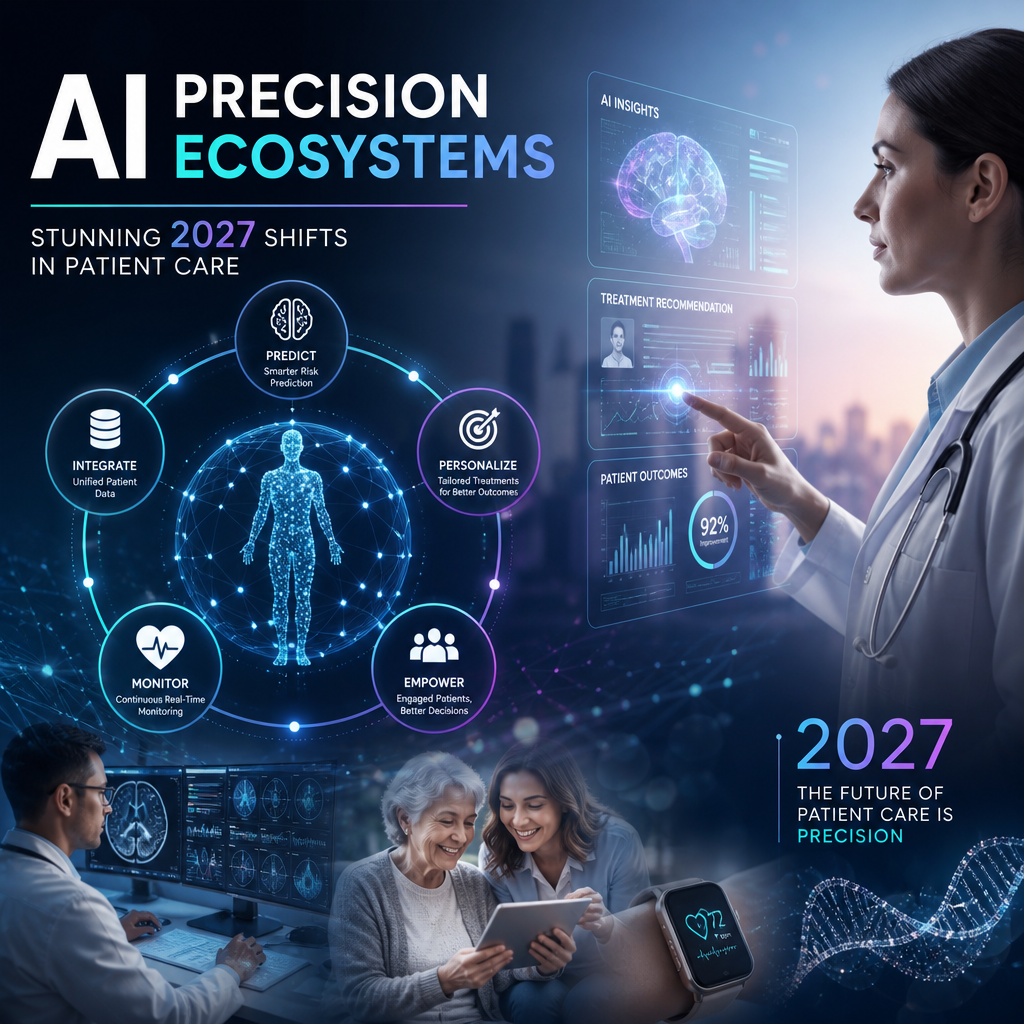
AI Precision Ecosystems: Stunning 2027 Shifts in Patient Care
AI precision ecosystems are moving healthcare from isolated tools toward connected systems that help clinicians make faster, more confident decisions. By 2027, the real breakthrough will not be a single algorithm that reads scans or predicts risk. It will be the way diagnostics, monitoring, treatment planning, and follow-up care work together as one adaptive network around the patient. This shift has the potential to improve outcomes, reduce delays, and make care more personalized than ever before.

For years, artificial intelligence in medicine has been described in terms of narrow tasks: detecting tumors, flagging abnormal lab values, or predicting readmission risk. Those capabilities are valuable, but they only solve part of the problem. Patient care is not a sequence of isolated tasks. It is a continuous process shaped by history, context, urgency, and human judgment. AI precision ecosystems aim to connect those pieces so that each decision is informed by the full picture.

What an AI Precision Ecosystem Actually Means
An AI precision ecosystem is more than a single model or software platform. It is a coordinated environment where multiple data sources, algorithms, clinical workflows, and human experts interact in real time. Instead of treating data as static records, the ecosystem uses it to update understanding as new information arrives.

That data may include:
- Imaging results
- Laboratory values
- Wearable device signals
- Genomic and molecular profiles
- Medication histories
- Physician notes
- Social and environmental factors
When these inputs are integrated thoughtfully, AI can help identify patterns that would be difficult for clinicians to see on their own. The goal is not to replace medical expertise. The goal is to extend it, giving care teams decision support that is more precise, timely, and individualized.
From Diagnostics to Decisions: The Core Shift
The phrase “from diagnostics to decisions” captures the most important change coming in healthcare. Traditional diagnostics often end at interpretation. A scan is read, a result is reported, and then the clinician decides what to do next. In an AI precision ecosystem, diagnosis becomes part of a broader decision engine.
For example, suppose a patient’s imaging shows a suspicious lesion. A conventional system might simply label it and send the report to the clinician. A precision ecosystem could do much more:
- Compare the image against prior scans
- Assess risk using the patient’s medical history
- Evaluate relevant genomic markers
- Estimate the urgency of intervention
- Suggest evidence-based treatment pathways
- Prioritize the case based on potential harm if delayed
This does not mean the system makes the final call. Instead, it helps clinicians see which decisions matter most and why. That extra layer of context can reduce uncertainty and improve consistency.
Why 2027 Could Be a Turning Point
Several forces are converging to make 2027 a pivotal year for AI in patient care. First, data infrastructure is improving. Health systems are increasingly able to unify records across departments and sites. Second, the quality of clinical AI models is improving as they are trained on larger, more diverse datasets. Third, healthcare organizations are under pressure to do more with limited staff and resources.
Just as important, the conversation around AI is maturing. Early enthusiasm often focused on automation alone. By 2027, the stronger use case will be augmentation: helping physicians, nurses, radiologists, pathologists, and care coordinators make better decisions under real-world constraints.
Another reason 2027 stands out is regulatory and operational readiness. As standards for validation, interoperability, and governance strengthen, health systems will be better positioned to deploy AI in ways that are safer and more trustworthy.
How AI Precision Ecosystems Will Reshape Patient Care
The impact of AI precision ecosystems will be felt across the care journey, not just in the diagnostic phase.
Earlier Detection and Intervention
One of the most immediate benefits will be earlier detection of disease. AI can synthesize subtle signals from imaging, labs, and longitudinal records to identify risk before symptoms become severe. That creates opportunities for earlier intervention, which often leads to better outcomes and lower costs.
More Personalized Treatment Plans
Precision medicine depends on tailoring care to the individual rather than relying on broad averages. AI can support this by matching patients to therapies based on biological markers, predicted response, comorbidities, and past outcomes in similar cases. This is especially important in areas such as oncology, cardiology, and autoimmune disease management.
Smarter Resource Allocation
Healthcare systems often struggle with prioritization. Which patients need immediate follow-up? Which cases can safely wait? Which patients are most likely to benefit from intensive monitoring? AI precision ecosystems can help answer those questions by ranking urgency and expected benefit, allowing teams to direct resources where they matter most.
Better Care Coordination
Many poor outcomes happen not because of a lack of knowledge, but because information gets fragmented across departments. Precision ecosystems can connect diagnostic findings with next steps, ensuring that referrals, prescriptions, follow-up tests, and patient education are aligned. This reduces the chance that critical insights are lost between visits.
The Role of Human Judgment
Even as AI grows more sophisticated, human judgment remains essential. Medicine is not only about pattern recognition; it is also about ethics, communication, empathy, and understanding patient preferences. A model may identify an optimal treatment on paper, but the clinician must determine whether it fits the patient’s goals, social situation, and tolerance for risk.
This is why the best AI precision ecosystems will be designed as decision support systems, not autonomous decision-makers. Clinicians will need transparent explanations, confidence levels, and evidence trails so they can assess recommendations critically. Trust will depend on the ability to understand how the system arrived at a suggestion.
Challenges That Must Be Solved
The promise of AI precision ecosystems is significant, but several challenges remain.
Data Quality and Interoperability
AI is only as good as the data it receives. Incomplete records, inconsistent coding, and disconnected systems can weaken performance. Health organizations will need better standards for data sharing and formatting.
Bias and Fairness
If training data underrepresents certain populations, AI recommendations may be less accurate for those groups. That could widen existing disparities instead of reducing them. Continuous auditing and diverse datasets are essential.
Privacy and Security
Precision ecosystems depend on sensitive information, including genetic data and detailed health histories. Strong security controls and clear governance will be necessary to protect patient trust.
Clinical Workflow Integration
Even the best AI tools fail if they slow down care or create alert fatigue. Successful systems must fit naturally into clinical workflows, presenting information at the right moment in the right form.
What Patients May Experience by 2027
For patients, the changes may feel subtle at first, but the overall experience could improve substantially. Appointments may become more targeted because clinicians will already have richer context before the visit. Follow-ups may happen sooner if risk signals appear. Treatment plans may be more personalized and easier to understand.
Patients may also see a shift from reactive care to proactive care. Instead of waiting until symptoms worsen, the system may flag emerging issues early enough for preventive action. That could mean fewer emergency visits, fewer unnecessary procedures, and more confidence in the path forward.
The Future Is Not Just Smarter Tools, But Smarter Systems
The biggest misconception about AI in healthcare is that progress will come from better standalone tools. In reality, the future belongs to connected systems that combine diagnostics, analytics, workflows, and clinical expertise into one precision ecosystem. That is what will transform information into action.
By 2027, the healthcare organizations that lead will likely be those that do not ask whether AI can perform a single task, but how it can improve the entire chain of care. From diagnostics to decisions, AI precision ecosystems are poised to reshape patient care by making it more timely, more personalized, and more aligned with the realities of modern medicine.