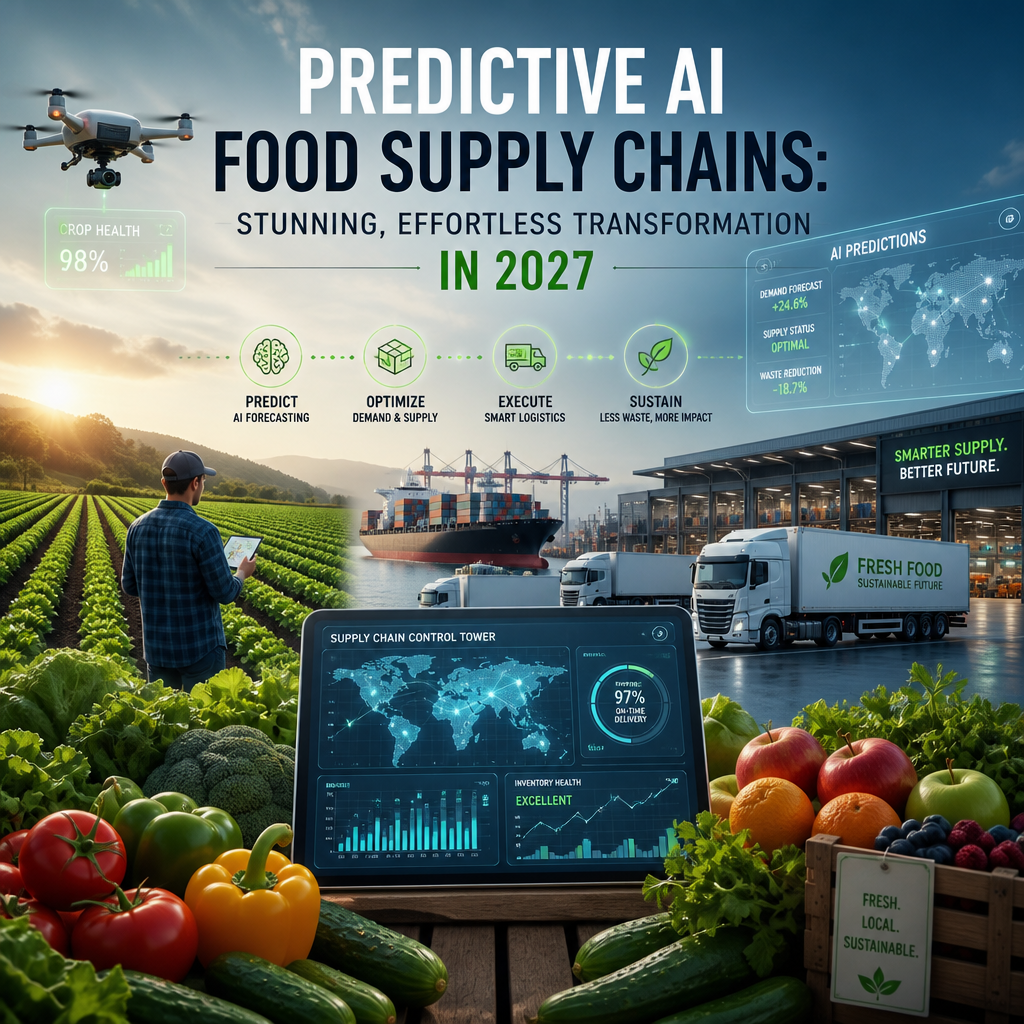
Predictive AI Food Supply Chains: Stunning, Effortless Transformation in 2027
From farm to fork, the global food supply chain is entering a new era of precision, resilience, and speed. By 2027, predictive AI and smart automation will no longer be experimental tools reserved for a few leading agribusinesses. They will become essential technologies helping producers, processors, distributors, retailers, and logistics providers respond to climate volatility, labor shortages, shifting consumer demand, and rising expectations for transparency. The result will be a food system that is more efficient, less wasteful, and better able to deliver fresh products safely and consistently.

Predictive AI and Smart Automation in the Food Supply Chain
Predictive AI uses historical data, real-time signals, and machine learning models to forecast what is likely to happen next. In food supply chains, that means anticipating crop yields, demand swings, spoilage risks, transportation delays, and equipment failures before they disrupt operations. Smart automation takes those predictions and turns them into action through connected systems, robotics, autonomous equipment, and workflow software.

Together, these technologies create a supply chain that does not simply react to problems. It anticipates them.

For example, an AI model can analyze weather patterns, soil conditions, planting schedules, and satellite imagery to predict a lower-than-expected harvest in a particular region. That forecast can trigger automated procurement changes, rerouting shipments, adjusting inventory targets, and notifying buyers before shortages become visible on shelves. Similar systems can predict when refrigerated trucks are likely to break down, when a storage facility is nearing temperature thresholds, or when consumer demand for a product will spike ahead of holidays or major events.
Why 2027 Will Be a Turning Point
Several trends are converging to make 2027 a pivotal year for food supply chains. First, the cost and accessibility of AI tools are improving rapidly. What once required large teams of data scientists can now be deployed through cloud platforms and specialized industry software. Second, sensor networks, edge computing, and connected equipment are becoming standard across farms, warehouses, and distribution centers.
At the same time, the food industry is under intense pressure. Climate change is increasing the frequency of droughts, floods, and extreme temperatures. Consumer expectations for freshness, sustainability, and traceability are rising. Margins are tight, and waste remains a persistent challenge. In this environment, organizations that rely only on manual forecasting and legacy systems will struggle to keep up.
By 2027, predictive AI and smart automation will be central to competitive advantage. Companies that adopt them early will likely reduce waste, improve service levels, and make faster decisions with fewer resources.
Smarter Farming Decisions at the Source
The food supply chain begins on the farm, and that is where predictive AI can create some of the biggest gains. Farmers already use digital tools to monitor weather and field conditions, but the next generation of systems will go much further.
Predictive models will help growers determine the best times to plant, irrigate, fertilize, and harvest. AI can combine drone imagery, soil sensors, satellite data, and crop history to estimate yield potential and detect disease or pest outbreaks before they spread. That means interventions can be targeted more precisely, reducing the need for blanket chemical applications and lowering costs.
Smart automation will also support labor-intensive tasks. Autonomous tractors, robotic weeders, and automated irrigation systems can perform repetitive work with consistent accuracy. In regions facing labor shortages, this will be especially important. By 2027, farms using connected automation platforms may be able to coordinate machinery, weather alerts, and field operations from a single interface, increasing productivity while reducing risk.
Predictive AI for Demand Forecasting and Inventory Control
One of the most valuable applications of predictive AI in food supply chains is demand forecasting. Food retailers and distributors have long struggled to match supply with changing customer preferences, seasonal patterns, and local buying behavior. Overstocking leads to waste, while understocking leads to lost sales and frustrated customers.
AI-powered forecasting systems can analyze much more than historical sales data. They can factor in weather forecasts, school calendars, promotions, social media trends, public events, inflation data, and even regional traffic patterns. This deeper insight helps companies predict demand at the product, store, and neighborhood level.
In 2027, inventory systems will increasingly respond automatically to those forecasts. If a heatwave is expected, demand for beverages, salads, and ice cream may rise, prompting dynamic replenishment. If a regional storm threatens delivery routes, systems may move inventory earlier or redirect shipments to maintain availability. The result is leaner inventory with less spoilage and fewer emergency shipments.
Automation in Warehousing, Processing, and Packaging
Once food leaves the farm, smart automation becomes critical in handling, processing, and packaging. Warehouses and distribution centers are already adopting robotics for picking, sorting, palletizing, and loading. By 2027, these systems will be more flexible, more integrated, and more aware of product quality.
Computer vision will allow automated inspection systems to detect bruising, contamination, incorrect labeling, and packaging defects at high speed. Robotic systems will sort produce by size, ripeness, and quality, helping suppliers direct items to the right market channels. For instance, premium fruit may be sent to fresh retail, while slightly imperfect items may be redirected to processing, reducing waste.
In food processing plants, automation will improve consistency and reduce the risk of human error. Predictive maintenance tools will monitor equipment performance and flag likely failures before they halt production. That means less downtime, more stable output, and improved food safety. Automated sanitation systems can also support compliance by ensuring cleaning routines are performed and documented consistently.
Transportation and Cold Chain Visibility
Food is highly perishable, and transportation remains one of the most fragile links in the chain. Predictive AI will be especially valuable in cold chain logistics, where even small temperature deviations can compromise safety and shelf life.
By 2027, smart sensors in trucks, containers, and storage facilities will stream real-time temperature, humidity, vibration, and location data. AI systems will analyze those signals to detect anomalies and predict spoilage risk. If a refrigerated unit begins to drift outside safe thresholds, alerts can be sent immediately to drivers, dispatchers, and warehouse teams.
Route optimization will also become more advanced. Predictive systems will account for traffic, weather, fuel prices, delivery windows, and vehicle condition to recommend the most efficient route. In some cases, autonomous or semi-autonomous vehicles will be part of the solution, especially for controlled logistics environments and short-haul delivery networks.
This level of visibility will help companies preserve product quality and cut losses from delays or equipment failures.
Traceability and Food Safety Will Improve
Consumers and regulators increasingly want to know where food comes from, how it was handled, and whether it is safe. Predictive AI and automation will strengthen traceability by connecting data across every stage of the supply chain.
When harvest, processing, shipping, and retail systems are integrated, companies can trace products faster and more accurately during recalls or contamination events. AI can also identify patterns that indicate elevated risk, such as repeated temperature excursions, supplier inconsistencies, or sanitation anomalies. Instead of waiting for a crisis, organizations can intervene earlier.
By 2027, traceability will likely shift from a reactive compliance function to a proactive risk management tool. This will benefit not only safety but also brand trust and customer loyalty.
Sustainability and Waste Reduction
Food waste is one of the biggest inefficiencies in the global supply chain, and predictive AI offers a powerful way to address it. By better matching supply with demand, routing products efficiently, and improving storage conditions, companies can reduce the volume of food that spoils before it reaches consumers.
Smart automation also helps optimize resource use at the production stage. Precision irrigation, targeted fertilization, and energy-efficient warehouse operations can lower environmental impact while preserving yields. Predictive analytics can guide where to send surplus products, whether to alternative retail channels, food banks, or processing facilities.
By 2027, sustainability will not just be a marketing priority. It will be embedded into operational decision-making through data-driven systems that minimize waste at every step.
Challenges That Must Be Managed
Despite the promise of these technologies, adoption will not be effortless. Food supply chains are complex, fragmented, and often built on legacy infrastructure. Smaller farms and suppliers may struggle with the cost of sensors, connectivity, and software integration. Data quality remains a major challenge, and AI models are only as strong as the information they receive.
There are also concerns about workforce disruption. Automation may reduce some manual roles, even as it creates new demand for technicians, data analysts, and system operators. Successful adoption will require training, change management, and clear communication about how technology supports rather than replaces human expertise.
Cybersecurity will be another important issue. As food systems become more connected, they also become more vulnerable to digital threats. Protecting operational data, equipment controls, and supplier networks will be essential.
The Future of Food Supply Chains Is Connected and Predictive
By 2027, the most successful food supply chains will be those that can see ahead, adapt quickly, and operate with greater precision. Predictive AI and smart automation will make that possible by linking farms, factories, warehouses, and delivery networks into a responsive digital ecosystem.
The transformation will not eliminate human judgment. Instead, it will amplify it. Farmers, processors, logistics teams, and retailers will make better decisions with better information and more reliable systems. Food will move more efficiently, waste less, and arrive with greater safety and freshness.
From farm to fork, the supply chain of 2027 will be defined by anticipation rather than reaction. And that shift will reshape how the world grows, moves, and experiences food.