AI Is Learning to Read the Planet as Scientists Search for Earlier Warnings
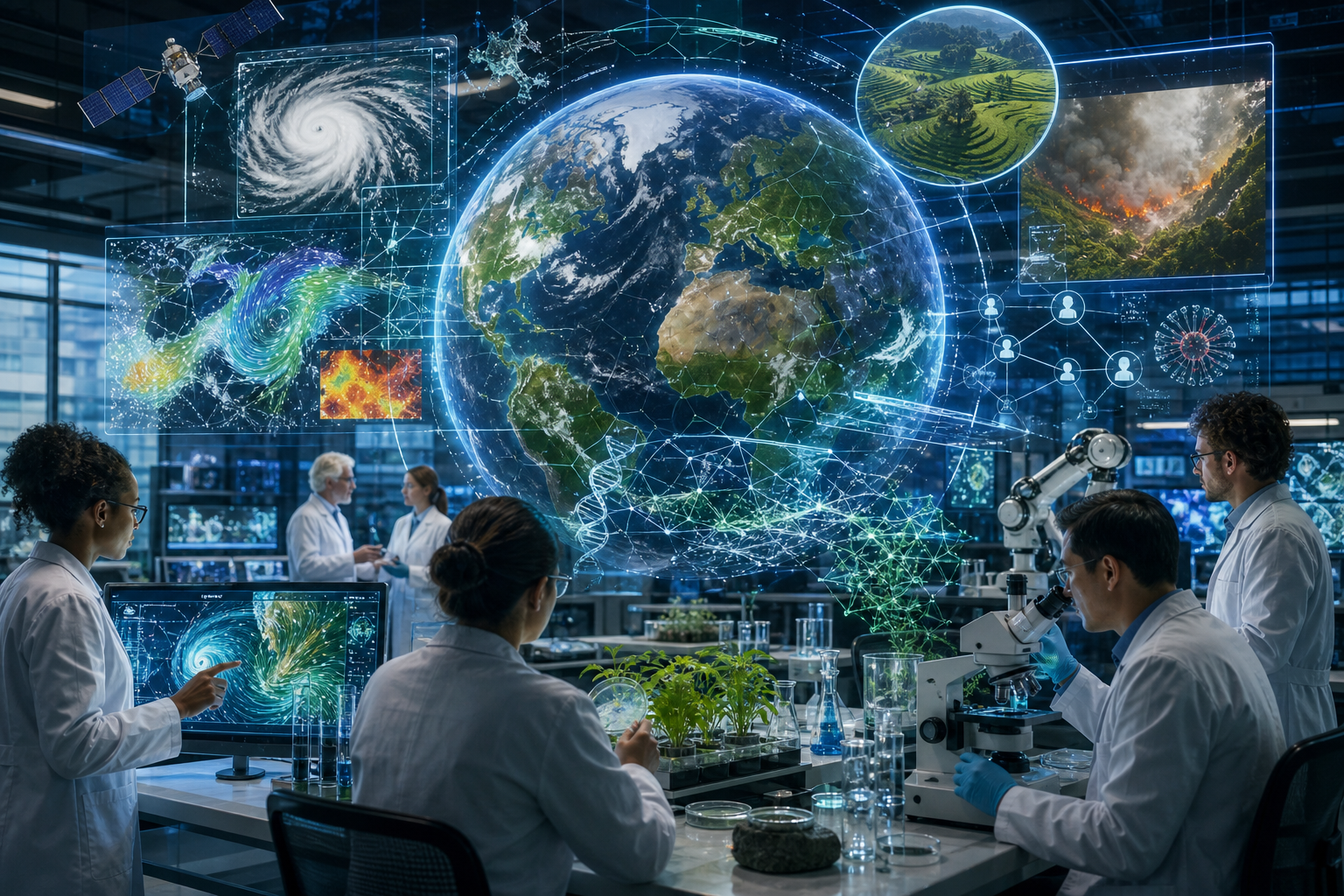
Artificial intelligence is being applied to scientific challenges including weather forecasting, public health, environmental research and food security. By analyzing large, varied datasets, AI can help identify patterns, improve predictions and highlight communities vulnerable to disasters.
AI is also supporting genetic and biomedical research, robotics and real-world technology development. Its results still require scientific testing and verification, because researchers must assess accuracy, limitations and practical risks before relying on AI-generated predictions.
Artificial intelligence is increasingly being used to understand complex changes across the planet, moving beyond everyday digital assistants into areas such as weather forecasting, public health and environmental research.
Google has reported that its latest AI research is being applied to several scientific challenges, including weather prediction, health monitoring and food security. Its newer WeatherNext system is designed to improve precipitation forecasting, while other AI tools combine information from different sources to help researchers identify communities that may be vulnerable to major crises.
These developments point to a broader change in scientific research. Instead of examining one dataset at a time, AI systems can process huge amounts of information from different fields and identify relationships that may be difficult to detect using conventional methods.
Weather and disaster prediction are among the areas where this approach could have practical consequences. More accurate forecasts can give communities additional time to prepare for floods, wildfires and other extreme events. Researchers are increasingly examining how AI can turn large collections of environmental data into faster and more useful predictions.
AI is also being applied to biological and medical research. Scientists are using advanced models to analyze genetic information and investigate possible connections between biological changes and human health. These systems do not replace scientific testing, but they can help researchers explore large numbers of possibilities more quickly.
The expansion of AI into scientific work is also being accompanied by investment in robotics, physical AI and biomedical technologies. Innovation programs in Europe are supporting projects designed to test emerging technologies outside laboratories and determine how they can work in real-world environments.
As AI becomes more involved in scientific research, reliability and verification will remain essential. A computer-generated prediction can help scientists identify a potential warning or discovery, but researchers still need to test the results and understand the limitations of the technology before using them for important decisions.