Scientists Captured a Quantum Jump in Sound in Real Time
Stanford researchers have directly observed a quantum jump in a phonon, the smallest quantum unit of mechanical vibration. Using a microscopic resonator and superconducting qubit, they repeatedly measured the system and captured its transition between energy states in real time.
The experiment could support future advances in quantum error detection, precision sensing, and control of mechanical vibrations in electronic devices. Researchers are also investigating related technology for detecting proteins inside cells.
Sound usually appears continuous. A ringing object gradually becomes quieter until it stops.

At the quantum scale, however, nature behaves differently.

Researchers at Stanford have now directly observed a quantum jump in a tiny unit of sound known as a phonon, capturing the transition in real time. The findings were published in Science and could have implications for quantum computing, precision sensing, and technologies that rely on sound.

Watching Sound Change Its Quantum State
A phonon can be thought of as the smallest quantum unit associated with a mechanical vibration.
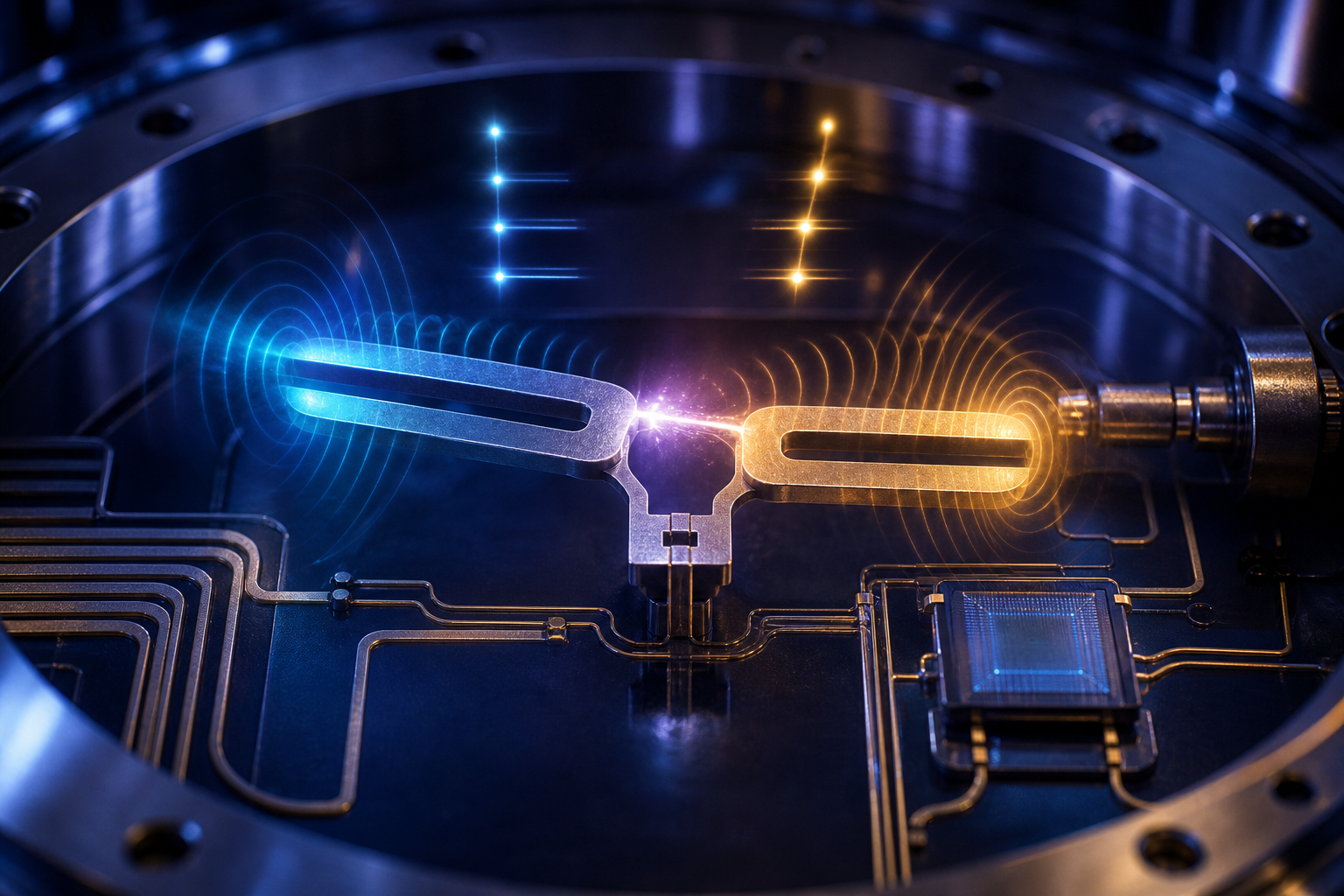
The Stanford researchers built a microscopic mechanical resonator that behaves somewhat like an extremely small tuning fork. Unlike an ordinary tuning fork, however, its vibration can be measured at the level of individual quantum energy states.
The resonator can continue vibrating for roughly two milliseconds — long enough for the researchers to make hundreds of measurements and identify the moment when its energy changed from one state to another.
Why the Jump Matters
Quantum systems are extremely sensitive. Measuring them without disturbing their fragile states is one of the central challenges of quantum engineering.
The researchers connected the mechanical resonator to a superconducting qubit that could repeatedly monitor the system without destroying the experiment.
That allowed the team to observe individual phonons making quantum jumps rather than merely inferring that such events had occurred.
A Possible Path Toward Better Quantum Systems
The significance of the experiment extends beyond the physics laboratory.
In many quantum-computing architectures, unwanted quantum jumps can represent errors. Being able to detect these changes could eventually contribute to improved methods for identifying and correcting errors in quantum systems.
The same platform may also have applications in extremely sensitive measurements.
Stanford researchers are already exploring whether related technology could help detect and identify proteins inside cells.
Could This Improve Everyday Technology?
The researchers also point to a less obvious possibility.
Sound and mechanical vibration already play roles in technologies such as smartphones and other electronic devices.
Greater control over mechanical vibrations at very small scales could eventually influence the design of future devices.That does not mean a quantum-powered smartphone is around the corner. The Stanford work is still fundamental research.
But it demonstrates something important: scientists are becoming increasingly capable of controlling and observing mechanical motion at the quantum level.
The Bigger Story
The breakthrough changes the way we can think about sound.
At everyday scales, sound is something we hear. At the quantum scale, vibration can become a precisely measurable information system.
The ability to watch a quantum jump happen in real time is therefore more than an unusual scientific observation. It is another step toward controlling the smallest physical processes that could eventually power new generations of computers, sensors, and electronic devices.