
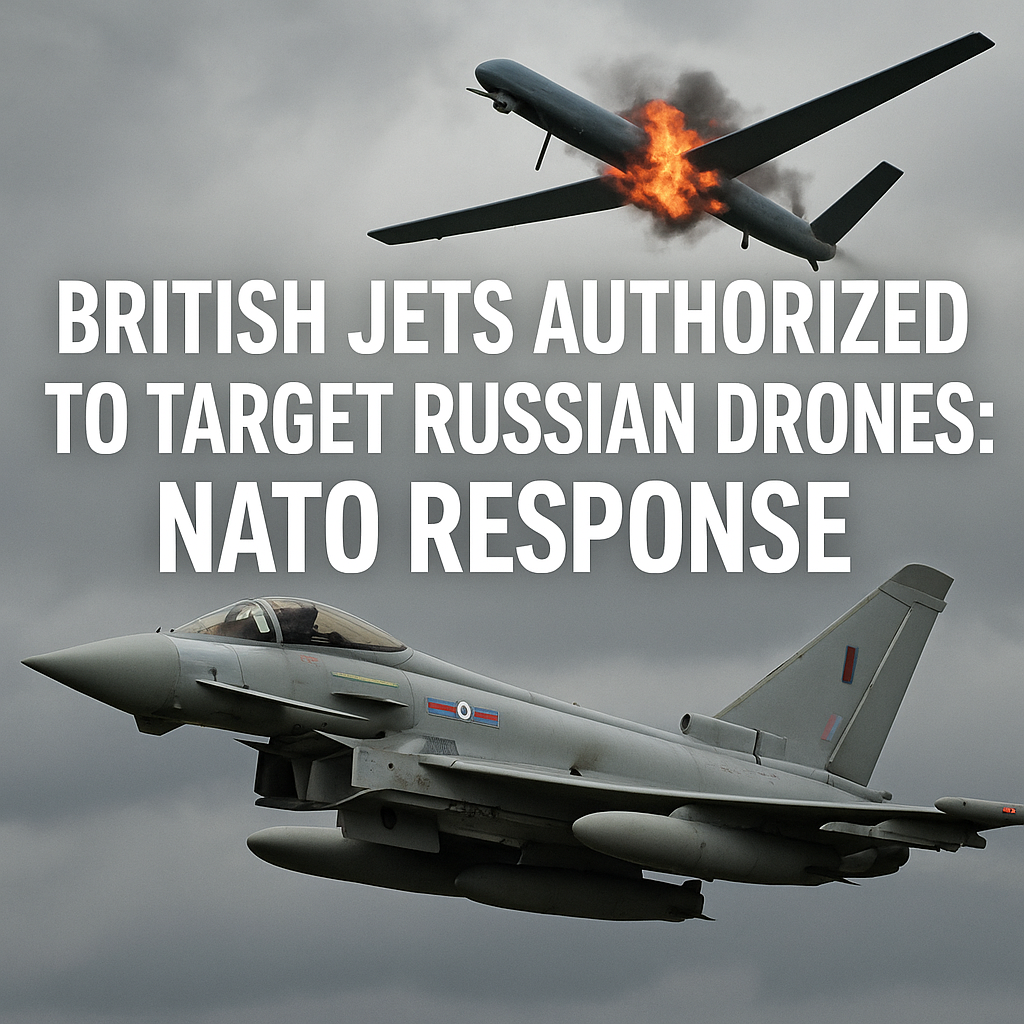
British Jets Authorized to Target Russian Drones: NATO Response

British Jets Authorized to Target Russian Drones: NATO Response
In a significant escalation of military engagements in Eastern Europe, British jets have been authorized to intercept Russian drones. This decision, framed within the larger context of NATO’s response to increasing tensions in the region, underscores the complicated interplay of international relations and military readiness.

Rising Tensions in Eastern Europe
The Kremlin’s increased use of drone technology in the ongoing conflict between Russia and Ukraine has sparked heightened concerns among NATO allies. British defense authorities have recently confirmed that Royal Air Force (RAF) jets are now equipped to target Russian drones across operational zones. This shift is part of a broader NATO strategy aimed at ensuring airspace security and countering potential threats to member states.


Different Perspectives on Military Actions
Responses to the news of British jets being authorized to engage Russian drones have varied, reflecting a spectrum of opinions on the implications of such military actions.


Support for Robust Defense Measures
Proponents of the directive argue that it is a necessary step to deter aggression from Russia, bolstering the security framework surrounding NATO countries. The UK’s Ministry of Defence has stated that this move is intended to protect not only Ukrainian sovereignty but also the safety of NATO allies. In a statement, a senior defense official noted: “We must remain vigilant and prepared to act decisively in the face of aggression.”
Concerns Over Escalation
Conversely, critics caution against drawing the UK into deeper conflict with direct military engagements. Analysts fear that authorizing jets to target drones could escalate hostilities, leading to wider confrontation between NATO and Russia. A former military strategist highlighted this concern, stating, “While it’s important to defend allies, we must tread carefully to avoid a miscalculation that could lead to a full-blown conflict.”
The Broader Picture of NATO’s Strategy
NATO’s response to Russian military strategies, particularly the growing use of drones, is deeply rooted in historical context. The alliance’s expansion into Eastern Europe has often been met with strong opposition from Moscow, which perceives these actions as encroachment on its sphere of influence. In light of these dynamics, NATO’s military posturing—including aerial capabilities—serves not just as a defense mechanism but also as a political statement.
The Role of International Relations
The authorization for RAF jets to engage Russian drones also sheds light on NATO’s commitment to collective defense. The principles laid out in Article 5 of the NATO treaty, which states that an armed attack against one member is an attack against all, are a fundamental component of the alliance’s deterrent strategy. However, how far NATO is willing to go in protecting this principle remains a subject for debate, especially given the potential for misinterpretation or provocation.
Uncertainties and Future Implications
As this situation unfolds, uncertainties loom large. The evaluation of tactics such as airstrikes and drone interceptions raises questions about the thresholds of engagement and what constitutes an appropriate defensive response. Furthermore, how Russia may react to these developments is unpredictable. Speculation ranges from further militarization of the region to potential diplomatic overtures, although the former appears more likely given current historical patterns.
Conclusion: An Ongoing Challenge
The authorization for British jets to target Russian drones reflects a critical juncture in NATO’s ongoing strategy to assert air superiority and protect regional allies. While many see it as a necessary measure to counter Russia’s aggressive tactics, the potential for escalation remains a pressing concern. As global powers navigate these complex dynamics, continuous dialogue and careful evaluation will be essential in preventing a military misstep that could lead to widespread conflict.
In this charged atmosphere, the balance of military readiness and diplomatic engagement will ultimately dictate the course of events in Eastern Europe for both NATO allies and Russia. Only time will tell how these intricate issues will evolve, but for now, Britain’s decision plays a crucial role in shaping the future of international military cooperation and territorial security.















