
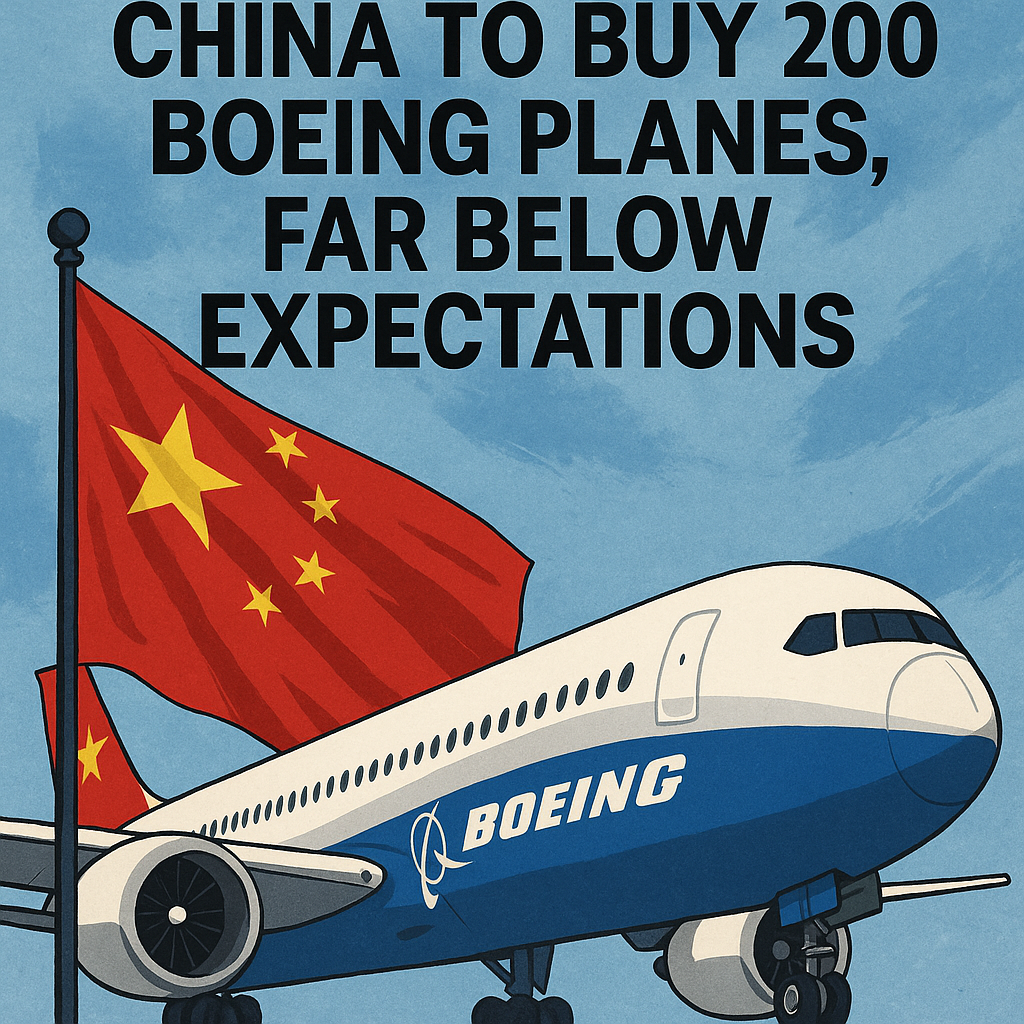
China to Buy 200 Boeing Planes, Far Below Expectations

China to Buy 200 Boeing Planes, Far Below Expectations
The recent announcement regarding China’s plan to purchase 200 Boeing planes has garnered significant attention, especially in the context of ongoing trade tensions and global aviation industry dynamics. While the news should ideally signify a buoyant shift for Boeing, it has been met with mixed sentiments and raised eyebrows as it falls short of industry expectations.

A Closer Look at the Agreement
The deal, announced by former President Donald Trump, was touted as a victory for Boeing, suggesting a much-anticipated return of confidence in the aviation sector after years of struggles. However, a closer inspection reveals that the figure of 200 aircraft is significantly less than analysts had anticipated. Many had predicted orders in the range of 300 to 500 planes, especially considering the resurgent demand for travel post-pandemic and China’s expanding air travel market.


Experts note that this quantity of aircraft, while a welcome boost for Boeing, does not reflect the robust recovery one might have hoped for. The aviation industry has faced tremendous turbulence due to the global pandemic, and demand is increasingly crucial. The 200-plane figure, while notable, may signal that recovery is still gradual, aligning with broader market uncertainties and ongoing geopolitical tensions.


Mixed Reactions from Industry Experts
The reactions from industry insiders have varied considerably. On one hand, some view this deal as an essential step forward. The highlighted order is expected to support thousands of jobs tied to Boeing’s manufacturing processes in the U.S. and is seen as a commitment to maintaining strong ties between the U.S. and Chinese aviation markets.
Conversely, others express skepticism about the deal’s implications. It should be noted that the deal’s scope has raised questions about China’s long-term commitment to purchasing from U.S. manufacturers amidst volatile relations with Western countries. Some analysts argue that Beijing’s order signals a cautious approach; the company is likely testing the waters rather than committing to larger, riskier orders while navigating current international relations.
The Future of U.S.-China Trade Relations
The geopolitical landscape surrounding U.S.-China trade relations continues to be complex. The aviation sector often reflects broader economic sentiments. One must consider past experiences when evaluating China’s aircraft buying patterns and the potential impact of ongoing tariffs and trade wars.
While the purchase of 200 Boeing planes indicates some level of cooperation, it also raises questions about the future trajectory of trade between the two nations. Events leading up to this announcement reveal a sector marked by strategic hesitations. If geopolitical tensions were to escalate further, they could potentially derail future orders and further hinder Boeing’s recovery efforts.
Moving Forward
For Boeing, the order for 200 planes is undeniably a positive sign—it provides a financial lifeline and bolsters the company’s position in the global market. However, the overarching sentiment remains one of cautious optimism. While the Chinese aviation market is important, the industry’s recovery is still precarious, influenced heavily by external factors.
As stakeholders continue to evaluate this landmark agreement, it becomes crucial to remain aware of the fluid dynamics at play in international relations. The aviation sector is both a barometer and a participant in the broader economic landscape. Monitoring future developments with China’s purchasing strategies could yield insights that inform not just the aviation market but also broader economic health, reflecting the intertwined fates of the world’s leading economies.
In conclusion, while the deal for 200 planes marks an optimistic note, it also opens the door to questions surrounding future business prospects amidst a backdrop of uncertainty. The complexity of U.S.-China relations will likely continue shaping the aviation industry, and only time will tell how these dynamics will evolve.















