
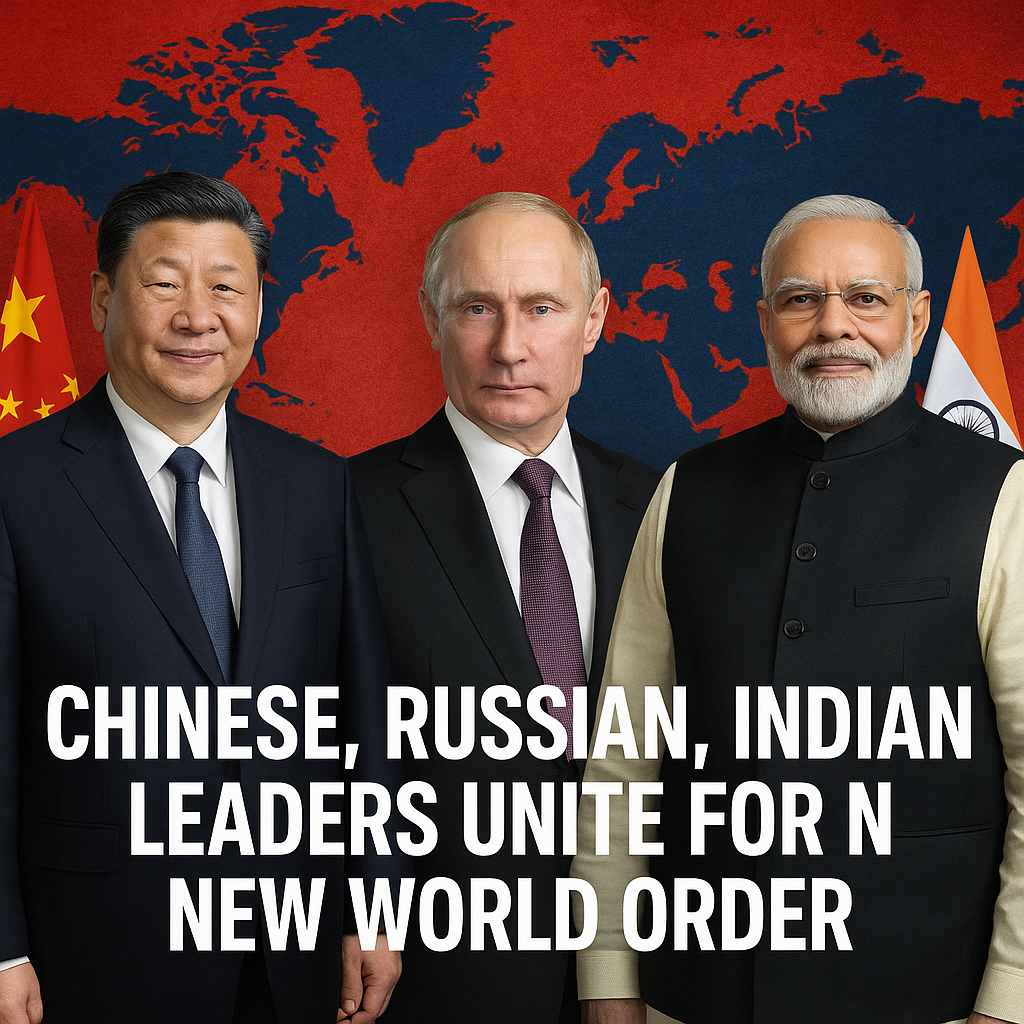
Chinese, Russian, Indian Leaders Unite for New World Order

Chinese, Russian, Indian Leaders Unite for New World Order
In an era marked by geopolitical tensions and shifting alliances, the recent meeting of Chinese, Russian, and Indian leaders in Beijing signifies a pivotal moment in the quest for a new world order. This trilateral engagement reflects not only a united front among these nations but also a broader challenge to the existing Western-centric global governance framework.

Emphasizing Unity and Cooperation
At the heart of the discussions was a pronounced emphasis on solidarity among the three nations, particularly as they navigate a rapidly changing international landscape. Chinese President Xi Jinping, Russian President Vladimir Putin, and Indian Prime Minister Narendra Modi collectively articulated their vision for a multipolar world—a departure from the unipolarity that has characterized international relations since the Cold War.


The leaders asserted their commitment to strengthening cooperation across various sectors, including trade, security, and technology. According to reports from Sky News, Xi underscored the need for enhanced partnerships, emphasizing that such unity would not only benefit their respective countries but also contribute to global stability. In this context, the term “new world order” implies a shift towards a system where power is more evenly distributed among nations, reducing the dominance of any single country.


Differing Perspectives on Global Governance
While the three leaders presented a harmonious front, the broader implications of their cooperation reveal a complex tapestry of international relations. For instance, Russian commentators have framed this alignment as a counterbalance to NATO and what they perceive as Western hegemony. Conversely, commentators from Al Jazeera noted that India maintains a more cautious approach toward its relationships with Russia and China, particularly in light of its own strategic interests which also align with the West.
This nuanced perspective is crucial: India, while engaging with both Russia and China, has not forsaken its ties with Western nations. The Indian government has been careful to advocate for a multipolar world while ensuring that its own national security interests remain intact. Analysts highlight that India’s economic and military considerations play a significant role in shaping its foreign policy, as evidenced by its recent hosting of a Quad summit with the U.S., Japan, and Australia.
Economic Implications of Collaboration
Economically, the alliance among China, Russia, and India presents both opportunities and risks. Trade among these nations is expected to be a focal point of their collaboration. As RT News reported, discussions included the potential for enhanced trade agreements, investments in infrastructure, and partnerships in technology sectors—a move that could generate significant economic synergy.
However, the volatility of emerging markets remains a concern. As these leaders promote greater economic ties, they must navigate issues such as fluctuating currencies and the challenges posed by Western sanctions on Russia. The varying economic stability of each nation adds another layer of complexity to this trilateral meeting.
Points of Contention
Despite the optimistic rhetoric, there are underlying points of contention that could strain this alliance. For instance, competition over influence in Central Asia and the Indo-Pacific region remains a significant concern. India is particularly wary of China’s assertiveness in its neighborhood, while Russia seeks to expand its foothold in South Asia. Thus, the unity displayed at the meeting may be more nuanced than it appears, as historical rivalries and regional dynamics can complicate collaborative efforts.
Moreover, some experts argue that while this summit was aimed at highlighting cooperation, the practical outcomes remain to be seen. The effectiveness of such partnerships often comes down to the ability to address bilateral grievances and regional disputes—issues that still loom large.
The Future of a Multipolar World
In light of these complexities, what does the future hold for this trilateral alliance? The joint declarations made in Beijing signal a readiness among these leaders to operate outside traditional Western frameworks. If successfully executed, this could lead to the establishment of alternative paradigms in international relations that prioritize collective decision-making and mutual benefit.
Nonetheless, the road ahead will likely be fraught with challenges. The balance of power, economic unpredictabilities, and the responses from Western nations will play critical roles in shaping this new alignment. The leaders’ meeting may have set the stage for profound changes in global governance, but as history tells us, the path to establishing a new world order is rarely straightforward or devoid of hurdles.
In conclusion, the gathering of Chinese, Russian, and Indian leaders marks a significant moment in contemporary geopolitics. While the ambitions for unity and a multipolar world are clear, the diverse interests and historical rivalries between these nations suggest a complex and evolving dynamic. As they navigate this new frontier, the effectiveness of their alliance will undoubtedly be put to the test in the coming months and years.















