
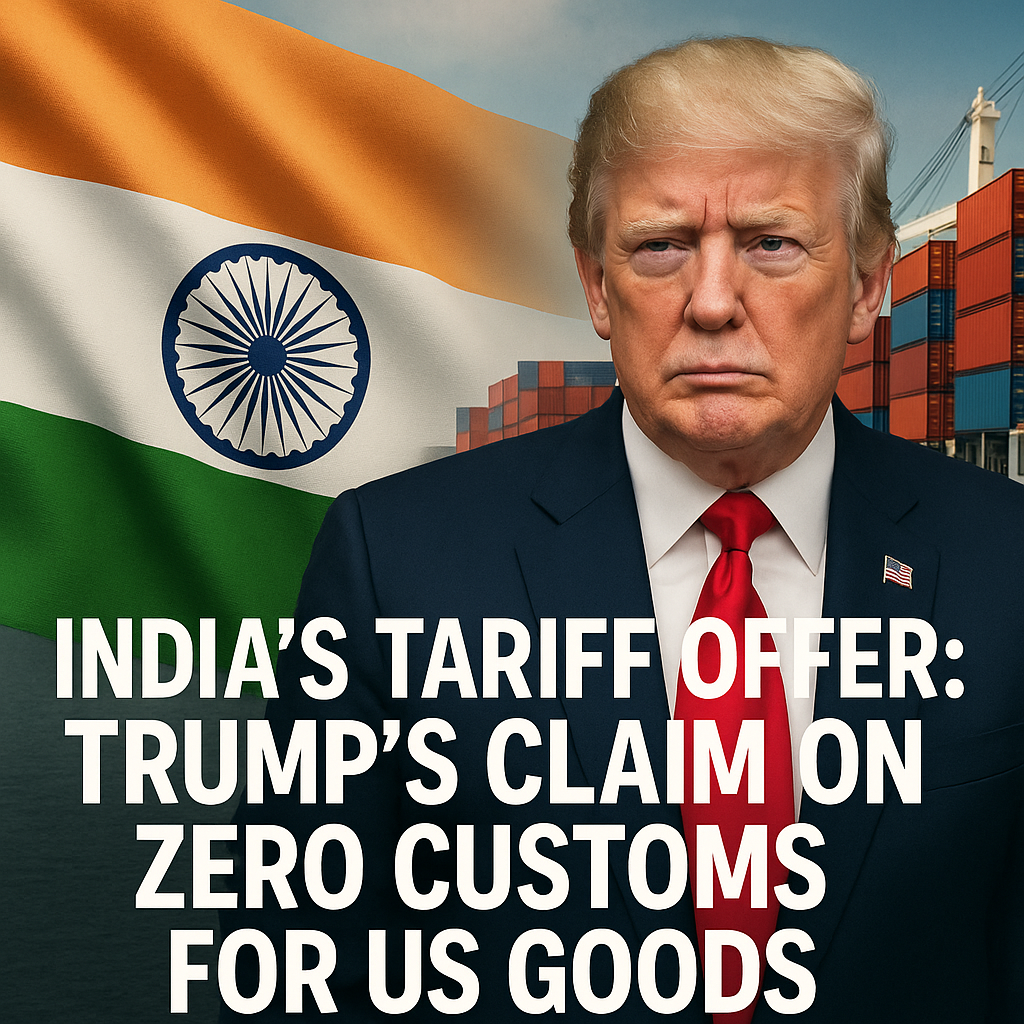
India’s Tariff Offer: Trump’s Claim on Zero Customs for US Goods

Understanding India’s Tariff Offer in the Context of Trump’s Claim of Zero Customs for US Goods
India’s tariff offer has sparked discussions, particularly influenced by former President Donald Trump’s assertion that the US-India trade relationship is “totally one-sided.” As these dialogues continue, they reveal a complex landscape of international trade, economic strategies, and diplomatic relations.

Unpacking Trump’s Claims
In a recent interview, Trump criticized the current tariffs imposed by India on US goods, suggesting that they hinder bilateral trade and economic cooperation. He remarked, “People don’t realize how much India taxes our goods,” implying that the high tariffs create an imbalance that disproportionately favors India’s market. Trump’s observations about the tariffs reflect broader concerns regarding trade relationships—with many commentators suggesting that tariffs can act as barriers preventing equal trade opportunities.


From a factual standpoint, according to Al Jazeera, India maintains various tariffs on US imports, which can reach up to 150% on certain items. These rates can certainly impact the competitiveness of US goods within the Indian market. This leads us to question the accuracy of Trump’s statements regarding a “zero customs” tariff. While Trump’s assertion may embellish the reality, it highlights a genuine concern about the fairness of trade practices.


The Complexity of Tariffs
The nature of tariffs is multifaceted. Tariffs serve not only as a means of generating revenue for governments but also as a tool for protecting domestic industries. In India’s case, high tariffs on specific products—such as automobiles and agricultural goods—are designed to stimulate local production while limiting foreign competition. Conversely, proponents of lower tariffs argue that free trade fosters economic growth and benefits consumers by providing more options and driving down prices.
In contrast to Trump’s views, economists and trade experts emphasize the necessity for balanced trade discussions that consider not just tariff rates but also broader economic impacts. Citing a range of studies, experts argue that reducing tariffs can lead to mutually beneficial outcomes for both nations. Simultaneously, there is recognition of the need for dialogue and negotiations to ensure any shift in tariffs is well-informed and strategically sound.
Multiple Perspectives on Trade Relations
Opinions diverge regarding the efficacy of Trump’s approach to US-India relations. Some analysts, such as those featured on RT News, believe that his confrontational stance may be counterproductive. They argue that trade negotiations require diplomacy and patience, rather than aggression. This sentiment resonates with the notion that enduring trade relationships are nurtured through cooperative dialogue rather than unilateral demands.
On the other hand, some advocates of stricter trade measures echo Trump’s concerns, arguing that proactive measures must be taken to level the playing field. They point to countries like China and India, which, they claim, often manipulate tariffs to their advantage, disadvantaging US businesses. This highlights the tension between protectionist sentiment and the ideals of free-market capitalism.
The Road Ahead: Balancing Interests
As discussions surrounding tariff policies persist, the future of US-India trade relations will hinge on multiple factors. Both nations are economically interlinked, with many American companies seeking to expand into the Indian market, particularly in sectors such as technology, pharmaceuticals, and renewable energy.
Policymakers will need to facilitate discussions that move beyond mere posturing. Addressing concerns around tariffs and customs should involve a comprehensive analysis focusing on the following:
– Sector-specific Tariffs: Understanding which industries are affected by current tariff structures can help tailor discussions that benefit specific sectors while still considering broader economic goals.
– Long-term Prosperity: Building a framework for sustainable economic growth will require both nations to recognize that trade is not merely about tariffs but about fostering environments for innovation and investment.
– Reciprocal Agreements: Engaging in talks to create reciprocal tariff structures may help alleviate some of the imbalances. This involves both sides negotiating terms that acknowledge the realities of each other’s economies.
In conclusion, while Trump’s claims regarding India’s customs policies underscore real tensions, the reality of international trade demands a nuanced approach. Evaluating this situation through a broader lens can lead to smarter, more effective negotiations and ultimately, stronger bilateral relationships. The future of US-India trade may very well depend on striking that delicate balance between competitive interests and cooperative efforts, making it essential to engage in dialogues that reflect thoughtful, informed perspectives rather than oversimplifications.















