
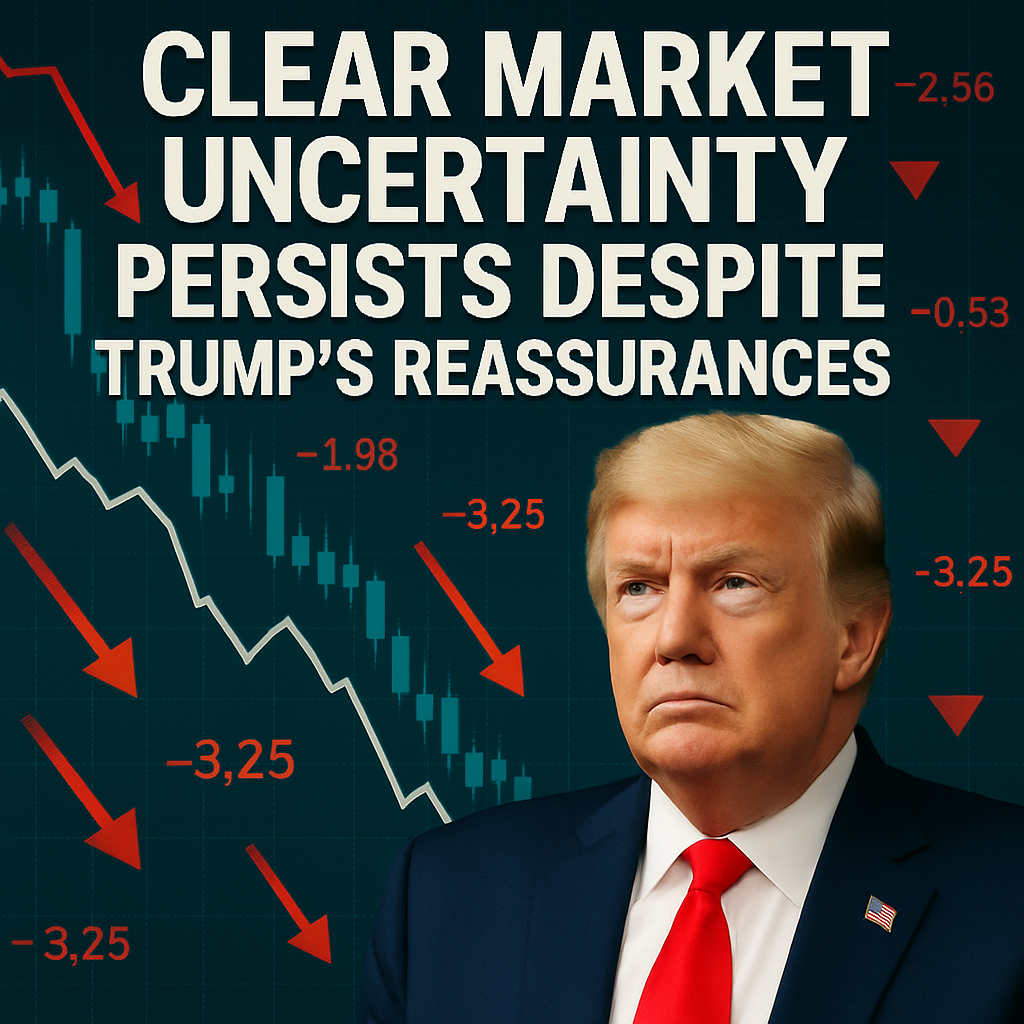
Clear Market Uncertainty Persists Despite Trump’s Reassurances

Clear Market Uncertainty Persists Despite Trump’s Reassurances
In the wake of former President Donald Trump’s recent statements aimed at soothing market concerns, significant uncertainty still looms over global financial markets. With a mix of optimism and skepticism surrounding his reassurances, investors continue to grapple with the implications of ongoing geopolitical tensions and economic anomalies.

Analyzing Trump’s Reassurances
In a recent public appearance, Trump sought to calm fears regarding market volatility, urging investors to look beyond immediate turmoil. According to reports from Sky News, his message centered on confidence and stability, emphasizing his past successes and promising that better days are ahead for the American economy. Trump’s narrative aims to stabilize sentiment, particularly among those specifically jittery about rising inflation and unstable supply chains exacerbated by the Ukraine crisis.


However, despite Trump’s assurances, skepticism persists among some analysts and investors. Al Jazeera reports that many financial experts remain unconvinced, citing persistent inflationary pressures and an uncertain trajectory for interest rates as critical indicators that contradict his optimistic viewpoint. This divergence illustrates the complexities of market sentiment, where emotional factors often collide with hard data.


Divergent Views from Financial Experts
While Trump’s assertions are intended to provide clarity and a sense of direction, market analysts present a more nuanced picture. Some experts argue that the financial climate remains precarious. They point to recent fluctuations in stock prices and commodities, which exhibit signs of volatility that Trump’s comments alone cannot assuage.
For instance, analysts from various financial institutions have highlighted that geopolitical tensions—such as the ongoing conflict in Ukraine and tensions with China—continue to exert downward pressure on markets. According to RT News, the uncertainty surrounding these global issues translates directly into investor behavior, with many opting for safer assets like gold, resulting in diverse market reactions.
This divide in perspectives illustrates a broader theme where personal beliefs about market recovery collide with fiscal realities. The absence of concrete policy changes or economic reforms that can reinforce Trump’s messages contributes to ongoing doubt among investors.
The Role of External Factors
Market dynamics are influenced by a wide array of external factors, many of which lay beyond any one person’s control. For example, the global economy is still navigating supply chain disruptions that began during the COVID-19 pandemic, with disruptions in labor and material availability hampering recovery efforts. As cited by Sky News, these fundamental challenges complicate any attempts to interpret Trump’s optimistic rhetoric in an actionable way.
Moreover, analysts are increasingly concerned about inflation expectations, which have been driven partly by stimulus measures and supply shortages. A growing number of economists argue that until these issues are resolved, confidence in financial markets cannot be restored. The sentiments echoed in various articles highlight a collective recognition that Trump’s reassurances serve more as a psychological balm rather than a panacea for real economic problems.
The Path Forward: Balance and Caution
Ultimately, while Trump’s words are intended to foster positive sentiment, market participants should approach the current environment with balanced caution. The complexity of market factors and external realities suggests that simple reassurances may not suffice to alter investor behavior or stabilize economic conditions.
For individuals and institutions watching the markets, it’s essential to remain vigilant about the underlying issues that create market instability. A multifaceted approach, considering economic indicators, geopolitical developments, and market psychology, will provide a more comprehensive understanding.
Moreover, analysts suggest diversifying investment strategies, focusing on fundamental strengths rather than rhetorical promises. This strategy aligns with the advice highlighted by various financial experts, emphasizing investment in resilient sectors or seeking out value in overlooked areas that may provide stability amid uncertainty.
In conclusion, while Trump’s efforts to reassure investors bring a semblance of optimism to the narrative, serious market challenges remain. The interplay of emotional investment and tangible economic realities underscores the complexities of the current financial landscape. Until palpable change occurs, both optimism and caution will remain pivotal in navigating through this unfamiliar terrain.















