
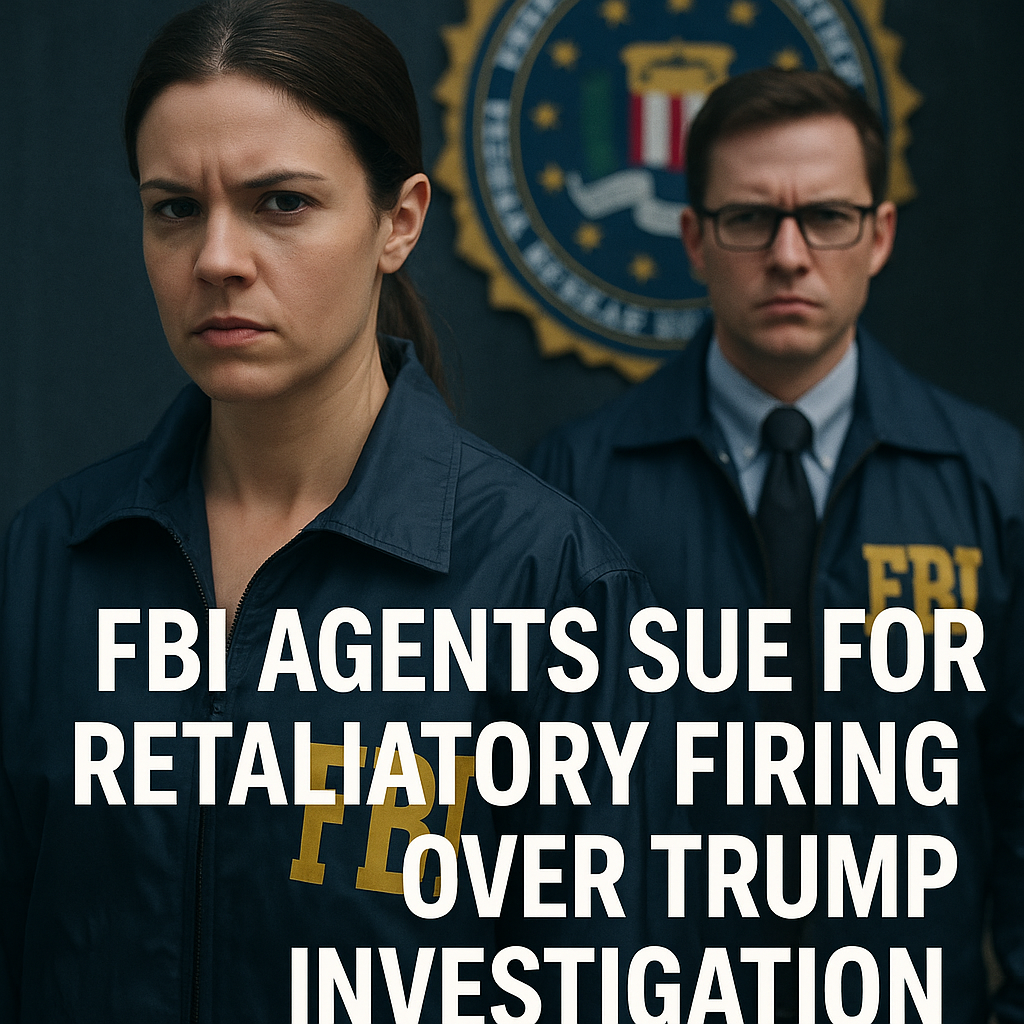
FBI Agents Sue for Retaliatory Firing Over Trump Investigation

FBI Agents Sue for Retaliatory Firing Over Trump Investigation
In a striking turn of events, FBI agents who were involved in the investigation into former President Donald Trump have filed a lawsuit alleging retaliatory firing. This legal action raises significant questions about workplace ethics, political influence within law enforcement, and the broader implications for government accountability.

Background of the Lawsuit
The lawsuit centers around claims made by several FBI agents who allege they were wrongfully terminated from their positions due to their involvement in the investigation of Trump and his associates. These agents argue that their firings were not based on performance issues or misconduct but rather as a direct consequence of their investigative work. According to the agents, their dismissal serves as a chilling reminder for those within federal agencies contemplating politically sensitive investigations.


Key Points from the Lawsuit:


– Allegations of Retaliation: The agents contend that their terminations were intended to silence critics of Trump and manipulate the public narrative surrounding the investigations.
– Political Climate: This incident occurs in a politically charged environment where questions about the integrity of investigations into high-profile political figures often arise.
– Possible Broader Implications: As cases of retaliation are typically difficult to prove, this lawsuit could set a precedent concerning the balance between political oversight and FBI independence.
Diverse Viewpoints
Reactions from experts and commentators reveal a spectrum of opinions on the ethical implications of the FBI’s actions and the lawsuit itself.
Support for the Agents: Advocates argue that the lawsuit underscores a troubling trend where political pressures undermine the integrity of federal investigations. Richard McGowan, a former DOJ official, opines that allowing public pressure to dictate personnel decisions within the FBI threatens the agency’s credibility as an impartial arbiter of justice.
Criticism of the Allegations: On the opposing side, some critics question the motives behind the lawsuit. They argue that such actions could be politically motivated and cast doubt on the objectivity of the agents involved. Political commentator Sarah Jenkins argues, “If these agents were performing their duties as investigators, their conduct must be scrutinized rigorously but fairly. It’s part of accountability in government service.”
The Broader Political Landscape
The ramifications of the lawsuit extend beyond individual cases of alleged misconduct. They touch on fundamental issues surrounding the intersection of law enforcement and politics. In an environment where political affiliations can heavily influence public opinion, the integrity of institutions such as the FBI becomes increasingly important.
– Impact on Agency Credibility: The Federal Bureau of Investigation must maintain its reputation for impartiality if it intends to uphold public trust. Any actions perceived as politically charged could further polarize an already divided public.
– Lessons from History: Historical precedents illustrate the complexities of political influence on law enforcement agencies. For instance, claims of bias or interference have surfaced in various investigations over the decades, leading to distrust between the public and the FBI.
Conclusion: The Path Ahead
As the lawsuit unfolds, it is crucial to approach the situation with a nuanced perspective. Both sides present compelling arguments, from concerns over political manipulation to potential missteps in the agency’s internal processes. The case ultimately invites scrutiny into how the FBI navigates the challenging waters of political accountability and its responsibility to conduct impartial investigations.
Moving forward, it will be vital for both the judiciary and the public to weigh the evidence critically and engage in a thoughtful dialogue about the implications of such high-stakes legal actions. Retaliation, if proven, could have seismic impacts on the workplace culture within federal law enforcement, prompting necessary reforms while reinforcing the imperative for investigative integrity regardless of political affiliations.















