
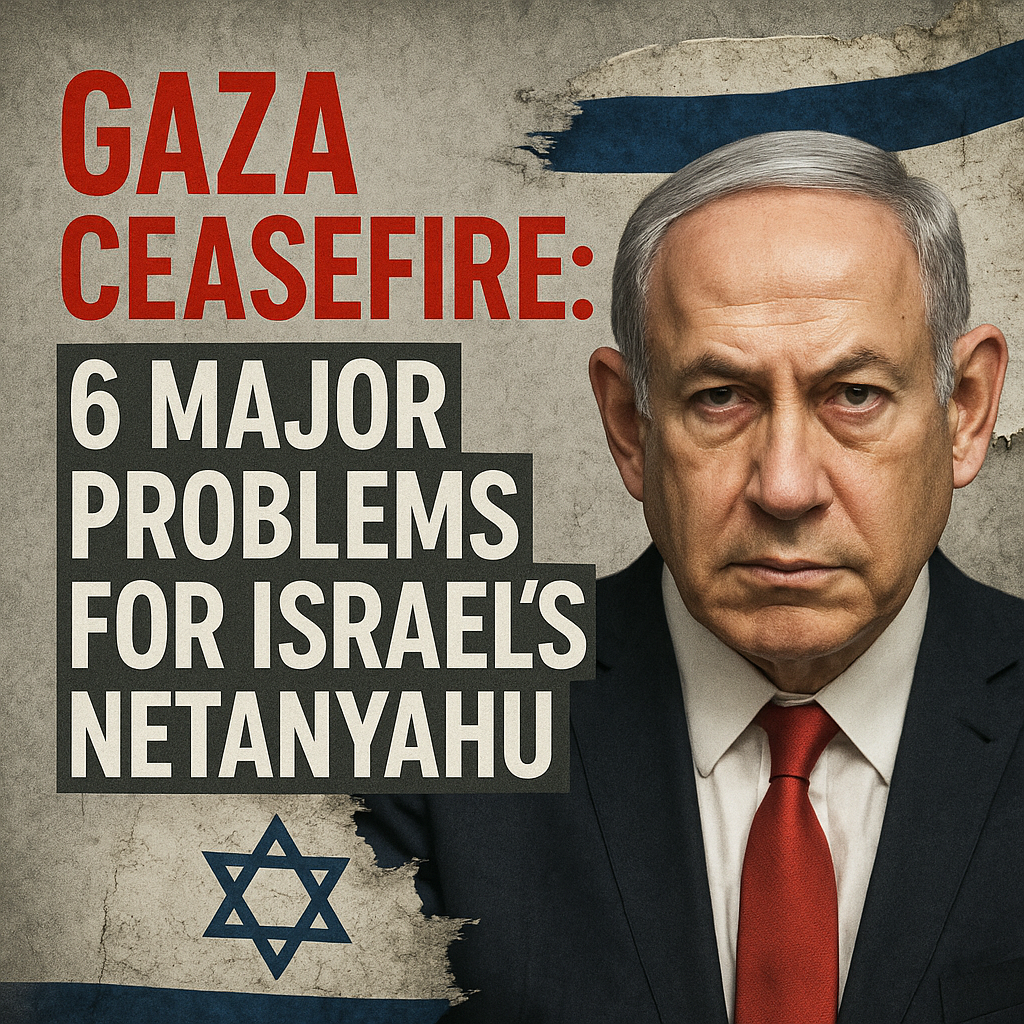
Gaza Ceasefire: 6 Major Problems for Israel’s Netanyahu

Gaza Ceasefire: 6 Major Problems for Israel’s Netanyahu
The recent Gaza ceasefire has created a tangled web of challenges for Israeli Prime Minister Benjamin Netanyahu. While the truce aims to reduce hostilities and usher in a period of relative calm, it also reveals significant complexities in both domestic and foreign policy arenas. Let’s delve into six major issues that Netanyahu faces as he navigates these turbulent waters.

Domestic Political Pressures
One of the primary challenges arising from the ceasefire is the political pressure within Netanyahu’s own coalition. As described in various reports, including a detailed analysis from Al Jazeera, the right-wing factions within his government view any concession to Hamas as a sign of weakness. This has led to increasing calls for a more aggressive military stance, raising concerns about a potential backlash from the far-right elements that support Netanyahu.


Fragmentation of the Political Landscape
Moreover, the fragile nature of Israel’s political landscape cannot be overlooked. Various opposition parties are capitalizing on the ceasefire to criticize Netanyahu’s leadership, pointing to what they perceive as an inability to achieve decisive victory over Hamas. For Netanyahu, whose coalition relies on a razor-thin majority, this criticism intensifies the stakes. If he fails to respond decisively to these domestic pressures, he risks alienating crucial support that keeps his administration afloat.


International Relations Complications
Another pressing issue arises in the realm of international relations. Netanyahu’s government has long adopted a hardline stance against both Hamas and similarly positioned groups. However, the ceasefire has prompted negotiations and diplomatic discussions that are crucial for Israel’s standing on the global stage. As reported by RT, Netanyahu faces criticism from allies who advocate for a more balanced approach to the Israel-Palestine conflict, suggesting that the ceasefire offers an opportunity for renewed peacemaking efforts.
The U.S. Factor
The relationship with the United States plays a pivotal role in this context. While U.S. support for Israel remains strong, calls from some American lawmakers for a reevaluation of this relationship complicate Netanyahu’s policy choices. Critics argue that a failure to fully embrace the ceasefire may damage Israel’s long-term strategic interests, particularly with an evolving geopolitical landscape that includes increased focus on human rights and humanitarian issues.
Societal Division and Public Sentiment
Public sentiment in Israel also presents a dilemma for Netanyahu. Many citizens feel war-weary, frustrated by prolonged violence and the associated toll on security and daily life. According to Sky News, recent polling indicates a growing divide among the populace regarding the effectiveness of military strategies versus diplomatic solutions. The call for a ceasefire is not just a political maneuver but also a reflection of grassroots demands for peace, making it increasingly difficult for Netanyahu to maintain a hardline approach without risking public backlash.
The Impact on Gaza’s Civilians
Moreover, the implications of a ceasefire extend beyond military tactics to humanitarian considerations. With widespread devastation in Gaza, there’s mounting pressure on the Israeli government to address humanitarian aid and reconstruction. Failure to facilitate adequate relief efforts could not only exacerbate tensions but also draw international condemnation, further complicating his administration’s position.
Conclusions and Dependencies
In summary, the Gaza ceasefire brings with it a series of formidable challenges for Netanyahu, each intertwined with his political future and Israel’s international standing. As he navigates these complex issues, the balancing act between maintaining a strong position against Hamas and responding to domestic and international pressures becomes increasingly precarious.
While the ceasefire may temporarily reduce hostilities, it also forces the hand of leadership to make difficult decisions in an environment where public sentiment, political alliances, and international expectations can shift rapidly. The consequences of these choices will resonate not just within Israel but across the broader Middle Eastern geopolitical landscape, leaving us to wonder how Netanyahu will maneuver through this complex maze of opportunities and challenges in the days to come.















