
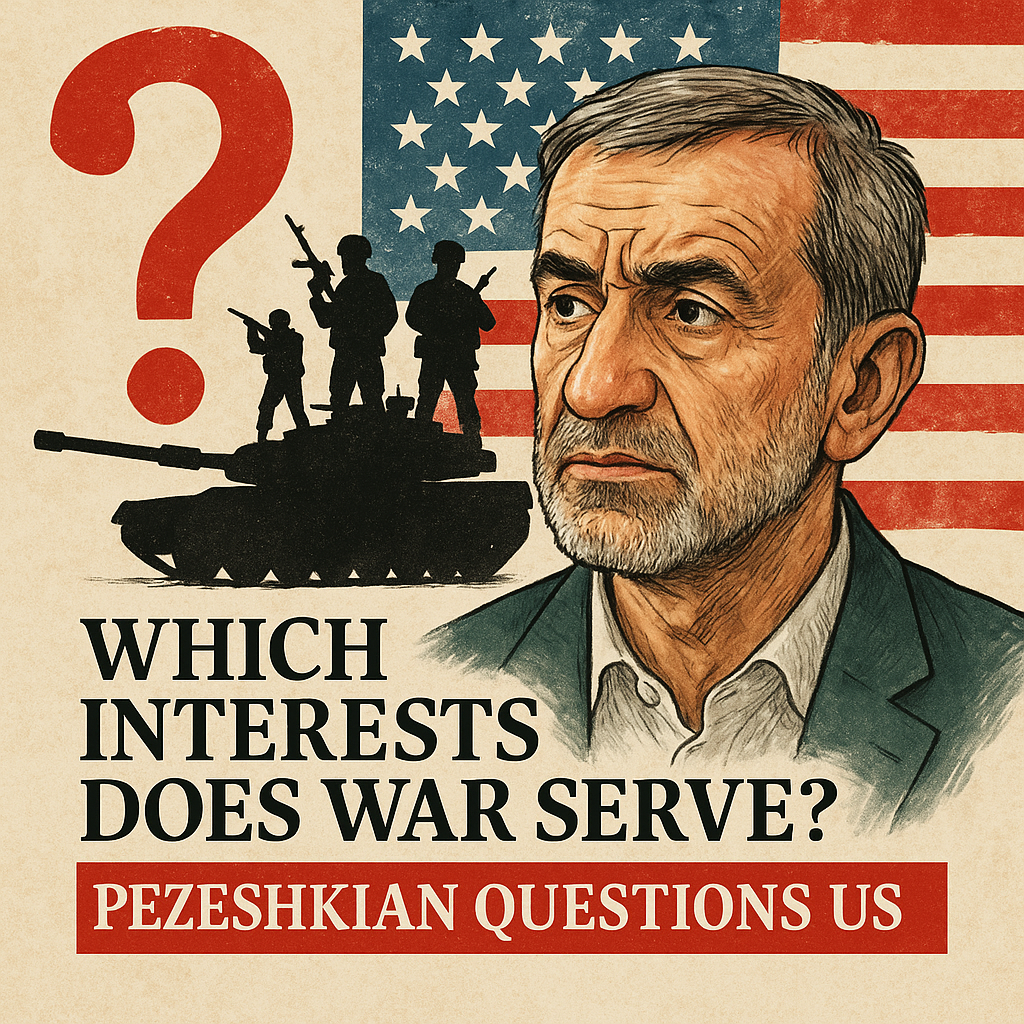
Which Interests Does War Serve? Pezeshkian Questions US

Which Interests Does War Serve? Pezeshkian Questions US
In a world often torn apart by conflict, the question of which interests wars serve looms large. Recently, Iranian politician Mohsen Pezeshkian posed this provocative question to the United States, signaling a critical moment for introspection regarding global conflicts and the motives that drive them.

The Political Landscape of War
Pezeshkian’s inquiry arrives amidst a complex tapestry of geopolitical tensions, emphasizing that wars are seldom fought for singular reasons. Various factors such as political ambitions, economic advantages, and strategic positioning intertwine to create a multitude of interests at play.


While analysts may debate the merits and ethical implications of military interventions, Pezeshkian’s assertion invites a deeper examination. Wars have historically served several interests, including:


– National Security: Nations often employ military action as a means to protect their sovereignty. The U.S. has justified numerous interventions under the banner of preventing terrorism or stabilizing regions, as seen in ongoing operations in the Middle East.
– Economic Gain: The pursuit of resources can also be a driving force behind conflict. Oil-rich regions have seen their fair share of turmoil, prompting questions about whether economic interests mask the rhetoric of national security.
– Geopolitical Influence: Nations may engage in warfare to assert dominance within a region, shaping the balance of power. The competition between the U.S., China, and Russia is a contemporary illustration of this maneuvering.
However, while these interests may align with national policies, the human cost of war frequently complicates the narrative. Critics argue that the consequences—loss of life, displacement, and long-term instability—often outweigh the purported benefits.
Diverging Perspectives on Motives
The perspectives surrounding Pezeshkian’s question are varied and reflect broader global sentiments. For instance, a recent Al Jazeera article highlighted how the U.S. military presence in various regions is often perceived as an act of aggression rather than defense. Local populations may view foreign intervention as an unwanted intrusion, incentivizing resistance and extending cycles of conflict.
Conversely, proponents of military intervention, including some U.S. policymakers, assert that such actions are necessary to combat threats. They argue that the U.S. plays a stabilizing role in volatile regions, although this stance is far from universally accepted. Critics vehemently argue that such interventions are more about American hegemony than genuine concern for global peace.
The Human Cost
Amid the games of power and interests, the human toll of war cannot be overlooked. The victims of conflict—civilians who lose their lives, families displaced, and children left without futures—often transcend political ideologies. An article by Sky News reported that the consequences of war devastate not only the regions where conflicts occur but also have ripple effects that reach globally, from migration crises to economic downturns.
The debate over whether wars serve national interests can sometimes overshadow the fundamental question of morality. As societies evolve and global interconnectedness intensifies, the ethical implications of military interventions become increasingly pertinent. How do governments justify their actions in the face of overwhelming evidence of human suffering?
Navigating the Future
The dialogue surrounding Pezeshkian’s question is more essential than ever. As international relations shift and new powers emerge, understanding the complexities behind warfare remains crucial for future policymaking. There is a necessity for global leaders to weigh the interests they serve and consider the multifaceted repercussions of war.
While Pezeshkian’s inquiry may not yield a definitive answer, it encourages a collective reflection on the consequences of military actions. Constructive dialogue could pave the way for more peaceful solutions, promoting diplomacy over warfare.
Notably, there is no singular conclusion that can be drawn from the discussion. The interests served by warfare are as varied as the conflicts themselves, and the perspectives surrounding them are equally complex. Furthermore, the lack of consensus among global leaders regarding the merits and ethics of military interventions adds another layer of uncertainty.
In a world marked by trepidation and division, understanding the multifaceted interests that drive conflicts will be pivotal. As Pezeshkian has highlighted, we must challenge existing narratives and probe deeper into the motivations behind war, urging ourselves to seek pathways to peace that transcend mere national interests.















