
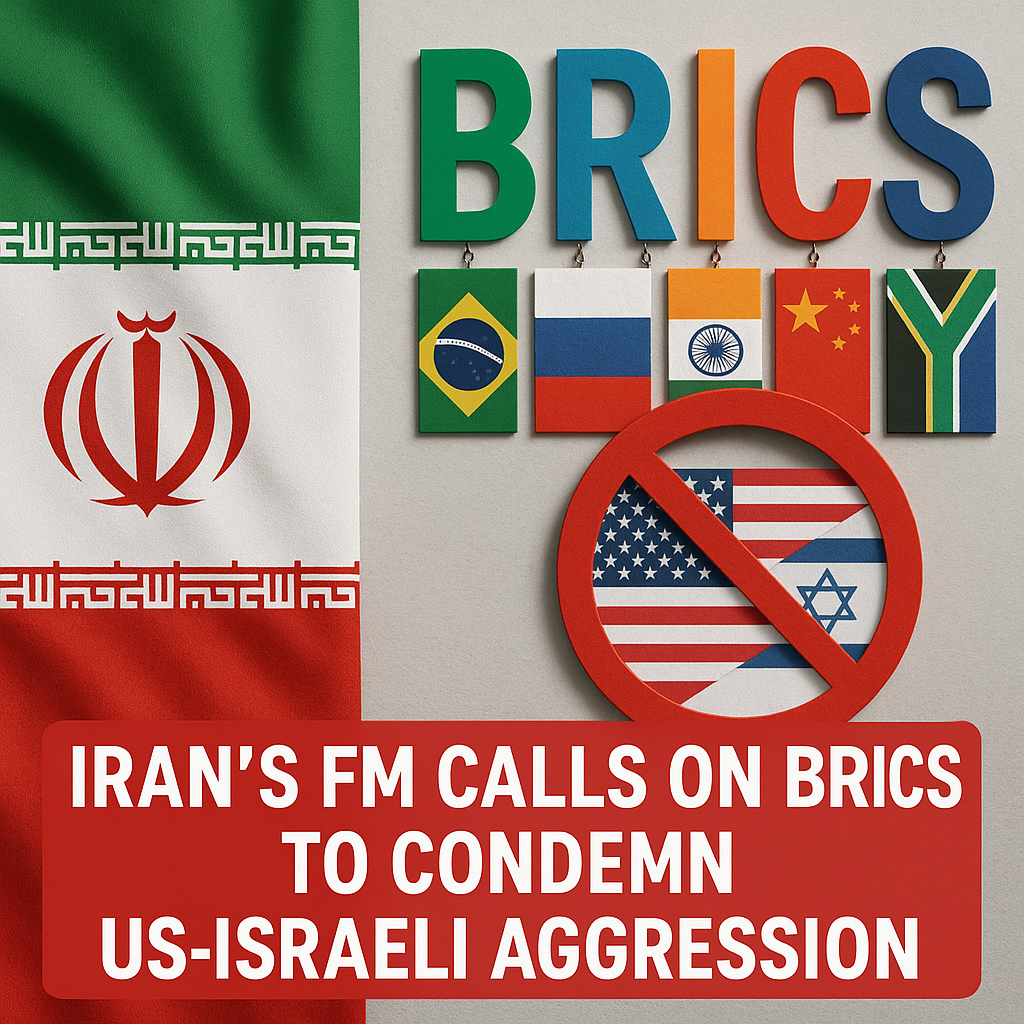
Iran’s FM Calls on BRICS to Condemn US-Israeli Aggression

Iran’s Foreign Minister’s Call for Global Solidarity

Iran’s Foreign Minister has recently called for BRICS nations—Brazil, Russia, India, China, and South Africa—to take a united stance against U.S.-Israeli aggression in the Middle East. This call highlights the growing tensions surrounding military and political maneuvering in the region, with Iran positioning itself as a vocal opponent of what it perceives as Western imperialism.


A Rising Tension in Middle Eastern Politics
The conflict in the Middle East has undergone a significant transformation in recent years, marked by shifting alliances and geopolitical strategies. Iran’s leadership perceives U.S.-Israeli actions, particularly in Palestine and against Iranian interests, as part of a broader strategy of destabilization. The urgency in Iran’s call to BRICS members showcases an acknowledgment of the importance of collective resistance in the face of what it labels aggressive policies of superpowers.


Despite the differences among BRICS nations—some of which maintain varying degrees of relations with the U.S.—Iran is appealing to a sense of solidarity. The Foreign Minister’s statement emphasizes the potential for BRICS to champion fairness and justice on the global stage, positioning the alliance as a counterweight to Western influence.
Diverse Reactions from the International Community
The global reaction to Iran’s plea has been mixed. On one side, supporters of Iran’s stance, particularly among non-Western nations, may view it as a legitimate critique of U.S. hegemony in the Middle East. Comparatively, others, especially nations aligned with Western interests, argue that Iran’s accusations serve to obscure its own aggressive actions and human rights violations, particularly regarding its internal policies and actions in conflict zones like Syria.
BRICS nations themselves have varied perspectives on the issue, reflecting their unique geopolitical realities. For instance, while Russia and China generally support Iran’s position regarding U.S. interventionism, countries like India may navigate a more cautious middle path, balancing their strategic ties with the U.S. alongside their participation in BRICS.
Furthermore, some analysts argue that Iran’s call also serves as a strategy to enhance its diplomatic footprint amid international isolation. By drawing major global players into a discussion on U.S.-Israeli aggression, Iran may seek to bolster its position in negotiations regarding its nuclear program and regional ambitions.
The Importance of Multilateralism in Addressing Global Issues
In an era marked by multipolarity, the importance of multilateral frameworks cannot be overstated. The world is witnessing a gradual shift away from unipolar leadership dominated by the U.S., leading to debates about the best way to handle conflicts and aggression. As Iran pushes for BRICS to take a stand, the implications of such a move extend beyond mere condemnation; they invite discussions on alternative pathways towards peace, conflict resolution, and cooperation.
Facing an increasingly complex geopolitical landscape, countries in BRICS are tasked with navigating their distinct interests while considering the influence of collective action. The call to condemn U.S.-Israeli aggression could serve as a catalyst for a deeper examination of international law and human rights in the context of state sovereignty.
The Road Ahead: Uncertainties and Complexities
While Iran’s appeal for BRICS nations to take action against U.S.-Israeli policies raises important points about global power dynamics, it also highlights the intricate web of international relations that complicate concrete outcomes. With countries within BRICS holding diverse interests and varying degrees of engagement with the U.S. and Israel, reaching a consensus on such a polarizing issue remains uncertain.
Moreover, the conversation surrounding this topic must account for the multifaceted nature of international politics. Efforts to condemn aggression should also consider the principles of engaging in productive dialogue and promoting conflict resolution. Iran’s diplomatic challenge lies in fostering cooperation without excluding those nations that may hold differing viewpoints on its regional activities.
In conclusion, the call from Iran’s Foreign Minister to BRICS represents not just a plea for solidarity against perceived aggression but also reflects the deeper complexities of global politics. As nations continue to grapple with their relationships and responses to international conflicts, the urgency for equitable and effective multilateralism becomes increasingly critical in establishing a more peaceful and balanced international order.















