
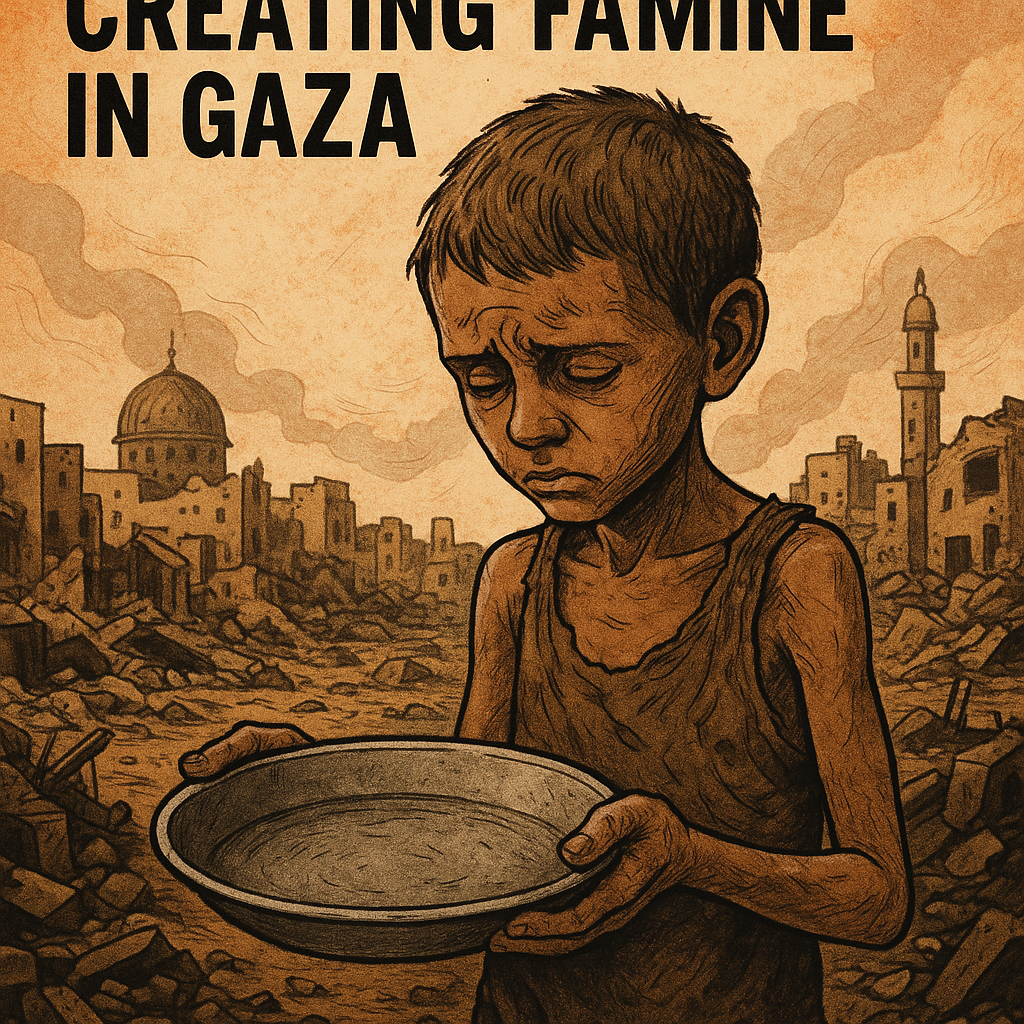
Israel’s Starvation Strategy: Creating Famine in Gaza

Israel’s Starvation Strategy: Creating Famine in Gaza
In the ongoing conflict between Israel and Hamas, the humanitarian crisis in Gaza has sparked intense debate regarding the implications of a so-called starvation strategy. The situation poses complex ethical questions, not only about warfare but also about the impact on the civilian populations involved.

The Humanitarian Crisis
The humanitarian conditions in Gaza have deteriorated significantly over the years, exacerbated by military blockades and restrictions on resources. Reports indicate that food scarcity is reaching critical levels, with many sources attributing this to deliberate strategies employed by Israel. According to Al Jazeera, the restrictions on fuel, electricity, and essential supplies have resulted in widespread malnutrition and severe health issues among the civilian population.


Perspectives on the Starvation Strategy
The framing of Israel’s actions as a “starvation strategy” is contentious. Proponents argue that the crippling of resources is designed to weaken Hamas by targeting the group’s support base among the Palestinian populace. They contend that such measures aim to reduce Hamas’s capabilities for future conflicts. This perspective is not unique to one news outlet; multiple reports indicate that Israel sees its blockade as a necessary security measure.


Conversely, critics of this approach emphasize the ethical implications of punishing an entire population for the actions of a militant organization. Sky News highlights that such strategies may violate international humanitarian laws that protect civilians during armed conflict. The human toll of these policies cannot be overlooked; countless families face extreme hunger and related health crises, as the crux of the debate pivots around the morality of collective punishment.
Economic Dimensions and Resource Availability
To grasp the full scope of the famine in Gaza, it’s essential to consider the economic factors at play. The closure of borders, coupled with limited access to agricultural inputs, has significantly impacted local food production. According to reports from RT, farmers in Gaza struggle to maintain their yield under the weight of restrictions, pointing to a cycle that deepens dependency on external aid.
While some argue that humanitarian aid offers a temporary solution, it often fails to address the root causes of the crisis. Researchers note that sustainable agricultural practices and resource management could alleviate some of the immediate pressures faced by Gaza’s population. However, under current conditions, Israeli restrictions complicate any efforts toward economic self-sufficiency.
International Responses
The international community’s responses to the crisis have varied significantly. Human rights organizations have called for accountability and urged Israel to reconsider its policies regarding resource control. Yet, reactions are not uniform; some governments express support for Israel’s right to defend itself, advocating for balanced security measures.
This dichotomy poses challenges for global opinion. On one side, advocates for Palestinian rights argue that humanitarian intervention is urgently needed; on the other, pro-Israel voices maintain that security concerns legitimate the blockade. This situation creates a complex landscape where policy decisions are influenced by divergent narratives.
Seeking Resolution and Future Implications
As discussions unfold, one question remains paramount: How can a balanced approach be reached that addresses both security concerns and humanitarian needs? Achieving peace will require an acknowledgment of the suffering endured by civilians, irrespective of their political affiliations.
The current crisis in Gaza stands as a poignant reminder of the human cost of conflict. While Israeli strategies may be designed with military objectives in mind, the resulting humanitarian fallout cannot be ignored. Addressing this issue with sensitivity and seriousness is paramount for those seeking a resolution to the ongoing conflict.
Though the future scenarios appear uncertain, there exists a shared responsibility—both regionally and internationally—to facilitate dialogue that prioritizes human life over political gain. Compromise may not come easy, but it is essential if both sides aim to alleviate the suffering and restore hope for a peaceful future.
In conclusion, the situation in Gaza, often framed by accusations of a starvation strategy, requires careful examination. By weighing the perspectives of both sides, it becomes clear that a comprehensive approach must integrate security and humanitarian considerations to forge a path toward lasting peace.















