
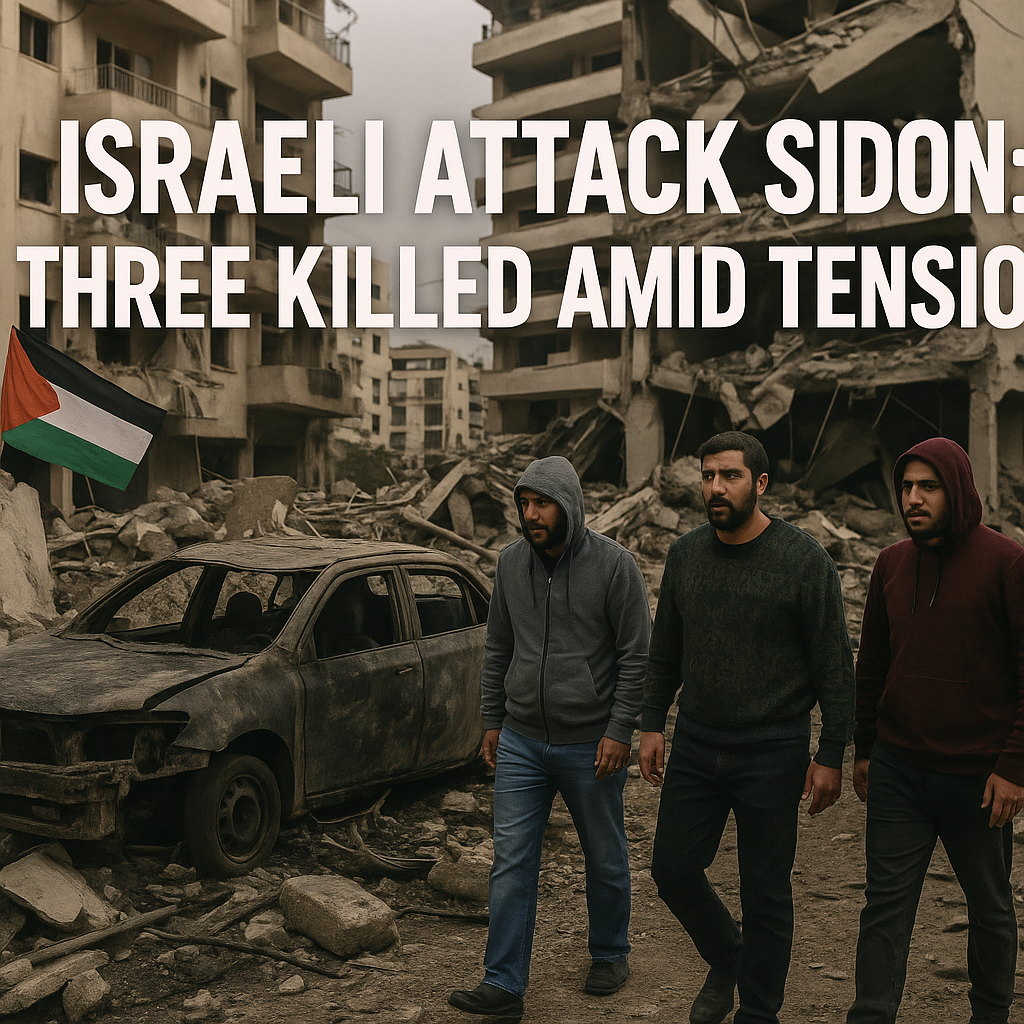
Israeli Attack in Sidon: Three Killed Amid Tensions

Israeli Attack in Sidon: Three Killed Amid Tensions
The recent Israeli airstrike in Sidon, Lebanon, which resulted in the deaths of three individuals, has exacerbated already heightened tensions in the region. This incident reflects a complex interplay of military actions, political implications, and humanitarian concerns that warrant a deeper examination.

Escalating Military Engagements
The Israeli strike targeted what military sources claimed was a Hezbollah position, a designation that has drawn significant scrutiny. According to reports from Al Jazeera, Israel conducted the attack in response to ongoing rocket fire from Lebanon, an assertion echoed by various military analysts. However, news outlets like RT have expressed skepticism regarding the claims of immediate threats posed by Hezbollah, suggesting that the Israeli government may be using military action as a pretext to assert dominance and distract from domestic issues.


While Israel maintains that such strikes are necessary to preempt threats against its territory, the toll on civilians raises urgent ethical questions. The three victims were described as non-combatants, once again bringing attention to the dangers of collateral damage in military operations. The situation in Sidon has escalated discussions on international law and the principles of proportionality and necessity in armed conflict.


Regional Reactions and Diplomatic Fallout
The aftermath of the Sidon attack has sparked responses from various regional actors. Analysts note that Lebanese officials have condemned the attack as a violation of sovereignty, labeling it as provocative and irresponsible. In contrast, some security analysts argue that Hezbollah’s activities merit a strong military response from Israel.
On the broader geopolitical stage, the incident complicates the already fraught relations between Israel and Lebanon. It comes at a time when peace talks remain stagnant, and fears of escalating violence are palpable. Many observers are concerned that such military actions could ignite further conflicts, especially with the ongoing uncertainty surrounding Iran’s influence in the region and its alliance with Hezbollah.
Humanitarian Concerns and International Responses
As the international community observes these developments, humanitarian concerns are mounting. The United Nations has called for an urgent investigation into the attack, emphasizing the need for accountability and protection of civilian lives. Human rights organizations have urged both sides to avoid civilian-targeted violence and adhere to international humanitarian law.
Quotes from various reports highlight these concerns: Al Jazeera quoted a spokesperson from a human rights organization stating, “Every civilian casualty in armed conflict raises questions about accountability and the rule of law.” The voices of those directly affected by these attacks often go unheard amid the political rhetoric. Local residents of Sidon have expressed their fears of instability, noting that such attacks only perpetuate a cycle of violence that harms ordinary people.
The Complexity of Peace
The attack in Sidon is indicative of a larger pattern of violence that complicates peace efforts in the Middle East. As Israeli forces continue to engage in tactical strikes aimed at perceived threats, Lebanon’s Hezbollah remains entrenched in its position against Israeli aggression. The cycle of retaliatory strikes and political posturing leaves little room for dialogue.
Furthermore, there are broader implications regarding international diplomatic relations. As states weigh in on these developments, the potential for a united front to advocate for peace appears dim. The divisions within the international community further complicate efforts for lasting peace in the region.
Conclusion: A Path Forward
While the attack in Sidon resulted in immediate tragedy, it serves as a microcosm of a more extensive, deeply rooted conflict. Recognizing the multi-faceted nature of this situation is crucial in order to understand its implications for both immediate and long-term peace and stability.
As the world watches, it becomes increasingly evident that mere military solutions rarely lead to sustained peace. Rather, dialogue, respect for sovereignty, and an earnest commitment to humanitarian principles must guide actions in order to break the cycle of violence that plagues the region. Looking ahead, the challenge lies in fostering conditions for peaceful resolution rather than responding in kind to aggression, as the latter only serves to escalate tensions further.















