
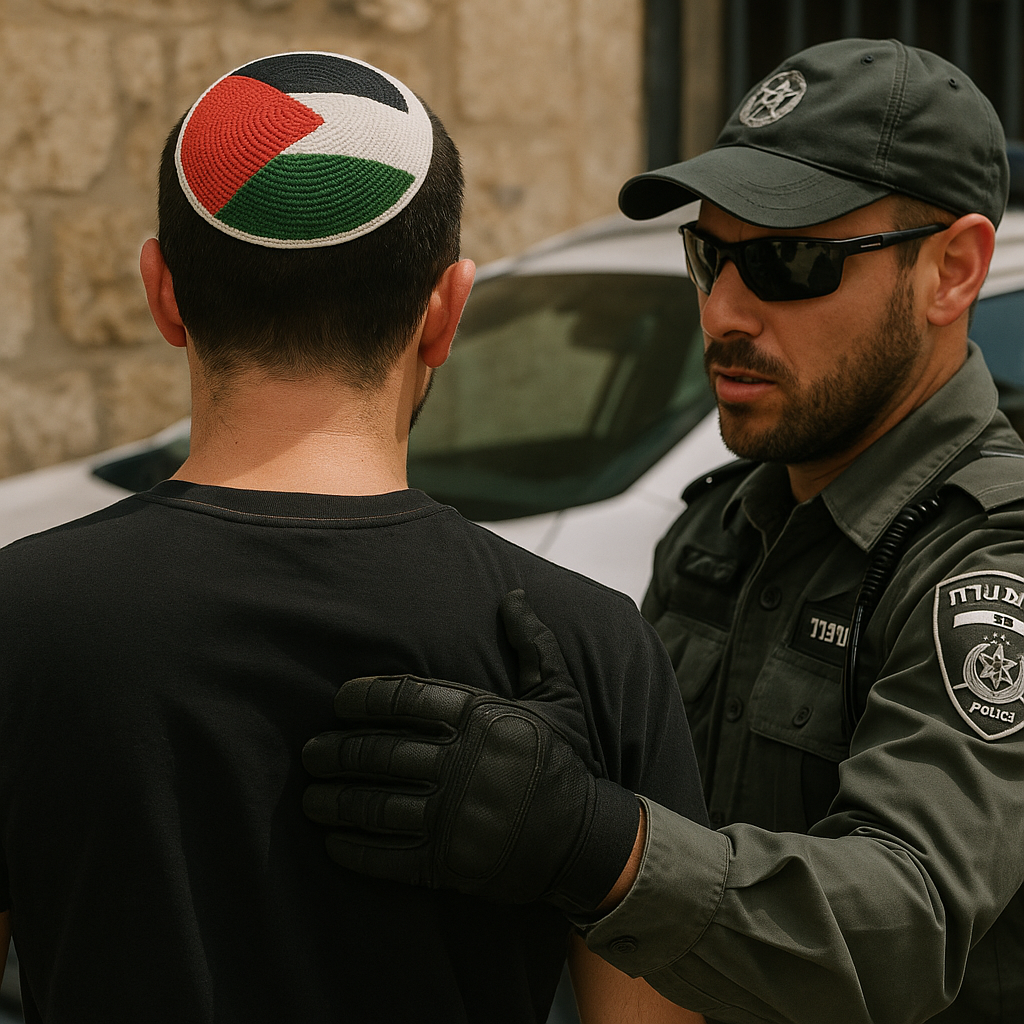
Israeli Man Arrested for Kippah with Palestinian Flag

Israeli Man Arrested for Kippah with Palestinian Flag: A Complex Reaction in Divided Society
In a notable incident highlighting tensions surrounding the Israeli-Palestinian conflict, an Israeli man was arrested for wearing a kippah adorned with the Palestinian flag. This situation opens a dialogue about freedom of expression, national identity, and the broader societal implications of such an arrest, reflecting deep-rooted tensions interwoven into the fabric of everyday life in Israel.

The Incident and Its Implications
The arrest stems from the controversial nature of symbols in a society already polarized over the Israeli-Palestinian conflict. This specific case revolves around a man who, during a Jewish ceremony, wore a kippah (a traditional Jewish head covering) that featured the Palestinian flag. This act was interpreted by some as a provocative statement against the backdrop of ongoing violence and disagreements related to national identity.


According to reports, local authorities apprehended the man under suspicion of incitement, arguing that the display of the Palestinian flag during a religious context could incite public disorder. Critics of the arrest argue that this is an infringement on free expression and raises questions about what constitutes acceptable forms of political commentary in public spaces.


Diverse Perspectives on Freedom of Expression
The spectrum of opinions surrounding this incident highlights the divide among Israeli society. Some citizens advocate for the right to express dissenting views, believing that such actions are vital for a thriving democracy. These supporters claim that wearing the flag can symbolize solidarity with Palestinian aspirations, framing it as an individual’s right to express support for human rights, irrespective of nationality.
Conversely, others contend that the kippah’s symbolism complicates the situation, arguing that it should exclusively represent Jewish identity. They assert that intertwining such sacred symbols with political motifs can only worsen societal divides. This viewpoint emphasizes the idea that symbols carry significant weight, and their misuse can provoke violence or unrest.
Broader Social Commentary
The reaction to the arrest extends beyond individual opinions, serving as a reflection of the broader societal constraints within Israel. Public sentiment appears to be sharply divided; some citizens argue the act painted the man as a traitor, while others championed him as a “truth-teller” advocating for peace and justice. The polarized environment underscores the complexities tied to identity politics.
Moreover, this incident feeds into a larger narrative about how expressions of dissent are treated in Israel. While the nation prides itself on being a democracy, critics argue that actions labeled as “incitement” can sometimes stifle free speech, creating a chilling effect on political activism and discourse. Conversations around the incident have reignited debates about what it means to be both Israeli and supportive of Palestinian rights—in essence, questioning whether these identities can coexist.
The Role of Symbols in Conflict
The use of symbols, like the Palestinian flag, plays a crucial role in the ongoing conflict. They are not merely fabric but compact representations of historical battles, aspirations, and grievances. Both the Israeli and Palestinian flags symbolize diverging narratives—the one teaches a history of survival, resilience, and nation-building, while the other embodies a struggle for self-determination and recognition.
Thus, the intricacies of this situation reveal how a single act can resonate throughout a community, igniting conversations on nationalism, identity, and the right to dissent. The responses range from calls for unity to demands for reforms in the treatment of political expression.
Conclusion: A Call for Reflection
The arrest of the Israeli man for wearing a kippah with the Palestinian flag embodies broader social tensions that continue to define Israel’s landscape. While the act was seen by some as a violation of societal norms, others perceived it as a vital expression of democracy that calls for necessary conversations about identity, national allegiance, and human rights.
As citizens of a fractured society continue to grapple with these themes, it becomes vital to approach such incidents with a lens of understanding. Recognizing diverse perspectives while fostering a dialogue around freedom of speech and the meanings of symbols in conflict may provide pathways toward coexistence. Ultimately, the journey toward resolving these complex issues requires not just tolerance but a commitment to mutual understanding.















