
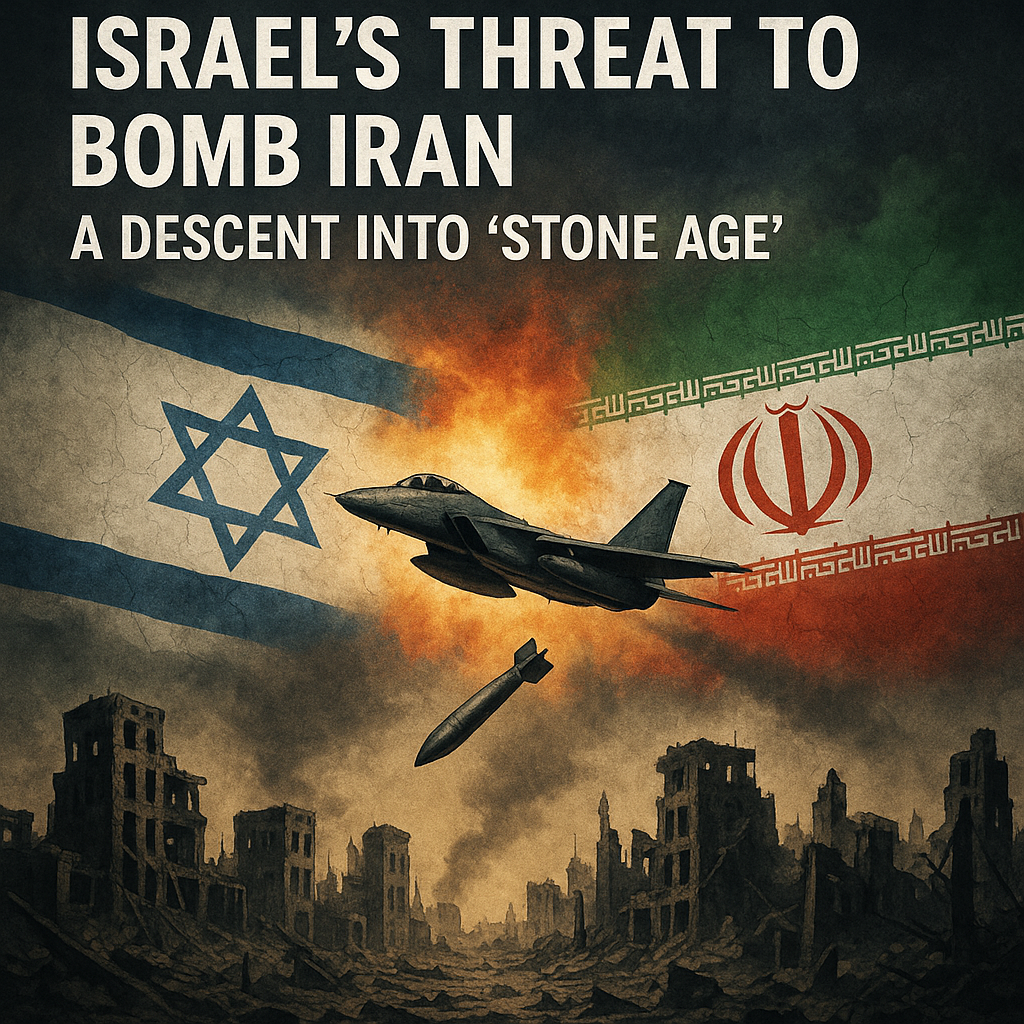
Israel’s Threat to Bomb Iran: A Descent into ‘Stone Age’

Israel’s Threat to Bomb Iran: A Descent into ‘Stone Age’
Tensions in the Middle East have escalated recently, with Israel’s provocative threats to bomb Iran, a scenario that many analysts argue would lead the region into a catastrophic situation. The rhetoric surrounding this threat, highlighted by Israeli officials describing the potential impact on Iran’s infrastructure as a descent into the “Stone Age,” underscores the gravity and complexity of the ongoing geopolitical confrontation between the two nations.

The Context of Escalating Threats
Israel’s repeated declarations regarding Iran’s nuclear ambitions are not new. The Israeli government has long perceived Iran as an existential threat, primarily due to its pursuit of nuclear capabilities and its support for groups like Hezbollah. According to a recent report by RT, Israeli officials have indicated that they are prepared to take military action if they believe that Iran is close to developing nuclear weapons.


In contrast, Iran has consistently denied these allegations, asserting that its nuclear program is intended for peaceful purposes like energy production and medical research. In an article from Al Jazeera, analysts pointed out that such tensions have resulted in a cycle of escalations, raising fears of a broader conflict that could involve regional and global powers.


Diverging Viewpoints on the Military Threat
The rhetoric comes amid a backdrop of complex diplomatic maneuvering. While the Israeli government insists on the necessity of a preemptive strike to protect its citizens, critics argue that such action could reignite violence across the region. In a piece from Sky News, experts noted that an Israeli airstrike could not only devastate Iran’s facilities but also have severe repercussions for the entire Middle Eastern landscape, potentially destabilizing neighboring countries and inciting a humanitarian crisis.
Opponents of military intervention argue that diplomatic options are still available and that engaging Iran through negotiation could lead to a more stable outcome. They cite previous situations where dialogue has successfully de-escalated tensions, notably during the negotiations that led to the 2015 Iran nuclear deal, known as the Joint Comprehensive Plan of Action (JCPOA). Al Jazeera highlighted that a return to diplomatic frameworks, rather than military threats, might be the key to ensuring long-term security in the region.
The Risks of Military Action
The potential for military action raises an important question: what would a bombing campaign truly achieve? Israeli officials posit that striking key nuclear facilities could temporarily delay Iran’s nuclear ambitions. However, experts warn that military strikes could also lead to unintended consequences, such as a full-scale war or a surge in terrorism aimed at Israeli interests globally.
Analysts agree that Iran has strategically dispersed its nuclear facilities, making them more challenging to destroy in a single military campaign. A report from RT highlighted that Israel’s threats could also motivate Iran to accelerate its nuclear program as a means of deterrence.
Conclusion: A Call for Diplomatic Solutions
The narratives presented by multiple sources underscore a deep-rooted conflict characterized by mutual distrust and escalating threats. While Israel views military action as a necessary tool for its national security, the broader consensus among analysts leans toward the need for diplomatic engagement.
Both the Israeli and Iranian governments have significant stakes in the outcome of this standoff, not just for their respective national interests, but for the stability of the entire region. As discussions surrounding military action intensify, the potential repercussions on civilian lives and geopolitical stability serve as urgent calls for diplomatic engagement.
In conclusion, while the allure of military intervention may seem immediate and tantalizing to those fearing an Iranian nuclear threat, the complexities of the situation demand a careful reevaluation of all available pathways—especially diplomatic ones. The path forward must be guided not by threats of descending into a “Stone Age,” but by a commitment to dialogue and peace.















