
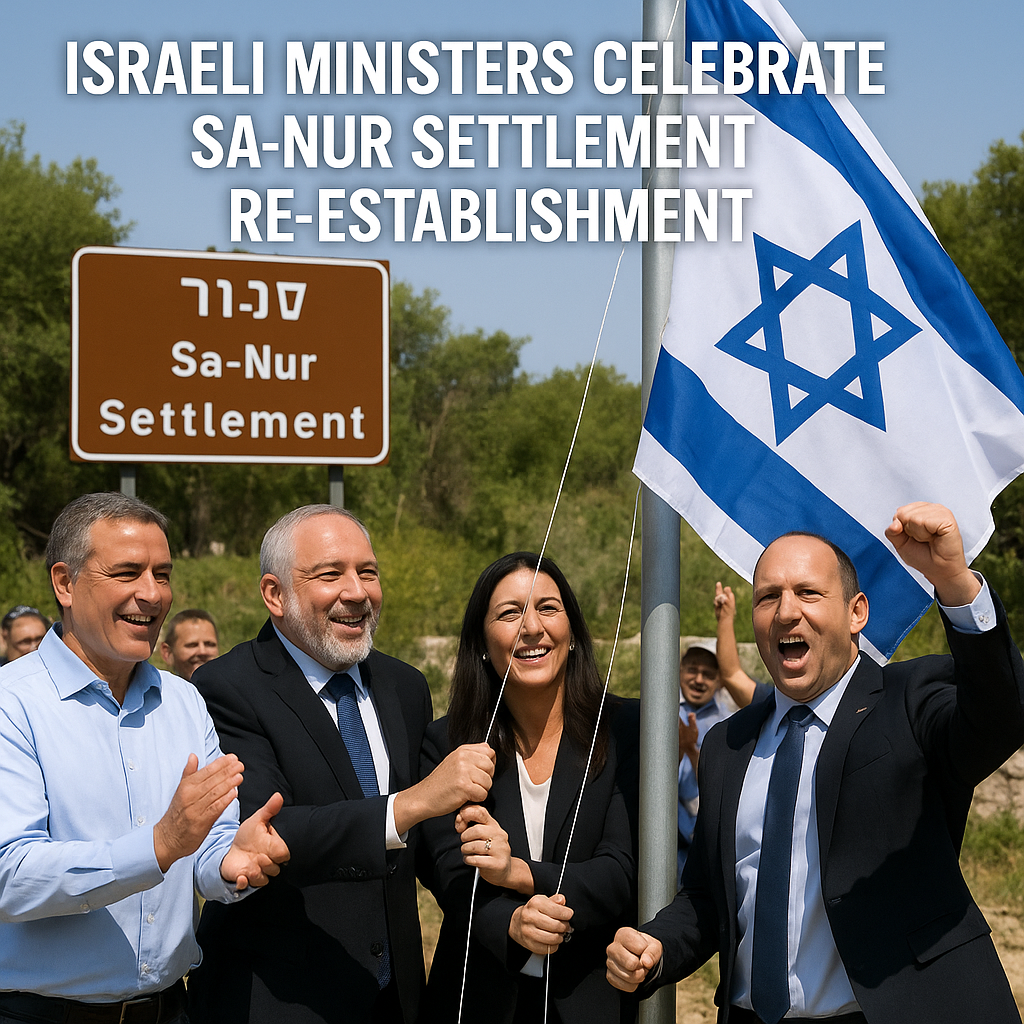
Israeli Ministers Celebrate Sa-Nur Settlement Re-establishment

Israeli Ministers Celebrate Sa-Nur Settlement Re-establishment
The recent celebration by Israeli ministers heralding the re-establishment of the Sa-Nur settlement in the West Bank has stirred considerable debate and emotion both within Israel and internationally. This pivotal event, marked by a cabinet meeting at the newly established site, reflects the ongoing complexities of the Israeli-Palestinian conflict and the broader geopolitical landscape in the region.

The Decision Behind Sa-Nur’s Revitalization
Israeli officials assert that re-establishing settlements like Sa-Nur is part of a broader strategy to strengthen Israel’s presence in contentious areas. Prime Minister Benjamin Netanyahu stated that the “historical and moral right” of the Jewish people to resettle areas seen as part of their national heritage fuels this initiative. Sa-Nur, evacuated in 2005 during Israel’s disengagement from the Gaza Strip, was symbolic in its removal, representing a willingness to concede land for peace talks with the Palestinians.


Yet, this perspective is met with significant opposition. Critics assert that the re-establishment of such settlements undermines the peace process and complicates prospects for a two-state solution. Palestinian Authority officials and leaders from various international organizations have condemned the move, viewing it as a provocative expansion of settlements that further erodes the potential for a viable Palestinian state.


Diverse Perspectives on Settlement Expansion
The Israeli government’s decision to reinstate Sa-Nur has ignited a spectrum of responses:
1. Support Within Israel: Many within the Israeli government and right-leaning factions view the re-establishment of Sa-Nur as a triumph. They cite security reasons and historical claims to justify the control of land, reflecting a broader nationalist sentiment. This view is anchored in a belief that settlements are not just strategic but are integral to Israel’s identity and continuity.
2. Opposition and International Reaction: Conversely, opposing viewpoints emphasize the implications for peace and stability in the region. International bodies, including the United Nations, have consistently criticized Israeli settlements in the occupied territories, labeling them illegal under international law. Palestinian leaders have voiced their grievances strongly, calling the re-establishment of Sa-Nur an encroachment that jeopardizes their aspirations for sovereignty and self-determination.
3. Yousef Munayyer, an expert on the conflict, articulated the dangers posed by such actions. In a statement, he mentioned, “Each new housing unit builds walls—instead of bridges—that perpetuate a cycle of conflict and resentment.” This sentiment echoes concerns over the widening gap between aspirations for peace and the reality on the ground.
The Broader Implications for Regional Dynamics
The re-establishment of settlements like Sa-Nur can be viewed through multiple lenses, bringing forth questions regarding the future dynamics in the region. In response to the renewed settlement activity:
– Increased Tensions: There is a palpable fear that this move will exacerbate tensions, not only between Israelis and Palestinians but also among neighboring Arab states. The potential rerouting of focus toward settlements rather than negotiations threatens to ignite further violence or unrest.
– Impact on Israeli-Palestinian Relations: The Palestinian Authority’s ability to negotiate effectively may be compromised. As settlements expand, the territory available for a future Palestinian state diminishes, making the prospect of meaningful negotiations ever more elusive.
– Shifting Views in Israeli Society: Within Israeli society itself, there is a growing debate about the future of settlements. While a significant portion of the population supports the government’s agenda, others begin to question whether such policies benefit Israel in the larger fight for national security and peace.
Conclusion: A Complicated Narrative Ahead
The celebration of Sa-Nur’s re-establishment serves as a reminder of the profound complexities that characterize the Israeli-Palestinian conflict. As perspectives clash and claims deepen, it becomes evident that the road ahead will be fraught with challenges.
Understanding these events requires a nuanced approach that considers historical claims, national security, and the aspirations of millions for peace and sovereignty. The intricacies of settlements and their impacts highlight not just territorial disputes but the intertwined fates of two peoples whose narratives are shaped by a long, tumultuous history.
As developments unfold, the hope for a comprehensive and lasting resolution remains contingent on addressing not only the political but the deeply rooted social dimensions that continue to influence everyday lives in both Israel and Palestine.















