
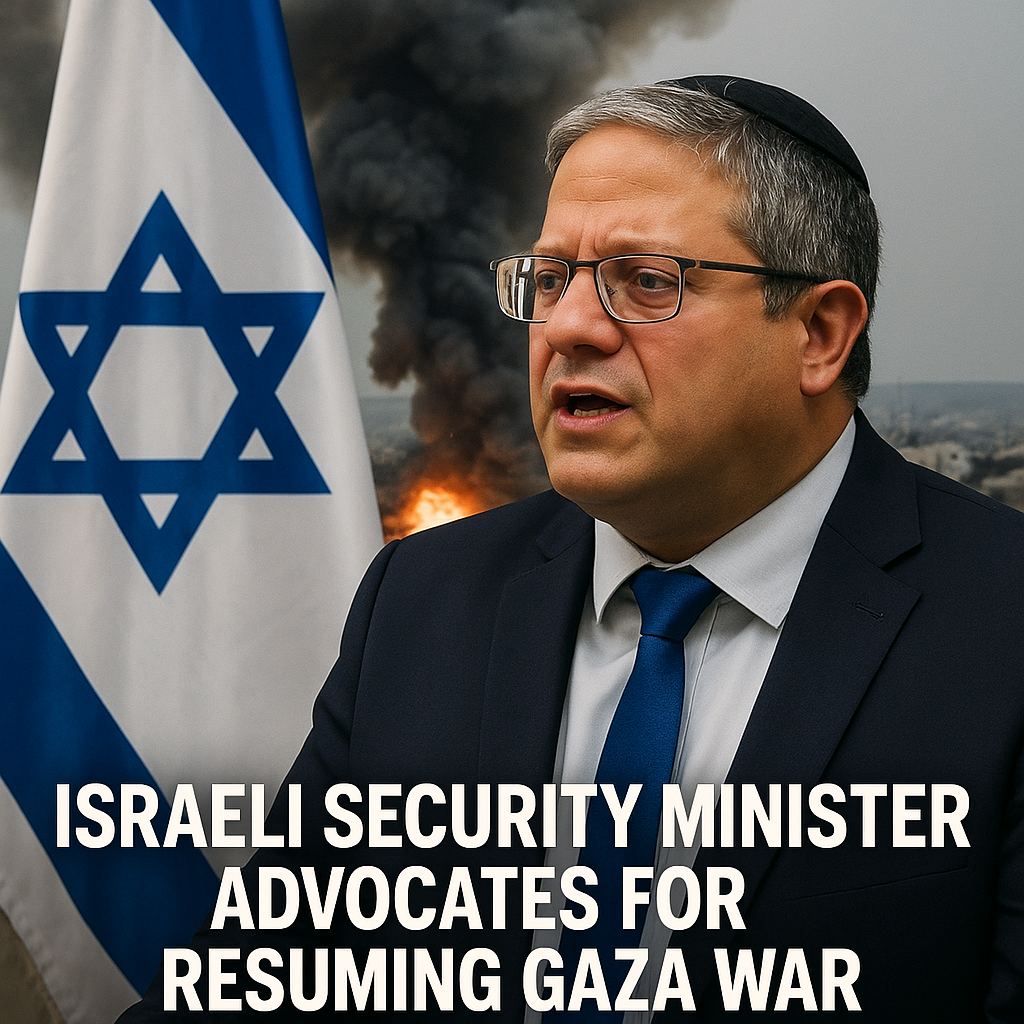
Israeli Security Minister Advocates for Resuming Gaza War

Israeli Security Minister Advocates for Resuming Gaza War
The ongoing conflict in the Gaza Strip has once again come to the forefront of international discussions, particularly following remarks from Israel’s Security Minister, which have sparked varying responses from both domestic and international observers. These discussions center around the potential consequences of resuming military operations in the region, reflecting a blend of viewpoints and sentiments.

Context of the Conflict
The Gaza Strip has experienced recurrent violence over many years, with periodic escalations leading to significant humanitarian crises. The backdrop of this new advocacy for military action involves complex political, social, and security dynamics. The recent advocacy by Security Minister Itamar Ben-Gvir to resume military action in Gaza is not simply a tactical recommendation; it reflects deeper concerns regarding national security and the fate of Israeli hostages, amidst ongoing tensions following the October 7 attacks that resulted in numerous fatalities on both sides.


From one perspective, officials like Ben-Gvir argue that military operations are necessary to prevent further Hamas activities and to secure the release of hostages taken during the October conflict. This sentiment aligns with reports from Al Jazeera, where military experts suggest that “a strong response is essential to deter further aggression.” The argument here delineates a clear rationale: engage in conflict to safeguard citizens and maintain order.


However, this viewpoint contrasts sharply with the concerns echoed by various human rights organizations and international leaders. They spotlight the humanitarian implications of a renewed military campaign in Gaza, stressing that any such action could exacerbate the existing humanitarian crisis. A piece from Sky News articulates this perspective, citing fears of civilian casualties and the potential for long-term destabilization in the region.
The Humanitarian Paradox
As Minister Ben-Gvir’s rhetoric gains traction within certain Israeli circles, the humanitarian implications cannot be overlooked. Reports indicate that a resurgence of conflict could further strain the already critical conditions in Gaza, where infrastructure has been severely damaged, and access to basic needs remains limited. Organizations A and B have highlighted that ongoing airstrikes and ground invasions could lead to a humanitarian disaster, worsening the plight of innocent civilians who are not involved in the conflict.
Furthermore, many voices from the international community have raised questions about the long-term implications of military actions. Western diplomats have pointed out that while security must be a priority, there should also be a concurrent focus on diplomatic solutions to engage with Gaza’s leadership constructively. Failure to do so could lead to entrenched divisions and ongoing cycles of violence that might further complicate peace processes in the future.
The Path Towards Resolution
What remains essential in this dialogue is the acknowledgment that ongoing military action might not be the panacea for Israel’s security issues. Various analysts suggest that achieving enduring peace requires a multifaceted approach that incorporates security measures, humanitarian aid, and diplomatic efforts. Notably, a report from RT.com stresses that any military action should ideally be accompanied by a broader strategy that seeks to address underlying grievances within the Palestinian community.
Additionally, recent actions to broker negotiations, potentially involving third-party nations or organizations, could provide an avenue for de-escalation. Such approaches would align with sentiments expressed in multiple sources that emphasize the importance of engaging with all parties involved, including Hamas, to address the root causes of the conflict.
Balancing Security and Human Rights
In conclusion, the situation in Gaza encapsulates a complex interplay of security concerns and humanitarian imperatives. As Israeli Security Minister Itamar Ben-Gvir advocates for military action to resume, the broader implications of such decisions must be considered. Balancing immediate security needs with respect for human rights and the long-term vision of peace could ultimately dictate the trajectory of the Israeli-Palestinian conflict.
While there is no clear consensus on how to proceed, the discourse surrounding the renewed calls for war reflects a deep division in strategy and ethics. Engaging multiple voices, including those advocating for peace and security in tandem, may provide a way forward that honors both sides’ needs and aspirations. The road ahead remains fraught with challenges, but it is imperative that all stakeholders work towards a solution that prioritizes both security and humanity.















