
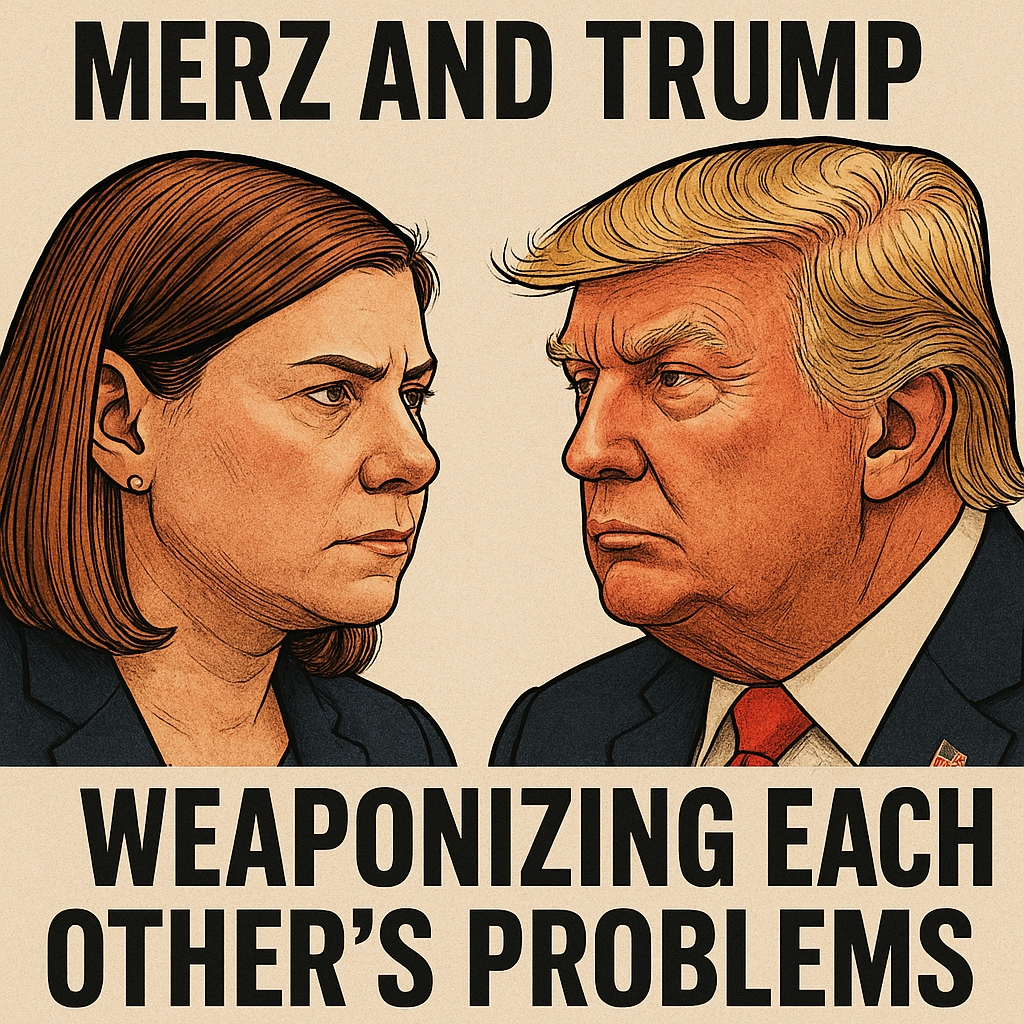
Merz and Trump: Weaponizing Each Other’s Problems

Merz and Trump: Weaponizing Each Other’s Problems
In a world where political landscapes shift rapidly, figures like Friedrich Merz and Donald Trump find themselves embroiled in a complex interplay of challenges and strategies. Both leaders are navigating turbulent waters—one in Germany and the other in the United States—each attempting to leverage the other’s issues to bolster their positions.

The Art of Political Strategy
Friedrich Merz, leader of the Christian Democratic Union (CDU) in Germany, has been keenly aware of the political tactics employed by Trump. As Trump faces legal hurdles, including ongoing criminal investigations, Merz appears poised to exploit these challenges. By framing his political stance as a counter to Trump’s chaos, Merz aims to reinforce his image as a steady leader who prioritizes stability over tumult.


Conversely, Trump’s approach to Merz’s challenges, such as rising costs of living and energy crises in Europe, has been to underline the differences in leadership styles. He contends that Merz’s strategies are naïve and ineffective when compared to his own bravado and aggressive strategies. Trump has publicly criticized European policies, suggesting that they exacerbate problems rather than solve them, a move that not only serves to distance himself from Merz but also attempts to rally his base by emphasizing nationalistic sentiment.


The crux of this dynamic lies in how both leaders utilize each other’s predicaments as tools for political advantage, a tactic that represents a significant trend in contemporary politics.
Diverging Political Landscapes
While both leaders operate within democratic frameworks, their political environments have marked differences. In Germany, the CDU has been trying to rebuild its image following a disappointing performance in recent elections, while in the U.S., Trump continues to command a divided yet fervent support base. This divergence leads to contrasting strategies.
Merz’s focus is on unifying various factions within the CDU and addressing public discontent surrounding inflation and energy prices. By emphasizing his experience and economic acumen, he seeks to broaden his appeal among voters disillusioned by the current government. In contrast, Trump relies on his personal brand of politics, which thrives on polarizing issues and rallying supporters through charismatic appeals, often simplifying complex realities into digestible sound bites.
Despite these different approaches, both politicians recognize that public perception plays a crucial role. Each leverages media narratives to frame their counterparts negatively, maneuvering public sentiments to solidify their follower bases.
Public Perception and Media Narratives
Public perception is profoundly shaped by the media, and both Merz and Trump utilize media narratives to their advantage. They acknowledge the power of social media and traditional press in molding opinions. Reports suggest that while Trump continues to have a substantial online presence, enticing his supporters with direct messaging, Merz is gradually learning the importance of digital outreach as a means to engage younger voters.
The media landscape complicates these shades of political maneuvering. Different platforms offer various narratives that can either amplify or undermine each leader. For instance, while some outlets may portray Trump’s actions as part of a broader populist movement, others depict them as reckless bravado. Conversely, Merz’s struggles might be framed as a cautious approach or, alternatively, as a failure to resonate with the electorate’s urgent needs.
Yet despite these narratives, a consensus remains elusive. Pundits and analysts often find it challenging to forecast definitive outcomes given the complexities involved. The shared vulnerabilities of both leaders indicate that weaponizing each other’s problems might lead to temporary gains but poses long-term risks for credibility and public trust.
Conclusion: Mutual Exploitation vs. Political Opportunity
The interplay between Merz and Trump represents more than mere opportunism; it highlights the intricacies of modern political strategy where adversities can transform into chances for advancement. As they navigate through personal challenges and public scrutiny, both leaders frame their struggles within broader narratives that appeal to their supporters while trying to undermine each other.
In this seemingly never-ending game of political chess, it is essential to observe the adaptations each leader makes. The focus on weaponizing each other’s problems not only showcases their tactics but also exemplifies the shifting nature of political discourse in a globalized world. Given the evolving landscape, both Merz and Trump must consider not just immediate gains but also the long-term implications of their strategies. The uncertainty surrounding their paths reflects broader trends in political communication and strategy, ultimately demonstrating that the collision of personal and political challenges often leads to a much larger narrative about leadership in the contemporary era.















