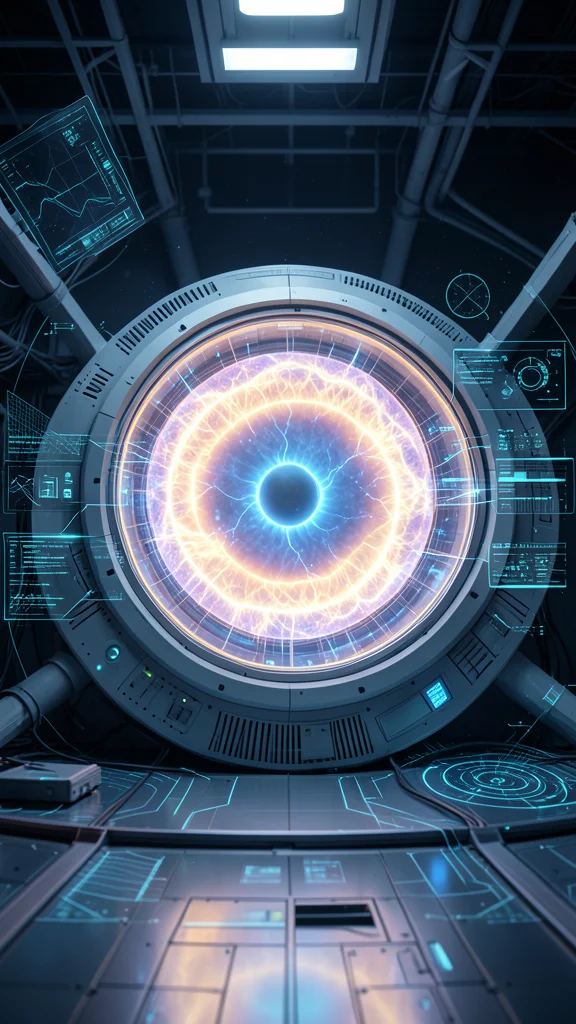
AI Learns to Control Fusion Plasma Before Instability Strikes
Researchers have successfully tested a new AI framework called PACMAN on a real fusion system, demonstrating how artificial intelligence could help scientists address one of the major challenges facing fusion energy: keeping extremely hot plasma stable.

Developed by researchers at Princeton University and the Princeton Plasma Physics Laboratory, PACMAN — short for Prediction And Control using MAchiNe learning — was tested in five experiments at the U.S. Department of Energy’s DIII-D National Fusion Facility in San Diego.

Fusion systems require plasma to remain extremely hot and stable. However, changes inside the plasma can develop in just milliseconds, making them too fast for human operators to handle manually.

PACMAN is designed to make rapid predictions and control decisions while keeping human researchers responsible for defining the system’s goals and safety limits. In the experiments, the framework successfully performed several tasks, including controlling plasma heating, adjusting plasma density and rotation, and detecting potentially disruptive behavior.
One of the most notable demonstrations involved an instability known as a tearing mode. A machine-learning model predicted the instability approximately 200 milliseconds before it was expected to occur. The system could then adjust the plasma conditions to prevent the instability from developing.
The achievement is significant because conventional control systems generally respond after an instability has already begun. Predicting the problem in advance gives an AI-based controller an opportunity to take preventive action instead of simply reacting to the event.
The researchers also demonstrated PACMAN’s ability to coordinate multiple plasma-heating systems simultaneously. This flexibility could make it easier to introduce additional AI models into future fusion experiments.
The development does not mean that fusion power is ready for widespread commercial use. Instead, it represents an important research step toward more sophisticated, real-time control of fusion systems.
As scientists continue working toward practical fusion energy, AI could become an increasingly important tool for understanding and controlling the complex behavior of plasma. The Princeton team’s latest experiments show how machine learning can move beyond analyzing scientific data and begin helping researchers control highly complex physical systems in real time.
Source: Princeton Plasma Physics Laboratory, Princeton University