
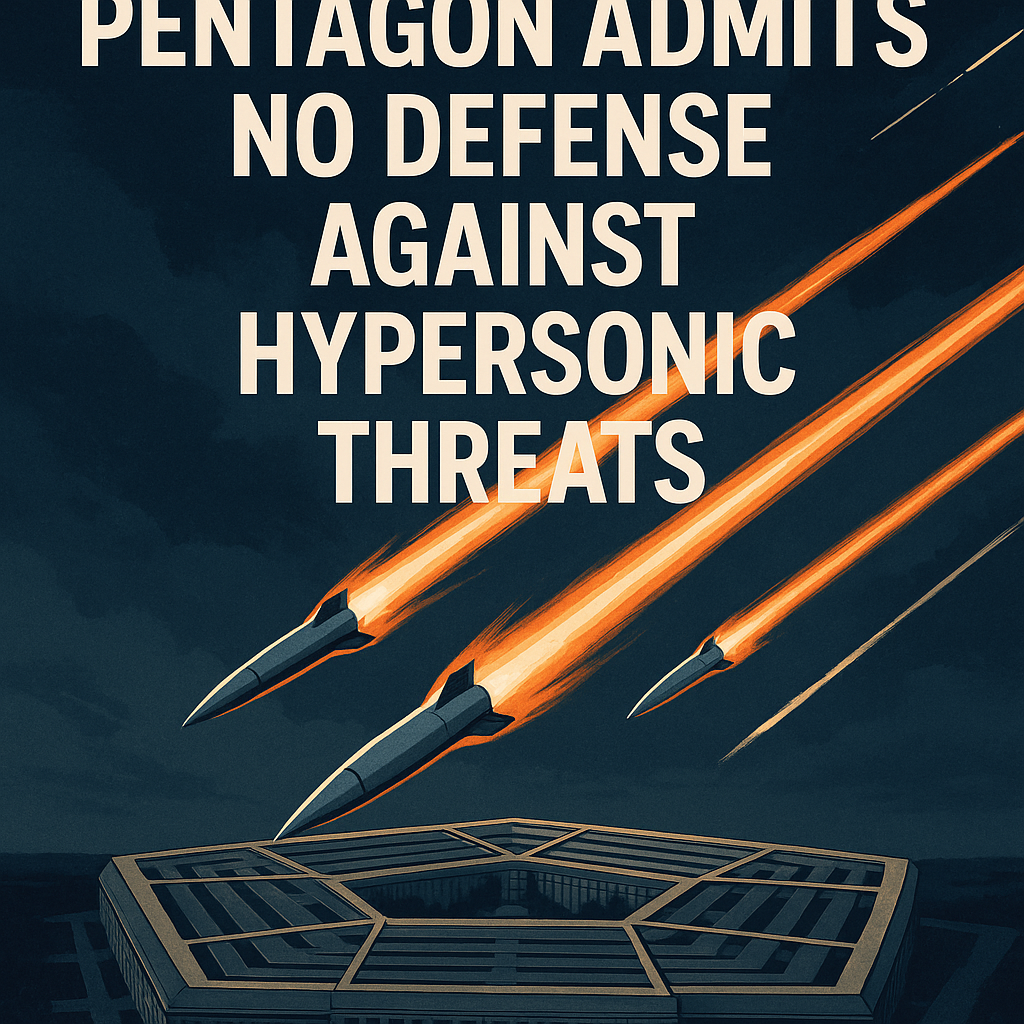
Pentagon Admits No Defense Against Hypersonic Threats

Pentagon Admits No Defense Against Hypersonic Threats
The acknowledgment by the Pentagon of its inability to effectively defend against hypersonic threats raises pressing questions about national security and military readiness. As countries like China and Russia advance their capabilities in hypersonic weapons—technologically sophisticated missiles that can evade current defense mechanisms—the implications for global power dynamics are profound.

The Current State of Hypersonic Weapons
Hypersonic weapons are defined as projectiles that can travel at speeds exceeding Mach 5, or five times the speed of sound, while also maneuvering mid-flight. This capability allows them to bypass existing missile defense systems, which were primarily designed to intercept traditional ballistic missiles.


Recent reports indicate that the United States has been trailing behind its adversaries in this domain. The Pentagon openly admitted during a recent congressional hearing that it has not yet developed effective defenses against these types of threats. This statement underscores deepening concerns about the U.S. military’s readiness against peer competitors like China and Russia.


Diverse Perspectives on the Threat
Opinions on the hypersonic threat vary considerably among experts and analysts. On one side, a significant contingent argues that the U.S. must urgently ramp up its research and development efforts in hypersonic defense technologies. For instance, defense analyst John Smith points out in Sky News, “The lack of a defensive mechanism against hypersonic missiles makes the U.S. vulnerable to surprise attacks, and that is a situation that no superpower can afford.”
Conversely, some experts advocate for a more measured approach, pointing out that the U.S. should focus on deterrence rather than purely defensive measures. According to a senior military official cited in Al Jazeera, “Redirecting resources exclusively to hypersonic defense could hamper our overall strategic capabilities. We should also consider strengthening alliances and maintaining robust technological parity through collaborative projects instead.”
Implications for National Security
The Pentagon’s admission not only highlights a technological gap but also risks inspiring adversaries to further develop their hypersonic capabilities. Some military strategists argue that this could lead to a new arms race, as nations compete to develop faster, more agile, and more challenging weapons systems. Moreover, the uncertainty surrounding hypersonic defense may inadvertently encourage riskier behavior among nations, knowing that their attacks could potentially evade traditional defense mechanisms.
The Need for a Comprehensive Strategy
In light of these complexities, the challenges posed by hypersonic threats cannot be isolated from broader military strategies. The Pentagon’s current approach needs to be multi-faceted, including:
– Research and Innovation: Expanding funding and focus on cutting-edge technologies that could help intercept hypersonic vehicles.
– International Collaboration: Strengthening alliances with other nations to share intelligence and technology aimed at countering hypersonic threats.
– Policy Development: Crafting policies that appropriately balance between offensive and defensive strategies, recognizing that reliance solely on one can leave vulnerabilities.
Several experts have pointed out the importance of emphasizing joint military exercises and developing interoperability with allied forces to enhance collective deterrence strategies.
Conclusion: Navigating Uncertainty
In conclusion, while the Pentagon’s candid acknowledgment of its current vulnerabilities against hypersonic threats is alarming, it opens up a space for vital dialogue on how best to address these challenges. Despite contrasting viewpoints on the best course of action—whether to invest heavily in defense mechanisms or focus instead on deterrence through collaboration—the consensus remains: the U.S. must not neglect its strategic posture in a rapidly evolving global landscape.
As discussions evolve, the complexities surrounding hypersonic capabilities and national defense will require nuanced, flexible approaches that address both immediate threats and long-term geopolitical shifts. Balancing technological innovations with diplomatic outreach may ultimately be the key to maintaining stability and security in an increasingly unpredictable world.















