
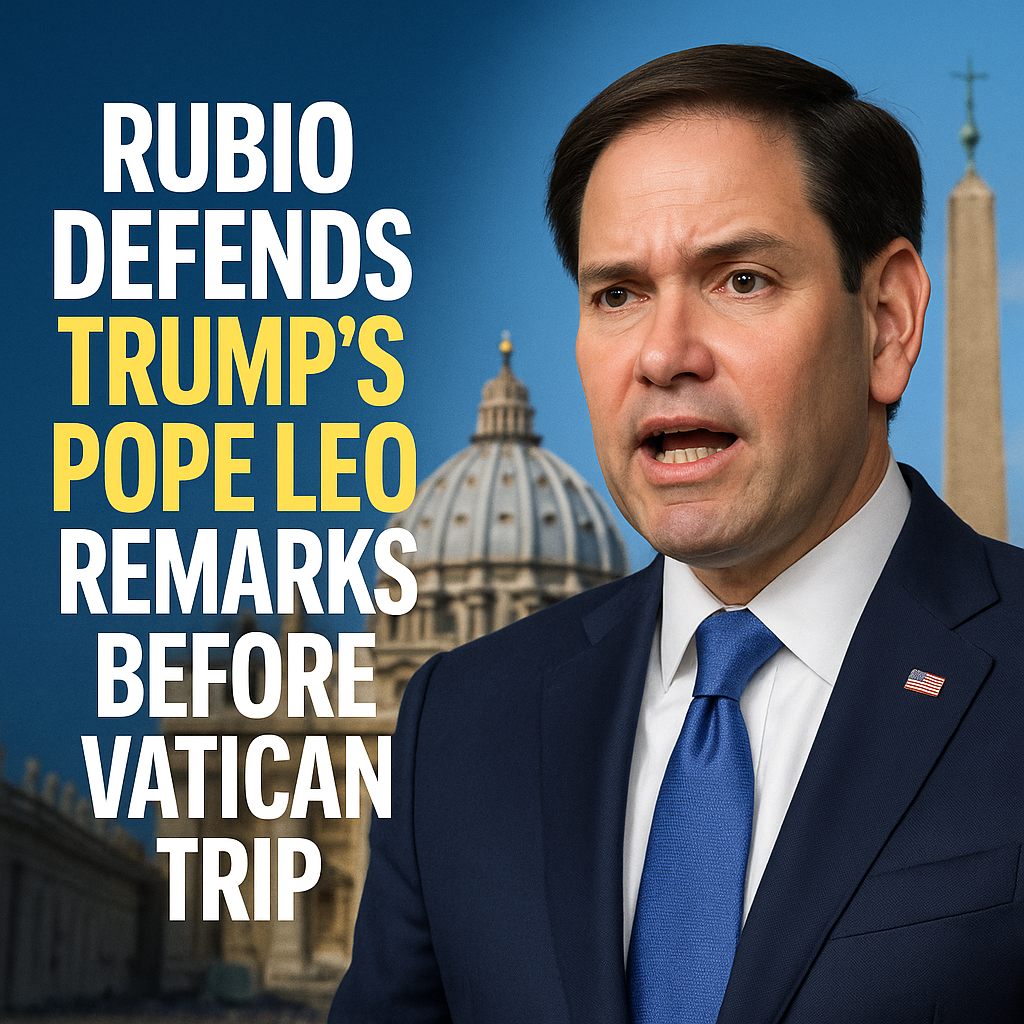
Rubio Defends Trump’s Pope Leo Remarks Before Vatican Trip

Rubio Defends Trump’s Pope Leo Remarks Before Vatican Trip
Marco Rubio recently found himself in the eye of a political storm as he defended former President Donald Trump’s controversial statements regarding Pope Leo X. This discussion unfolded just before an anticipated trip to the Vatican by Trump, elevating the dialogue surrounding diplomacy and historical context within contemporary geopolitics.

Historical Context and Controversy
Trump’s comments reference Pope Leo X, who presided over the Catholic Church during a tumultuous period marked by the Protestant Reformation. Trump suggested that Leo X, regarded as a controversial figure due to his lavish lifestyle and the Church’s monetary practices of the time, could have benefitted from a more austere approach when it came to addressing the challenges facing the Church. This statement has sparked a mix of reactions, ranging from support among Trump’s allies to fierce criticism from various religious and political figures.


Rubio’s defense focused on the importance of historical perspective, attempting to position Trump’s remarks as an invitation to rethink historical narratives around leadership and morality. He articulated that understanding past figures, including their shortcomings, can enhance today’s political discussions and decisions, particularly in light of pressing global issues such as Iran’s nuclear ambitions.


Diverging Opinions on Diplomacy and Rhetoric
The reactions to both Trump’s remarks and Rubio’s defense signal a significant divide in public sentiment. Supporters of Trump argue that he is merely expressing a necessary critique of a pivotal historical figure, aligning with a broader narrative that seeks to challenge established, often unexamined, historical paradigms. They emphasize that such critical examinations could foster more robust discussions about modern religious leadership and moral integrity.
Conversely, critics assert that the former president’s comments trivialize the complex interplay of faith, power, and ethics that defined Pope Leo X’s reign. Some commentators liken this rhetorical maneuver to a risky strategy that could undermine diplomatic relationships, particularly with the Vatican, an institution that has maintained a delicate balance of influence and authority over centuries.
The Vatican’s response to Trump’s impending visit remains ambiguous, which adds another layer of uncertainty. Some sources suggest that while the Holy See typically maintains diplomatic decorum, they may approach this visit with caution, especially given the charged atmosphere surrounding Trump’s remarks.
The Implications for U.S.-Vatican Relations
As Trump prepares for his visit, the implications for U.S.-Vatican relations could be significant. The relationship has historically oscillated based on the personalities in power and their alignment with Vatican priorities. Observers note that Trump’s presidency had previously seen both engaged and strained interactions with the Holy See, particularly concerning issues like climate change, immigration, and social justice.
Rubio’s defense of Trump could have repercussions not only for intra-party dynamics but for broader U.S. foreign policy. Should the trip go smoothly, it might reinvigorate Trump’s standing among segments of the Republican base that value religious affiliation and traditional values, while also giving Rubio a platform to reaffirm his influence as a key player in U.S.-Catholic relations.
However, potential fallout looms if Trump’s rhetoric clouding historic lessons antagonizes Vatican leaders. This incident spotlights a broader theme: navigating sensitive historical narratives in the arena of international diplomacy requires a balance between critique and respect. Failure to achieve this may lead to broader ramifications in U.S. foreign relations.
Conclusion
The tension surrounding Trump’s remarks and Rubio’s subsequent defense encapsulates the complexities of modern political discourse. It illustrates how historical references can provoke passionate debate, revealing deep divides among various factions. The outcome of Trump’s Vatican visit and its subsequent implications for U.S.-Vatican relations remain to be seen, but the discussions it has sparked highlight the intricate dynamics of faith, history, and politics in today’s world. Amidst this climate, it becomes increasingly clear that navigating these waters requires a nuanced approach, one that recognizes both the power of critique and the importance of respectful dialogue.















