
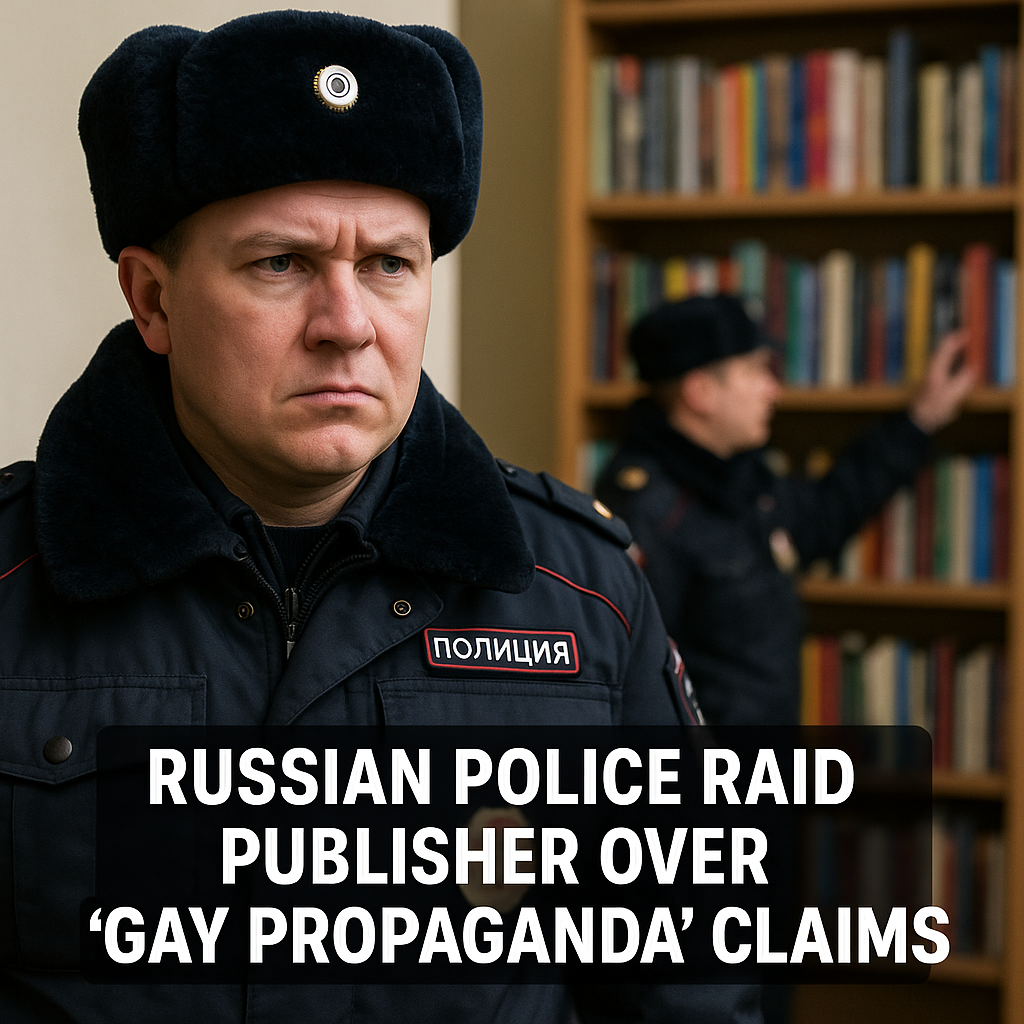
Russian Police Raid Publisher Over ‘Gay Propaganda’ Claims

Russian Police Raid Publisher Over ‘Gay Propaganda’ Claims
In a significant escalation of Russia’s crackdown on LGBT rights, police recently raided a prominent book publisher accused of promoting “gay propaganda.” This incident ignites discussions surrounding censorship, state power, and civil liberties in a country where same-sex relationships are often met with hostility.

Understanding the Context: The Law on ‘Gay Propaganda’
The term “gay propaganda” has become synonymous with Russia’s controversial 2013 law prohibiting the promotion of “non-traditional” sexual relationships to minors. This legislation, widely criticized by various human rights organizations and Western governments, has facilitated a broader atmosphere of censorship and repression against the LGBTQ+ community. The authorities argue that such laws are designed to protect traditional family values and cater to public sentiment, although critics contend that they fuel discrimination and intolerance.


The recent raid on the book publisher serves as a striking example of how this law is being exercised in real-world scenarios. According to reports, police seized several titles that were deemed inappropriate, further illustrating the thin line between cultural expression and government regulation.


Diverse Perspectives on the Recent Raid
Law Enforcement’s Stance
From the law enforcement perspective, the raid is framed as a necessary action to uphold national laws designed to safeguard moral and ethical standards within society. State representatives assert that the materials promoted by the publisher violate the 2013 law, arguing that it is their duty to act in the interest of societal values. They emphasize a commitment to protecting minors from exposure to content they consider harmful. However, this justification raises concerns about the prioritization of state interests over individual freedoms.
Civil Liberties Concerns
On the opposite end of the spectrum, human rights advocates and various international organizations have vehemently condemned the raid, viewing it as a blatant infringement on freedom of expression and a form of state-sanctioned harassment. Critics argue that these actions are part of a larger campaign to suppress any dialogue surrounding LGBTQ+ rights, effectively marginalizing an entire community. The publisher in question, along with numerous activists and allies, has claimed that such raids create a climate of fear, preventing not just creative expression but also dialogues that can lead to greater acceptance.
The Broader Implications for Society
The implications of the Russian police raid extend beyond the immediate fallout for the publisher and their authors. It challenges society to confront pivotal questions regarding liberty, morality, and culture. Some analysts suggest that the ongoing repression of the LGBTQ+ community might instigate a counter-response, pushing individuals to advocate more passionately for their rights.
Conversely, state support for such measures seems to solidify the government’s backing of conservative values, potentially stymieing any progressive movements. For instance, the regime has historically leveraged public sentiments concerning morality and traditional values to consolidate power. In this light, the raid can be interpreted not only as an attack on an individual publisher but also as a broader strategy to maintain social cohesion through division, exploiting fear and prejudice.
A Cloudy Future for Free Expression?
As tensions rise and the state tightens its grip on the narrative surrounding LGBTQ+ issues, it is inevitable that discussions about free expression will become more contentious. The nuanced perspectives surrounding the police raid illustrate a society grappling with the balance between protecting cultural values and ensuring individual freedoms. While government rhetoric often emphasizes the need for “moral safeguarding,” advocates for civil liberties argue passionately for the importance of diverse voices.
Many experts seem to agree that as long as such laws exist, they will be wielded as tools of oppression rather than protection. The challenge remains: how can society foster an environment where all its members, regardless of sexual orientation, feel safe and represented?
In conclusion, the police raid on the publisher raises serious questions about Russia’s trajectory regarding human rights. It is clear that the future remains uncertain, oscillating between the pursuit of individual freedoms and the state’s inclination to regulate morality. Whether this incident is a tipping point for increased advocacy or a continued descent into censorship will depend on the resilience of those willing to confront these complex issues.















