
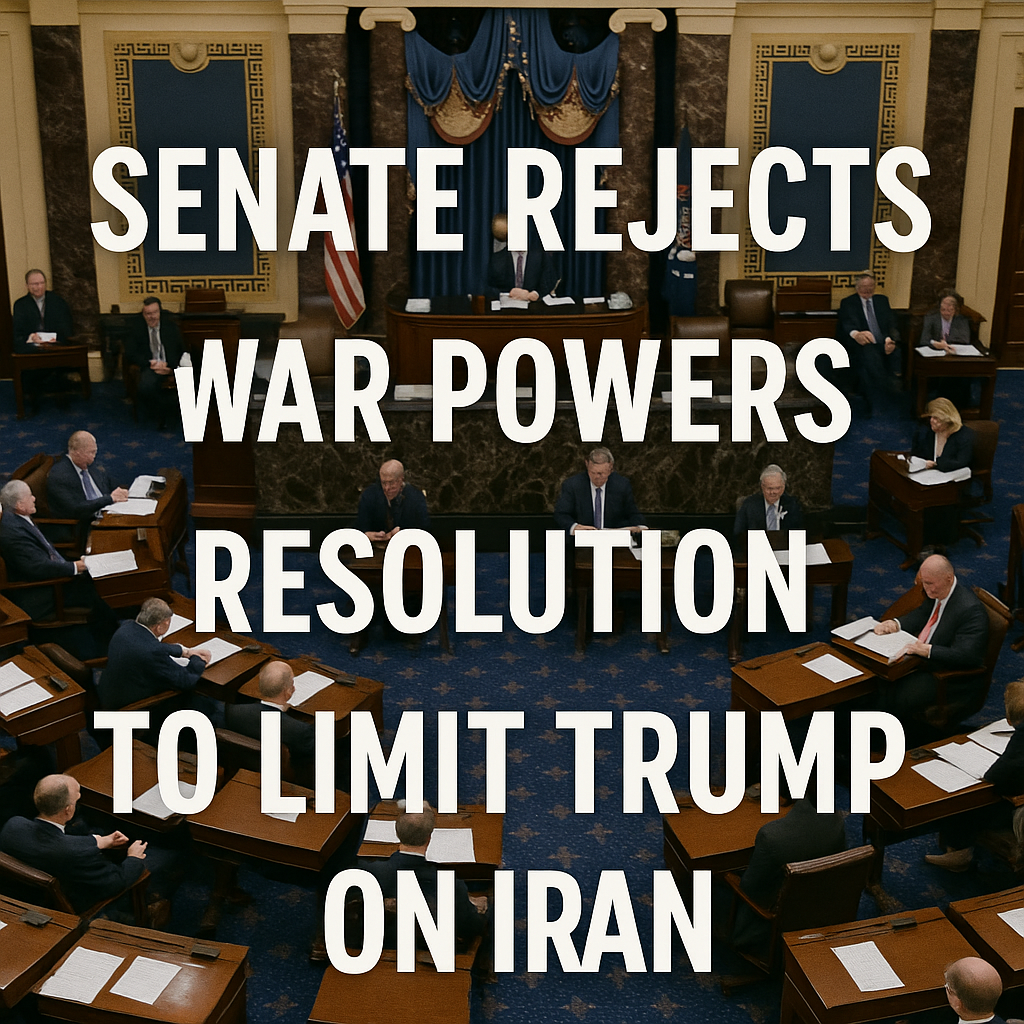
Senate Rejects War Powers Resolution to Limit Trump on Iran

Senate Rejects War Powers Resolution to Limit Trump on Iran
In a pivotal decision, the Senate has rejected a War Powers Resolution aimed at limiting President Donald Trump’s military actions regarding Iran. This development highlights the ongoing tension between the legislative branch and the executive branch concerning foreign policy oversight, indicating a complex landscape of opinions and responsibilities.

The Context of the Resolution
The resolution proposed by Senate Democrats sought to curtail Trump’s power to engage in military actions without prior Congressional approval. Supporters argued that this measure was essential for maintaining checks and balances, particularly following heightened tensions with Iran after the U.S. assassination of General Qassem Soleimani in early 2020.


Historically, the War Powers Resolution of 1973 aimed to ensure that Congress had a critical role in decisions regarding military engagement. According to Al Jazeera, proponents of the resolution stressed that recent actions had escalated the threat of conflict with Iran, urging the Senate to assert its constitutional authority to prevent unchecked military use.


Conversely, opponents contended that the resolution undermined the President’s capacity to respond rapidly to threats. As reported by RT, Republican Senators emphasized the importance of flexibility in foreign policy, arguing that the U.S. needs the ability to act decisively against perceived threats from Iran.
Divergent Views on Military Engagement
One of the significant points of contention centers around the balance of power. Democrats have argued that, after two decades of military engagements in the Middle East, it is time for a recalibration of military authority. Senator Tim Kaine, who spearheaded the resolution, stated, “The president must take military action only with Congressional approval” (Al Jazeera).
Despite these arguments, Republicans have often countered that the executive branch must retain certain powers to respond swiftly to unfolding situations. Senator Mitch McConnell remarked on the Senate floor, “The men and women of our Armed Forces deserve a Commander in Chief who is able to respond to threats in real-time” (RT). This divide raises critical questions about how the U.S. defines its role in global conflicts and how much authority it is willing to relinquish to the legislative branch.
The Impact on U.S. Foreign Policy
The Senate’s rejection of the resolution has potentially significant consequences for U.S. foreign policy. Experts suggest that this decision may embolden the Trump administration to pursue a more aggressive stance against Iran. As tensions continue to simmer, the lack of legislative constraints leaves room for expanded military action, which some analysts fear could lead to unnecessary escalation.
There are also broader implications for international relations. The perception that the U.S. is willing to act unilaterally, without adequate Congressional oversight, can strain relationships with allies and set a precedent for international behavior. This sentiment underscores the delicate balance the U.S. must maintain while navigating a complex web of global diplomacy.
A Lacking Consensus
The debate surrounding the War Powers Resolution reflects a broader national conversation about America’s military involvement abroad. While both sides present compelling arguments, the lack of a clear consensus leaves citizens uncertain about the future direction of U.S. foreign policy.
Public opinion appears to be equally divided. Many Americans express concern over endless wars and the costs associated with prolonged engagements in the Middle East. However, a substantial portion believes that the United States should maintain a decisive, militarily capable presence to deter threats.
The implications of this decision extend beyond mere policy discussions. It emphasizes the need for a more cohesive strategy that integrates public sentiment, legislative input, and executive clarity. As military and diplomatic considerations grow increasingly intertwined, the American public and their representatives must grapple with these pressing issues.
Conclusion
The Senate’s recent rejection of the War Powers Resolution regarding Iran illustrates a significant struggle within the U.S. government over authority in military matters. As the nation becomes more polarized around military engagement, it raises critical questions about governance, accountability, and the path forward in foreign relations. While the administration may feel empowered by this decision, the broader implications could influence the dynamics of U.S. foreign policy in the years to come. Insight, collaboration, and transparency will be essential as the nation navigates the complex challenges posed by a rapidly evolving global landscape.















