
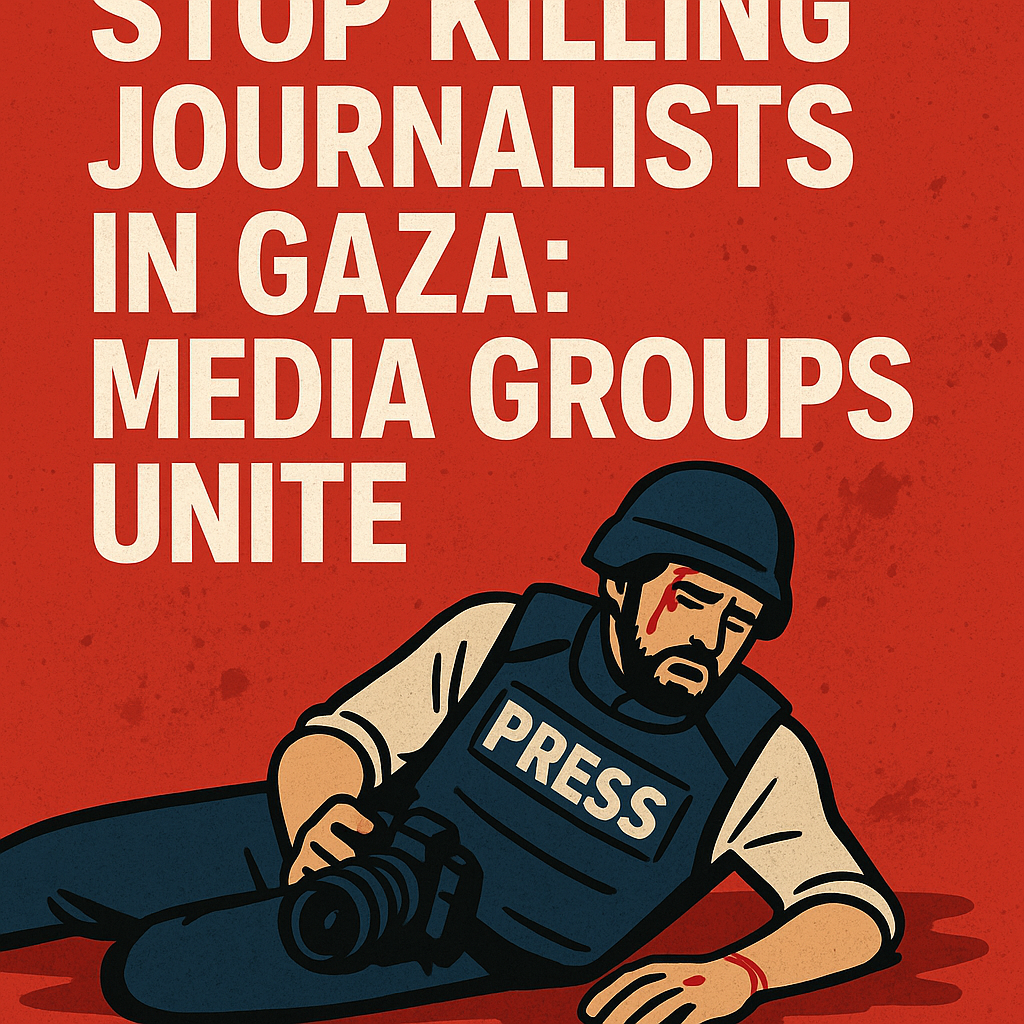
Stop Killing Journalists in Gaza: Media Groups Unite

Stop Killing Journalists in Gaza: Media Groups Unite
The escalating violence in Gaza has reignited urgent calls from media organizations worldwide to protect journalists covering conflicts. The message is clear: the safety of journalists must be prioritized, particularly in war zones where the dangers are heightened. The recent surge in attacks on journalists has led to unification among various media advocacy groups who demand justice and accountability.

The Harrowing Reality for Journalists
In recent weeks, reports have surfaced detailing the deaths and injuries of journalists in Gaza amid ongoing military operations. A joint statement from multiple media organizations highlights the risks faced by correspondents on the ground. According to Al Jazeera, several journalists have been targeted, resulting in loss of life and severe injuries while attempting to report on the humanitarian crisis unfolding in the region.


Organizations such as the Committee to Protect Journalists (CPJ) and Reporters Without Borders have expressed deep concern. They emphasize not only the physical danger to reporters but also the chilling effect such violence has on press freedom. As stated on RT, the ability to convey accurate information is crucial during conflicts, and attacks on journalists can lead to a significant distortion of reality.


Diverse Perspectives on the Issue
While the majority view among media groups is one of solidarity against violence, perspectives on accountability and the motives behind these attacks vary.
– Media Advocacy Groups: These organizations uniformly call for international accountability. They argue that impunity encourages further violence against journalists, suggesting that a lack of repercussions emboldens those who seek to suppress free speech through intimidation. They advocate for global governments to hold accountable those responsible for targeting reporters.
– Israeli Military’s Defense: On the other side, representatives from the Israeli government contend that the military actions are taken in the context of self-defense against terrorism. They claim the intention is not to target journalists but rather to engage with legitimate threats. As reported by Sky News, the Israeli Defense Forces (IDF) argue that in complex conflict situations, innocent bystanders, including journalists, may inadvertently be placed in harm’s way.
This divergence highlights a fundamental tension: the need for robust reporting versus the realities of military operations in densely populated areas.
The International Community’s Role
Addressing these issues requires a concerted effort from the international community. Advocacy from respected media organizations should not merely be symbolic. Sustained pressure can lead to significant changes—both in policy and practice—regarding the treatment of journalists in conflict zones.
– Global Pressure for Justice: Advocacy groups are pushing for international bodies, such as the United Nations, to investigate these crimes rigorously. This includes holding states accountable for providing a safe environment for journalists. Recent statements from Al Jazeera point out that without accountability, the cycle of violence will continue, putting future journalism at risk.
– Community Engagement: At a grassroots level, media organizations are also calling for public engagement to raise awareness about the hazards faced by journalists. Campaigns to educate the public about the essential role of a free press in society may foster greater understanding and support for media professionals, particularly in times of conflict.
The Road Ahead
As the situation in Gaza continues to evolve, the call for the protection of journalists cannot be overstated. The fate of independent reporting hinges on the ability to report safely and without fear of retribution. Journalists are critical to documenting and narrating the realities of conflict. Their work, under the threat of violence, underscores not only their bravery but also the need for systemic change in how conflicts are reported and managed.
The diverse perspectives highlight a pressing complexity: how does one balance national security interests with the fundamental right to free speech and a press that can operate without fear? While the Israeli military and media advocacy groups differ significantly in their viewpoints, the root of the issue is linked to a broader global discourse on human rights and the importance of free media.
In conclusion, as media organizations unite in their demands for justice and accountability, it is essential for the international community to acknowledge the significance of a free press. Only through collective action can we hope to ensure that journalists in Gaza—and everywhere else—can perform their vital work without fear of violence or persecution.















