
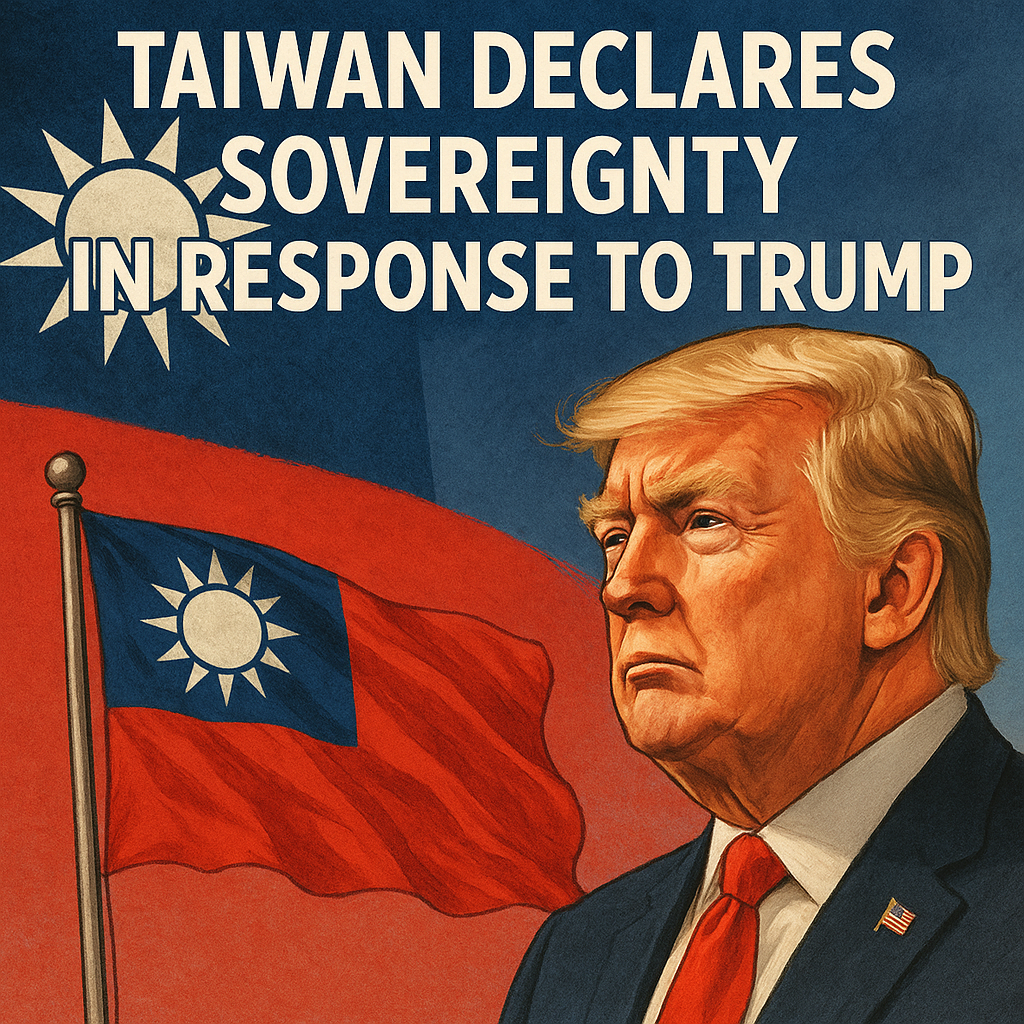
Taiwan Declares Sovereignty in Response to Trump

Taiwan Declares Sovereignty in Response to Trump
In a significant geopolitical development, Taiwan has boldly reaffirmed its sovereignty in the wake of former President Donald Trump’s latest comments regarding the island nation. This declaration underscores Taiwan’s desire for recognition and autonomy, particularly in a region fraught with tension and historical complexities involving China.

The Context of Taiwan’s Declaration
Recent remarks made by Trump, which suggested potential shifts in U.S. policy towards Taiwan, have prompted the island to publicly assert its independence. According to reports from Al Jazeera, Taiwan’s response emphasizes its status as a sovereign entity, distinct from mainland China. Taiwanese President Tsai Ing-wen reiterated that the island is “an independent country” and will continue to safeguard its democratic way of life against external pressures.


This assertion occurs against a backdrop of increasing military posturing and aggressive rhetoric from China, which views Taiwan as a breakaway province rather than a sovereign nation. The complexity of this situation is highlighted by the historical connection between the two sides, tracing back to the Chinese Civil War when the Nationalists retreated to Taiwan.


Diverging Perspectives on Sovereignty
The declaration has elicited mixed reactions on the international stage. Some analysts argue that Taiwan’s assertion of sovereignty is a necessary step for its defense and identity. They believe that Trump’s comments represent an opportunity for Taiwan to strengthen its diplomatic ties, especially with the U.S., which has been a long-standing ally. This perspective aligns with Taiwan’s long-standing strategy of seeking greater international recognition and participation in global institutions.
Conversely, critics caution that such a declaration could inflame tensions with Beijing, which has retaliated with military drills and firm warnings. The Chinese government has issued statements asserting that anyone pursuing Taiwanese independence would face severe consequences. RT News highlights that China’s recent aggressive military demonstrations are intended as a clear message against any form of perceived separatism.
The International Ramifications
The geopolitical implications of Taiwan’s stance cannot be understated. As the U.S. navigates its foreign policy in the Asia-Pacific region, its involvement will be scrutinized. The Biden administration has indicated a commitment to supporting Taiwan, yet the complexities of U.S.-China relations add layers of uncertainty. Observers note that while the U.S. has maintained a policy of “strategic ambiguity,” the recent developments may compel a more defined stance in favor of Taiwan’s sovereignty.
Moreover, international responses vary, with some nations expressing support for Taiwan’s right to self-determination, while others remain cautious to avoid antagonizing China. This split reflects the wider global tension between support for democratic values and the pragmatic need to engage with China as a major world power.
Conclusion: A Defining Moment for Taiwan
Taiwan’s declaration of sovereignty in response to Trump is more than just a political statement; it is a reflection of resilience in the face of unprecedented external pressures. The island’s leaders clearly aim to assert their identity and right to self-determination as they navigate an often adversarial international landscape.
While the future remains uncertain, Taiwan’s move has reignited discussions about its status on the world stage. As nations observe and react to this declaration, it ultimately poses critical questions about sovereignty, democracy, and international relations moving forward. The confluence of tensions between the U.S., Taiwan, and China indicates that this defining moment will undoubtedly shape the geopolitical dynamics of the region for years to come.















