
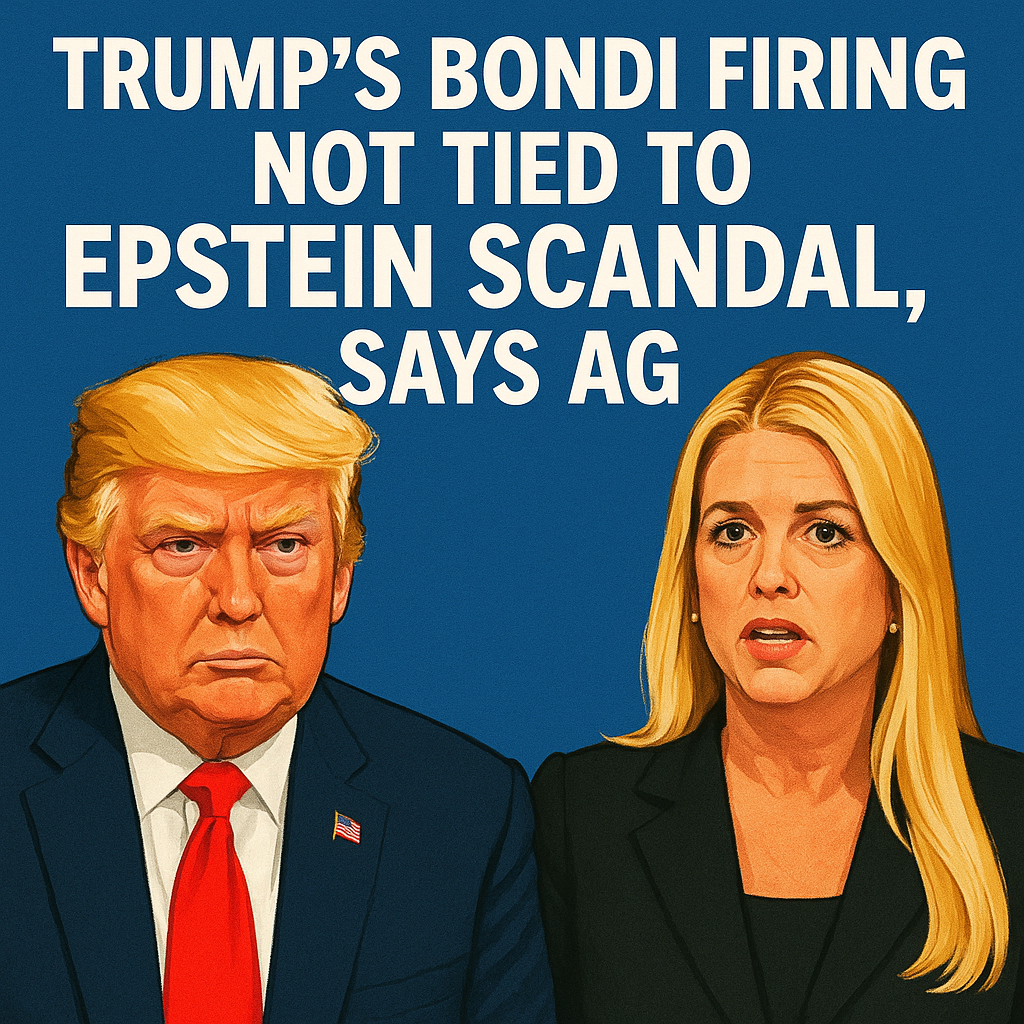
Trump’s Bondi Firing Not Tied to Epstein Scandal, Says AG

Trump’s Bondi Firing Not Tied to Epstein Scandal, Says AG
In a recent development, the Attorney General has asserted that former President Donald Trump’s decision to fire attorney Pam Bondi is unrelated to the controversy surrounding Jeffrey Epstein. This revelation has sparked discussions regarding political motivations, ethics, and the complex web of connections that often accompany high-profile cases.

Context of the Firing
Pam Bondi, a former Florida Attorney General, was dismissed from her role as a Trump advisor, with speculation immediately connecting her ousting to the Epstein case. Epstein, who was arrested on charges of sex trafficking and conspiracy, had various connections within elite social circles, including Trump himself. The concerns about Bondi’s ties to this scandal were especially pronounced given her prior decisions that seemingly shielded Epstein from legal repercussions.


However, in statements released by the Attorney General, it was emphasized that the timing of Bondi’s termination should not be interpreted as a direct response to her involvement—or lack thereof—in the Epstein case. Instead, it is classified as a routine personnel adjustment. This assertion has stirred varied reactions across different political spheres and news outlets.


Diverging Perspectives
Reports from Al Jazeera illustrate a general unease about the “routine” nature of such political dismissals, especially when set against the backdrop of high-profile criminal cases. Critics argue that Bondi’s firing at this particular moment raises questions about transparency and accountability. They contend that the interconnectedness of political figures and criminal actors often necessitates more substantial clarity and communication, particularly when legal boundaries are not distinct.
Conversely, RT argues that the Attorney General’s statements should be taken at face value, suggesting that such personnel changes are commonplace in political administrations and should not be blown out of proportion. They point out that the former President’s administration underwent numerous staff changes that were often unrelated to scandals or public controversies. This perspective emphasizes a potential overreaction to what may merely be a shifting of roles within an often tumultuous political framework.
The Broader Implications
The debate surrounding Bondi’s firing encapsulates larger questions about ethics in politics. Trust is crucial for effective governance, and any perceived inconsistency can lead to skepticism among the public. While the Attorney General insists that Bondi’s removal is unrelated to Epstein, many observers remain unconvinced. They argue that even if the decision was not directly tied to the scandal, it is impossible to ignore the context in which it occurred.
Key Considerations:
– Public Perception: The public’s understanding and interpretation of events connected to scandal are often influenced by timing and media portrayal.
– Political Strategy: Leaders may choose to make changes to their staff during or after controversies to distance themselves from those implicated, even if the connections are tenuous.
– Transparency in Governance: There is an increasing demand for transparency from political figures, particularly in cases related to sexual misconduct and trafficking that have devastating real-world consequences.
Looking Forward
As investigations into Epstein’s operations continue, the implications for those associated with him—whether directly or indirectly—remain a point of contention. For Trump, distancing himself from any whiff of scandal becomes increasingly critical, especially as he eyes future political ambitions. As more facts unfold, the integrity and motivations behind personnel changes like Bondi’s may be scrutinized more closely.
While the Attorney General’s assertion may hold a semblance of truth, the complexities surrounding these narratives define major political discussions. The discourse surrounding Bondi’s firing highlights the necessity for clear communication between political leaders and their constituents, especially in eras of heightened scrutiny and skepticism.
In conclusion, while the assertion that Bondi’s firing is not linked to the Epstein scandal is currently the official stance, the varied interpretations and reactions underline a critical reality: politics is rarely straightforward, and context often weighs heavily on public perceptions. The intricacies of the situation echo broader concerns about ethics and transparency, reminding us that every political action has ramifications that extend beyond its immediate context.















