
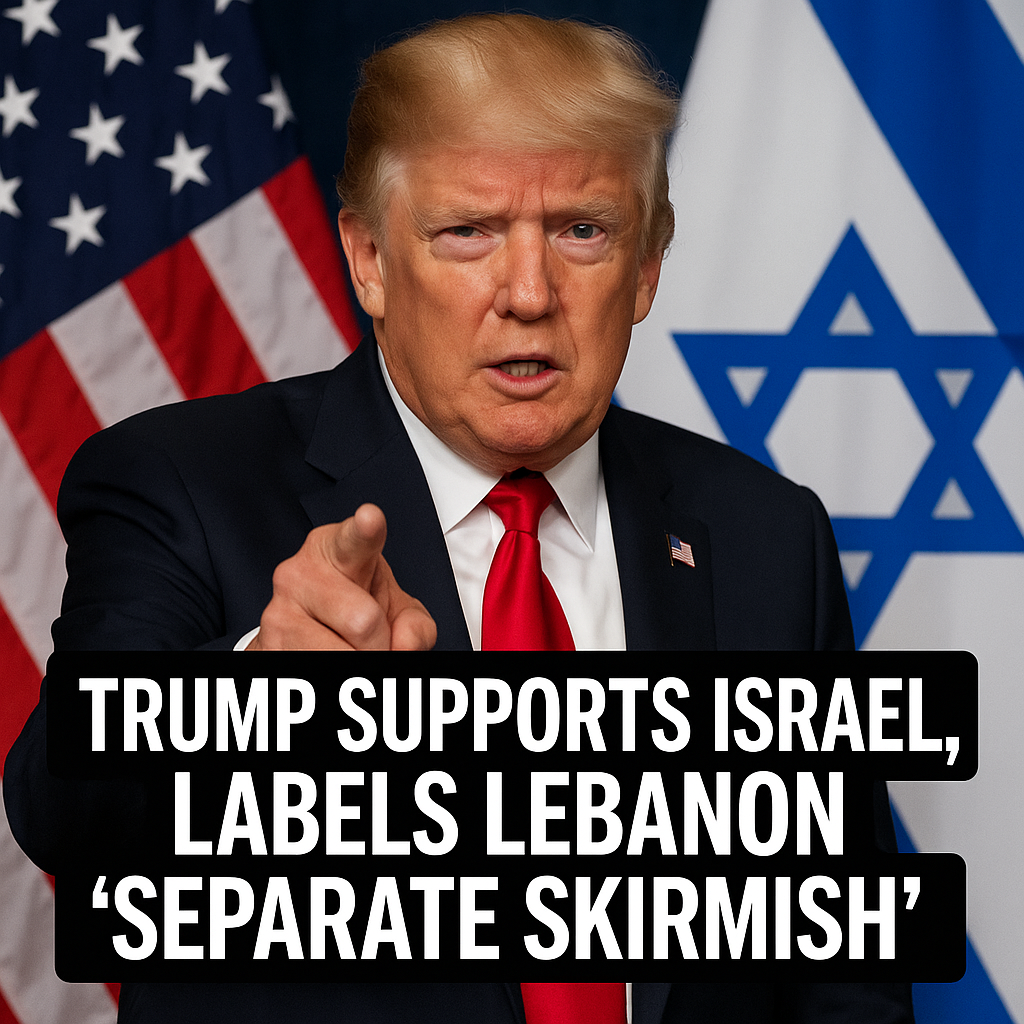
Trump Supports Israel, Labels Lebanon ‘Separate Skirmish’

Trump Supports Israel, Labels Lebanon ‘Separate Skirmish’
In a recent statement, former President Donald Trump expressed his unwavering support for Israel amidst escalating tensions in the region, specifically regarding Lebanon, which he categorized as a “separate skirmish.” This framing, emerging from the recent ceasefire between Israel and Lebanese Hezbollah forces, reflects a complex geopolitical landscape where perspectives on Israel’s military actions and regional dynamics vary significantly.

Understanding the Context of Trump’s Statement
Trump’s remarks come at a time when tensions between Israel and Hezbollah are high. The situation has been exacerbated by various military skirmishes, leading to significant loss of life and increased fear among civilians. The U.S., under Trump’s administration and even now, has historically positioned itself as a staunch ally of Israel, often framing conflicts with its neighbors through a lens that emphasizes Israel’s right to defend itself.


According to recent reports, Trump’s assertion that Lebanon is merely a “separate skirmish” downplays the gravity of the situation. Critics argue that this perspective risks oversimplifying the nuanced realities faced by those in Lebanon and the broader implications for stability in the region.


The Balancing Act: Support for Israel vs. Acknowledgment of Regional Nuances
From one standpoint, Trump’s unwavering support for Israel is evident in his administration’s policies that included moving the U.S. Embassy to Jerusalem and recognizing Israeli sovereignty over the Golan Heights. He further emphasized Israel’s right to act against attacks, stating, “Israel has a right to defend itself,” which resonates with many American supporters of Israel, particularly in the wake of missile attacks attributed to Hezbollah.
On the other hand, Trump’s characterization of the conflict concerning Lebanon has drawn criticism from various corners, including humanitarian organizations and local Lebanese authorities. They argue that describing a complex armed conflict involving civilian casualties as a “skirmish” diminishes the realities faced by those trapped in the crossfire. Reports indicate that numerous civilians have been affected, and the ongoing violence poses a severe humanitarian crisis, which some contend must not be overlooked.
Diverging Views on Regional Stability
The divergence in perspectives on Trump’s comments can also be seen among political analysts and commentators in major news outlets. Some echo Trump’s stance, arguing that a strong Israel is vital for regional stability and serve American interests. They point to historical instabilities in the region, asserting that Hezbollah, backed by Iran, represents a significant threat that needs to be curtailed.
Conversely, others advocate for a balanced approach, stressing the importance of acknowledging the complex socio-political issues at play. Critics note that minimizing the conflict in Lebanon and framing it as a mere skirmish is alarming and risks further exacerbating tensions. They urge for a more human-centric view of international incidents, advocating for diplomatic solutions rather than military ones.
The Impact of U.S. Politics on Middle Eastern Dynamics
Trump’s statements also highlight the role of U.S. domestic politics in shaping foreign perceptions. The former President has maintained a significant base of support driven by strong pro-Israel sentiments, which may influence his language and positions. However, this can potentially alienate other stakeholders in the region who may view U.S. backing of Israel as one-sided.
Furthermore, as the 2024 presidential election approaches, Trump’s continued focus on Israel may reflect a strategic move to consolidate support among evangelical Christians and other voters who prioritize strong U.S.-Israel relations. This political maneuvering in the U.S. often contrasts with the realities on the ground in the Middle East, where civilians are caught in the midst of ongoing conflict, and the lines between friend and foe are increasingly blurred.
Conclusion: A Complex Web of Perspectives
In conclusion, Trump’s endorsement of Israel while characterizing Lebanon’s situation as a mere “skirmish” encapsulates the complexities of geopolitical discourse today. While support for Israel is a prevalent stance within many U.S. political circles, it is critical to view these conflicts through a multi-faceted lens that recognizes the humanitarian implications and long-standing tensions in the region.
The ongoing conflict poses difficult questions about how the U.S. determines its foreign policy priorities and how those decisions impact real lives. Balancing unwavering support for allies like Israel while addressing the humanitarian crises in neighboring regions should be a foundational aspect of American foreign policy. As these dynamics evolve, the dialogue must continue to incorporate diverse perspectives, prioritizing diplomatic engagement over militaristic pressures whenever possible.















