
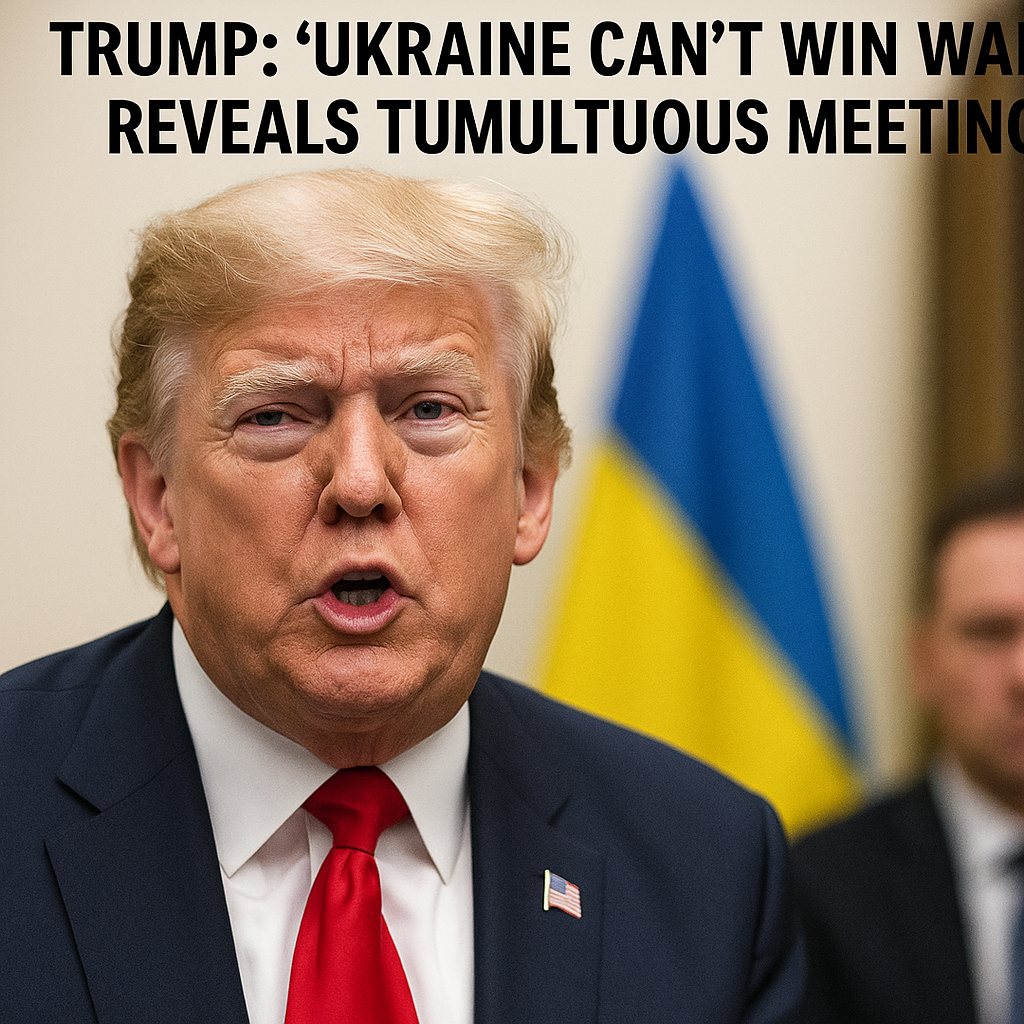
Trump: “Ukraine Can’t Win War,” Reveals Tumultuous Meeting

Trump: “Ukraine Can’t Win War,” Reveals Tumultuous Meeting
In recent discussions concerning the ongoing conflict in Ukraine, former President Donald Trump made headlines by stating that “Ukraine can’t win the war,” reflecting a significant pivot in his approach to this complex geopolitical issue. The tumultuous meeting with Ukrainian President Volodymyr Zelenskyy has reignited debates around U.S. foreign policy and the strategic implications of America’s support for Ukraine.

A Shift in Perspective
Trump’s assertion during the meeting marks a departure from the more supportive tone generally adopted by U.S. leaders in the wake of Russia’s invasion of Ukraine. While many voices in the political sphere argue for continued backing of Ukraine, Trump’s comments underscore a growing concern about the efficiency and sustainability of such aid. His statements, as reported by Sky News, suggest a skepticism about Ukraine’s ability to achieve a decisive victory against Russian forces.


Diverse Reactions from Political Circles
Trump’s remarks have drawn a wide array of responses, indicating the fractured nature of opinions on U.S. involvement in Ukraine. Supporters of Trump argue that his stance reflects a pragmatic approach in foreign policy, one that prioritizes American interests and questions the efficacy of continuous military assistance to Ukraine. Critics, however, see this as dangerously undermining the resolve of Ukraine and emboldening Russian aggression.


– Supporters’ Viewpoint: Some Republican allies assert that continued funding and support for Ukraine is unsustainable and distracts from pressing issues on the domestic front, such as inflation and economic instability. They argue for a pivot toward diplomacy rather than military escalation.
– Opponents’ Perspective: Conversely, a significant faction within both Democratic and some Republican circles argues that abandoning Ukraine now could lead to broader regional instability. They fear that weakening support for Ukraine would not only harm its sovereignty but also encourage further Russian expansionism, setting a dangerous precedent.
The Impact of Global Orders
The implications of Trump’s comments extend beyond just U.S.-Ukraine relations; they resonate deeply in the context of global geopolitical dynamics. Many experts view the ongoing war as not just a localized conflict, but a test of the international rules-based order established post-World War II. A potential withdrawal of U.S. support might embolden not only Russia but also other authoritarian regimes around the globe.
The dynamic becomes even more complex considering China’s ascendance. For instance, as Trump questions Ukraine’s viability, analysts caution that this could signal to China potential acceptance of aggressive actions in the Asia-Pacific region. Such scenarios hint at a broader shift in how aggressive states may calculate their future actions if they perceive the U.S. commitment to its allies as wavering.
Economic Considerations
Underlying the political debates are robust economic concerns. The financial strain of supporting Ukraine has been a focal point of discussions, particularly given the extensive military and humanitarian aid pledged by the U.S. and its allies. Critics of continued aid suggest that the funds could be redirected to pressing domestic issues, offering a compelling argument for Americans who prioritize immediate local needs over international engagements.
However, proponents counter that the cost of inaction or decreased support could far exceed the current outlays, particularly if the conflict escalates or spreads. The economic reasoning here posits that investment in Ukraine serves not just a moral imperative but also a strategic one, potentially saving larger expenses in future military engagements and humanitarian emergencies.
Conclusion: A Divided Path Forward
Trump’s comments create a clear divide among political factions, highlighting not just differing views on Ukraine, but also broader disagreements regarding U.S. foreign policy. As the situation unfolds, the complexities surrounding military support, economic implications, and the global geopolitical landscape will continue to shape discussions on this pivotal issue.
While some see Trump’s stance as a bold challenge to the status quo, others overwhelmingly reject it as a dangerous retreat from the principles of international solidarity. In navigating this contentious landscape, the U.S. must carefully weigh its decisions against the backdrop of historical commitments, economic realities, and the very nature of global alliances.
As the debate rages on, it remains essential for decision-makers to engage thoughtfully with diverse perspectives on Ukraine, illustrating the multifaceted challenges of maintaining a stable and just international community. The road ahead may be fraught with uncertainty, but open dialogue and a balanced approach may yet provide a path toward resolution in the complex context of this ongoing conflict.















