
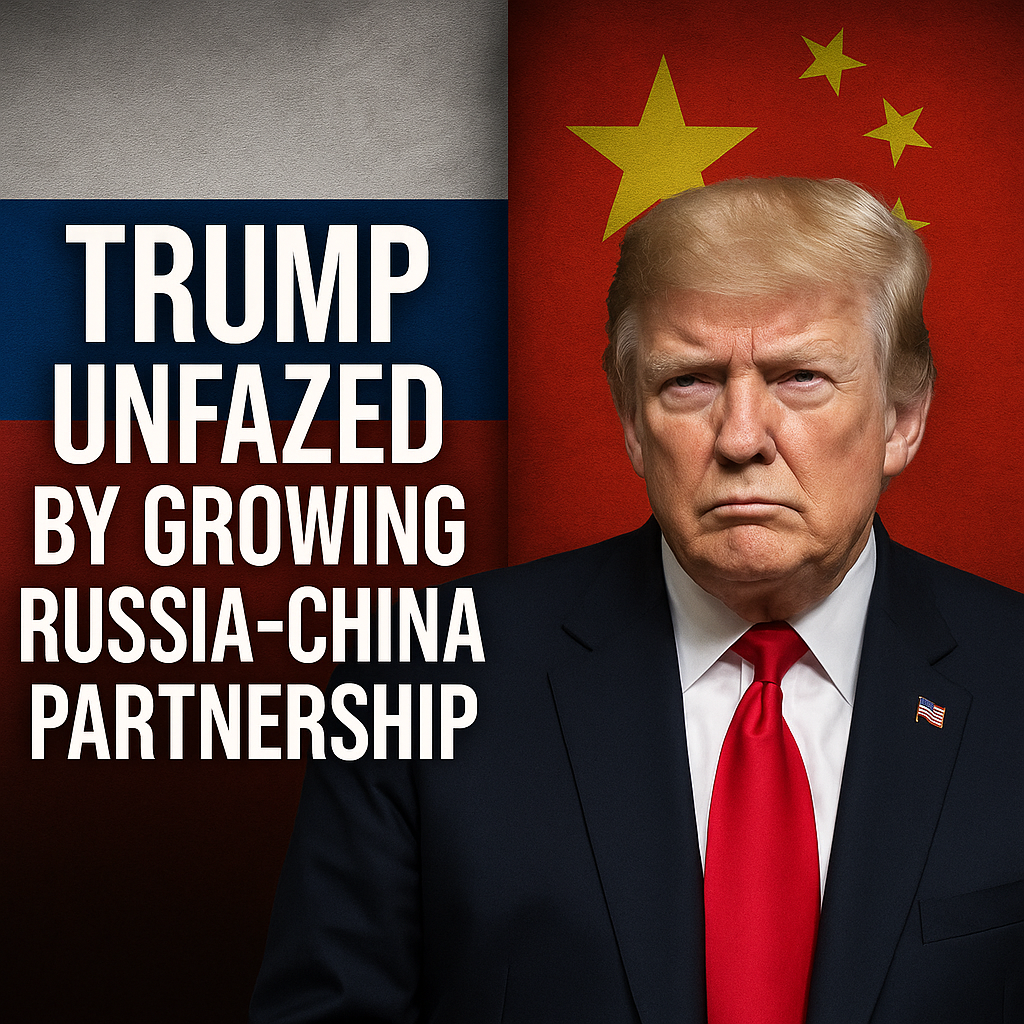
Trump Unfazed by Growing Russia-China Partnership

Trump Unfazed by Growing Russia-China Partnership
In recent months, the intensifying partnership between Russia and China has raised eyebrows across the globe. However, former President Donald Trump appears unfazed by this development, maintaining his unique perspective on the geopolitical ramifications.

Understanding the Russia-China Dynamic
As tensions rise between Western countries and both Russia and China, the two nations are increasingly aligning themselves economically and militarily. According to Al Jazeera, this partnership is seen as a counterweight to Western influence, particularly from the United States and Europe. The two countries have held joint military exercises, conducted significant trade agreements, and even issued statements in solidarity against perceived Western aggression.


Despite the growing partnership, Trump—a figure known for his distinct and often controversial views—has largely downplayed the potential threat this alliance poses to U.S. interests. In an interview with RT, Trump stated that he believes the United States can handle the geopolitical landscape effectively without significant concern over Russia or China. His assertion resonates with a particular segment of his supporters who view foreign affairs through a lens of American exceptionalism, often suggesting that global shifts in power are overstated.


The Contrasting Perspectives on Threats
While Trump downplays the partnership’s significance, many analysts express alarm at the evolving dynamics between the two countries. Reports indicate that Russia and China are not merely collaborating for mutual benefit; their partnership signifies a shared vision for a multipolar world—a scenario that could indeed alter the global balance of power. As highlighted by Sky News, experts warn that such an alliance may embolden both nations to pursue aggressive stances in international conflicts, particularly in areas like Eastern Europe and the South China Sea.
The dissonance between Trump’s analysis and that of many geopolitical analysts is striking. While the former president focuses on America’s strengths, foreign policy experts urge caution, emphasizing that the interconnectedness of defense and economic strategies between Russia and China could ultimately threaten U.S. dominance.
Is the U.S. Prepared for Challenges Ahead?
The prevailing sentiment among critics of Trump’s position is that his reaction—or lack thereof—might be indicative of a broader misunderstanding of international relations. Military alliances and economic partnerships, especially those forming against a backdrop of increasing hostility towards the West, should not be taken lightly. As reported in various reports, the collaboration on military exercises and burgeoning trade relations signify a collective ambition that could outlast transient political shifts.
On the domestic front, Trump’s supporters regard his approach as reflective of his “America First” ethos, which prioritizes U.S. interests without extensive foreign entanglements. This philosophy is attractive to many voters who are fatigued by prolonged international engagements. However, critics assert that such isolationist rhetoric could lead to complacency in a rapidly changing global landscape.
Navigating Uncertainties in World Affairs
The uncertainty surrounding the implications of the Russia-China partnership suggests a complex geopolitical puzzle. The reality is that while Trump may remain unconcerned, many others are playing a serious game of chess that demands vigilance. As global economies become increasingly interdependent, failure to acknowledge this emerging alliance could place the United States—and its allies—at a disadvantage.
The balance of power is a delicate equation, and insights from respected analytical sources point toward a need for a multidimensional strategy that not only acknowledges Trump’s viewpoint but also incorporates the cautious perspectives of foreign policy experts.
In examining the possible futures—whether the partnership serves as a mere tactical maneuver or evolves into a formidable geopolitical block—it’s clear that staying attuned to these developments is critical.
Conclusion: A Shift in Global Dynamics
In conclusion, while Trump projects an air of confidence regarding the growing relationship between Russia and China, a multitude of factors complicate the narrative. The potential for miscalculation exists, and while his supporters cheer for his nonchalance, experts warn of the implications that could arise if this partnership matures unchecked. As the geopolitical stage continues to shift, the United States must engage thoughtfully with these complexities, ensuring that its position remains secure in a world of ambitious allies.
In navigating these challenging waters, a balanced perspective that weighs the optimism of American strength against the realities of an evolving global landscape will be essential for future leaders.















