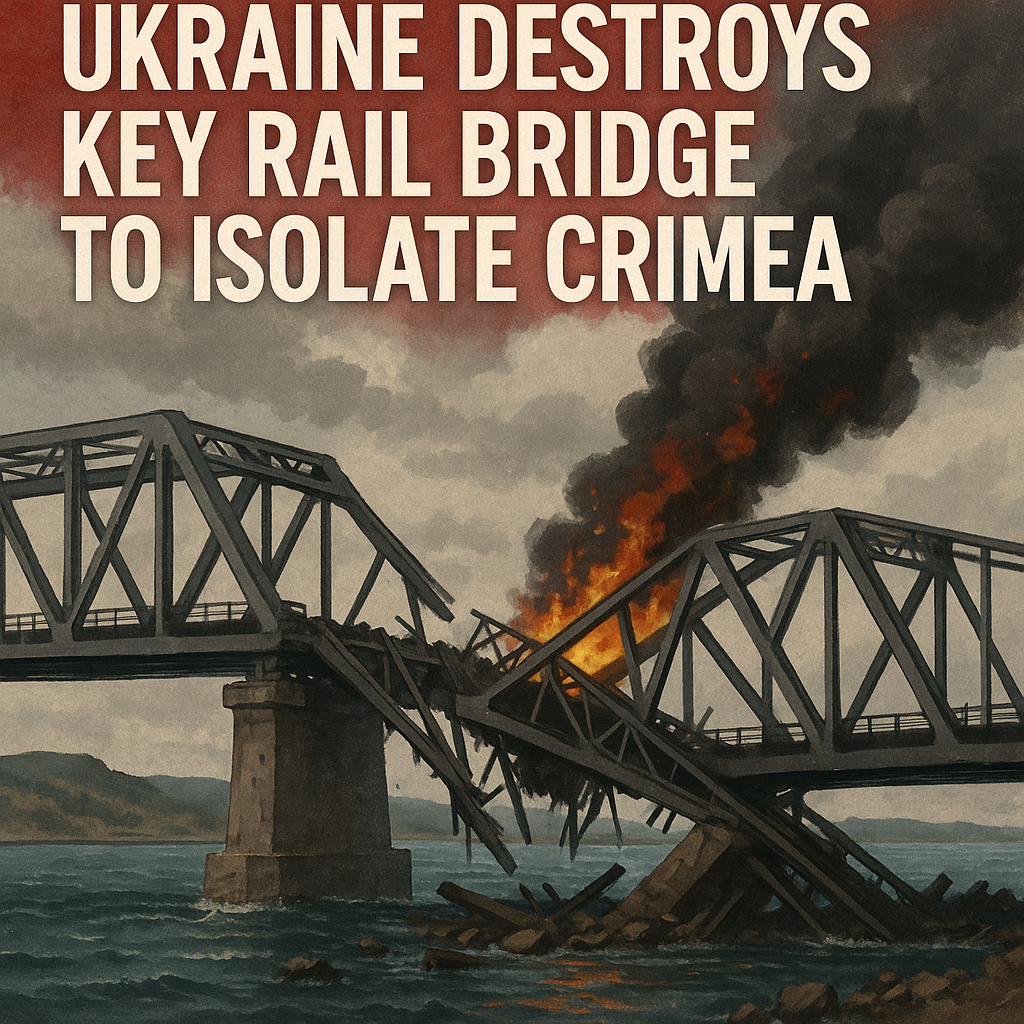
Ukraine Destroys Key Rail Bridge to Isolate Crimea

Ukraine Destroys Key Rail Bridge to Isolate Crimea
In a strategic move aimed at hampering Russian military logistics, Ukraine has successfully destroyed a critical rail bridge connecting the mainland to Crimea. This significant development not only exemplifies the ongoing conflict between Ukraine and Russia but also reflects a series of tactical maneuvers designed to shift the balance of power in the region.

The Implications of the Bridge Destruction
The targeted rail bridge has been essential for Russia’s supply lines, especially in the ongoing efforts to maintain a military presence in occupied territories. By demolishing this infrastructure, Ukraine aims to limit Russia’s ability to transport troops, equipment, and supplies, thereby impacting military operations in regions such as Kherson and Zaporizhzhia. This action aligns with Ukrainian President Volodymyr Zelensky’s broader strategy to reclaim territory and assert Ukraine’s sovereignty.


Reports indicate that the strike was executed using precision weaponry, showcasing Ukraine’s growing capabilities, possibly bolstered by Western aid and advanced military technology. While details on the weaponry used remain somewhat ambiguous, the efficiency of the operation signals increased tactical proficiency on Ukraine’s part.


Reactions from Russia and Ukraine
Russia responded to this development with a mixture of defiance and alarm. A spokesperson for the Kremlin described the bridge’s destruction as an “act of terrorism,” highlighting the Russian government’s ongoing narrative that the conflict is not just a military engagement but an existential struggle. Furthermore, Russian government officials insist that recovery efforts will be prioritized and that the bridge will be rebuilt, aiming to mitigate the psychological and logistical impact of the Ukrainian strike.
Conversely, Ukrainian officials have framed this operation as a vital step towards “liberating” Crimea—a region Russia annexed in 2014. Ukrainian military analysts suggest that the bridge’s destruction could lead to significant long-term advantages, potentially altering troop movements and strategies in the broader conflict.
The Strategic Importance of Crimea
The significance of Crimea extends beyond its geographical boundaries. The region serves as both a symbolic and strategic asset for Russia, hosting the Black Sea Fleet and supplying critical naval deployment capabilities. Control over Crimea affects not just military logistics but also the geopolitical dynamics in the Black Sea region, which has seen rising tensions in recent years.
Moreover, Crimea has a strong historical and cultural connection to Russia, further complicating efforts to displace Russian influence there. Thus, any Ukrainian initiative to weaken Russian logistics faces not only military obstacles but also significant societal and political challenges.
Conclusion: A Complex Landscape
As this conflict continues to evolve, the destruction of the rail bridge represents a larger narrative surrounding the struggle for control in Eastern Europe. Ukraine’s efforts to isolate Crimea and disrupt Russian supply lines underscore both military innovation and the resilience of a nation fighting for its sovereignty. However, as evident from Russia’s reaction, the situation remains fraught with tension, and the potential for escalation exists.
In summary, while Ukraine’s recent military efforts mark a noteworthy phase in the ongoing conflict, the multifaceted implications of such actions reveal a landscape of uncertainty. The actions taken on the battlefield may shift the tide temporarily, but the socio-political ramifications will likely shape the conflict for years to come.