
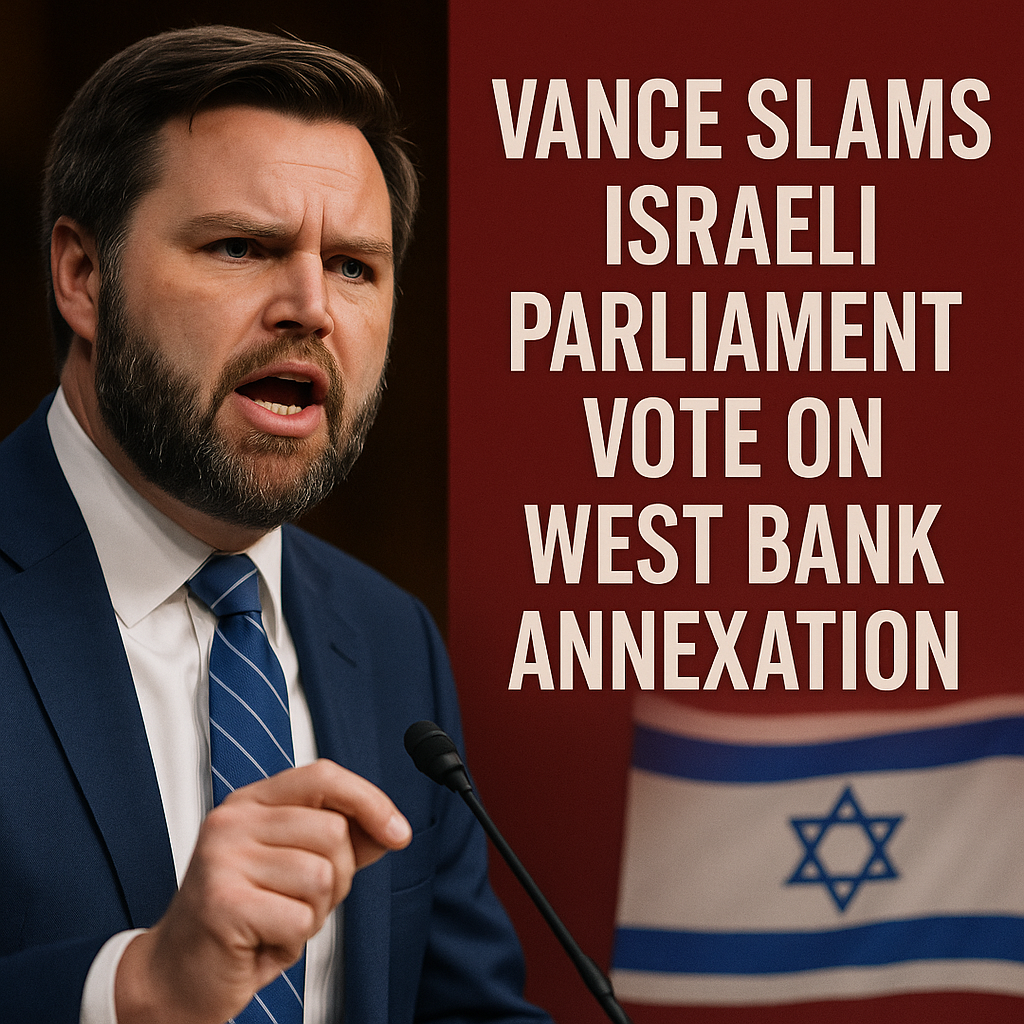
Vance Slams Israeli Parliament Vote on West Bank Annexation

Vance Slams Israeli Parliament Vote on West Bank Annexation
The recent vote by the Israeli parliament concerning the annexation of parts of the West Bank has ignited a firestorm of controversy, drawing sharp criticism from various leaders, including U.S. politician J.D. Vance. In a rapidly evolving geopolitical landscape, the implications of such decisions can reverberate far beyond the region.

The Context of the Vote
The Israeli parliament, known as the Knesset, has been at the center of fierce debate regarding the future of the West Bank. With a history that dates back to the Six-Day War in 1967, the region remains one of the most contentious areas in the Israeli-Palestinian conflict. The recent parliamentary decision to advance annexation plans has heightened tensions, leading to diverse reactions both domestically and internationally.


Diverse Reactions
While some view the vote as a step toward securing Israeli sovereignty over the disputed territories, others argue it undermines the peace process and exacerbates existing tensions. J.D. Vance, a Republican Senator from Ohio, has been vocal in his opposition to the parliament’s action. According to statements reported by Al Jazeera, Vance criticized the move as detrimental to both national interests and the broader peace in the region.


Conversely, proponents of the annexation argue that it solidifies Israel’s claim to territories essential for its security and identity. They view the International criticisms as misaligned with Israel’s right to self-determination. This perspective highlights a deep divide: should Israel prioritize its historical claims, or seek a reconciliatory approach that involves differing narratives and acknowledgment of Palestinian rights?
The Broader Implications
Vance’s critique signifies a growing concern among U.S. lawmakers regarding the implications of unilateral decisions by Israel. Analysts point out that Vance’s position reflects a broader bipartisan unease about the potential ramifications on U.S.-Israel relations and the stability of the Middle East.
Tensions with the U.S. Administration
The Biden administration has urged restraint regarding unilateral actions that could hinder peace prospects. According to reports from Sky News, officials have indicated that such legislative moves may complicate diplomatic efforts in the region, affecting America’s long-standing role as a mediator. The administration has emphasized the importance of renewing negotiations between Israel and Palestine, aiming for a two-state solution as the most viable path toward enduring stability.
However, not all experts agree on the efficacy of the two-state solution in the current climate. Some argue that as Israeli settlements expand and annexation plans advance, the feasibility of two states living side by side diminishes, leading to questions about the future of Palestinian statehood. This adds layers of complexity to Vance’s argument, illustrating that time may be running out for practical resolutions.
Areas of Uncertainty
Despite the divergent views, a clear consensus on the next steps remains elusive. Critics of annexation warn that such a strategy could lead to increased violence and further alienation of Palestinians, while proponents emphasize the necessity of ensuring Israel’s security. The reality is that with growing unrest and a lack of trust between the parties, finding a balanced solution will require both courage and creativity.
Leaders across the political spectrum are now contending with the challenge of addressing the humanitarian and political ramifications of the situation. The potential for escalated conflict looms large, affecting not only the local population but also international relations, particularly within the framework of U.S. foreign policy.
Conclusion
As the world watches the developments in Israel and the West Bank, one thing is clear: decisions made within the Knesset can have far-reaching consequences that extend well beyond its borders. Vance’s criticism resonates with a growing number of voices calling for a thoughtful approach to conflict resolution—one that transcends historical grievances and fosters dialogue.
Navigating this complex landscape will require more than political posturing; it will take collaborative efforts that honor the narratives of both Israelis and Palestinians. The hope lies in dialogue that prioritizes mutual recognition, understanding, and a shared commitment to peace. Only time will tell how this critical juncture will impact the broader fabric of Middle Eastern geopolitics.















