
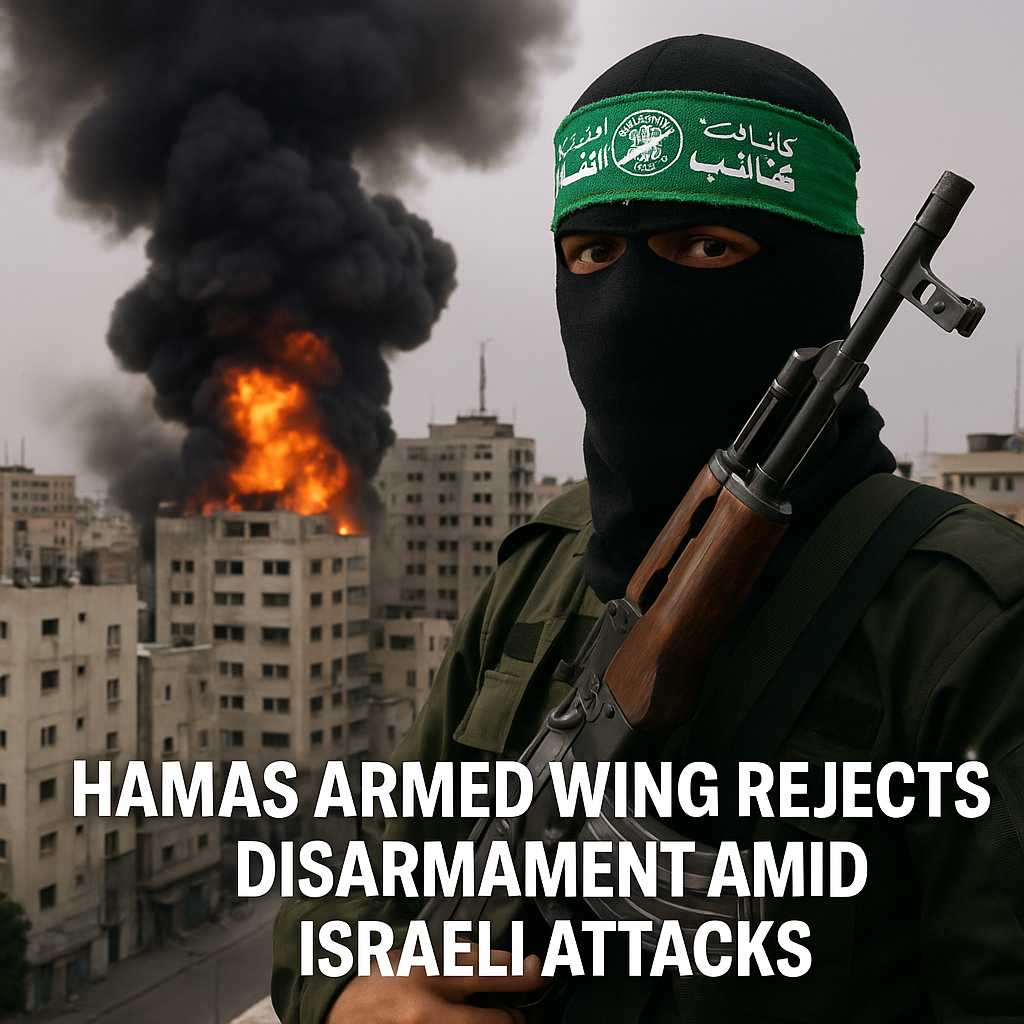
Hamas Armed Wing Rejects Disarmament Amid Israeli Attacks
Hamas Armed Wing Rejects Disarmament Amid Israeli Attacks
The ongoing conflict in the Middle East has reached another climactic point, as the Hamas armed wing firmly rejected disarmament in light of continued Israeli military actions. This stance highlights a complex and escalating situation marked by deep-seated animosities and an unyielding cycle of violence. As both sides entrench themselves, the prospect for peace becomes increasingly elusive.

The Stance of Hamas and the Implications of Disarmament
Following recent Israeli airstrikes that targeted military sites in Gaza, Hamas announced that it would not consider disarmament, viewing it as an unrealistic expectation in the face of ongoing aggression. A representative for the group emphasized that “we will defend our land and people,” underscoring their commitment to armed resistance as a strategy of survival. This sentiment resonates deeply within Gaza, where many view arms as a necessary deterrent against potential incursions.

On one hand, Hamas’ rejection of disarmament stems from a historical context of distrust towards Israel. Previous peace agreements and negotiations have often resulted in little more than a temporary cessation of hostilities rather than a lasting resolution. From the perspective of Hamas and its supporters, disarming would leave them vulnerable to an opponent they perceive as relentless and aggressive.

The Israeli Perspective
Conversely, the Israeli government argues that a disarmed Hamas would lead to a more stable and secure region. Officials suggest that Hamas’ weapons stockpile contributes to a cycle of violence and chaos, endangering not only Israeli citizens but also Palestinians who live in Gaza. An Israeli spokesperson stated that “for any peace deal to be successful, there must be a genuine commitment from Hamas to disarm,” pointing to the necessity of removing what they see as a direct threat.
Israeli military strategy has focused on disabling Hamas’s capabilities through targeted strikes aimed at dismantling their infrastructure. Critics of this approach, however, argue that such actions often result in significant civilian casualties and exacerbate the humanitarian crisis in Gaza. The situation is further complicated by international responses, as some nations advocate for negotiations while others support Israel’s right to defend itself.
Weighing Perspectives on the Path Forward
The ongoing conflict reveals a stark division in perspectives, raising questions about the possibilities of peace. A consistent theme is the deep mistrust between both parties. While Hamas maintains its position of armed resistance, Israel insists on the importance of disarmament as a precondition for any meaningful dialogue. This standoff results in a cyclical pattern of violence that often leaves civilians caught in the crossfire.
The Human toll
Data compiled by humanitarian organizations indicate that the escalating violence has led to thousands of casualties and a humanitarian disaster in Gaza. The situation remains dire, with limited access to clean water, medical supplies, and shelter, increasing the desperation among civilians. Depending on whom you ask, the blame for this suffering is either directed at the unwavering actions of Israel or the militant strategies employed by Hamas.
As international diplomatic efforts continue to flounder, the humanitarian conditions in Gaza are at a tipping point. As one aid worker noted, “While politicians negotiate in air-conditioned rooms, families here are struggling for survival.”
Possible Pathways to Resolution
While disarmament seems an unlikely agreement in the short term, avenues for dialogue must remain open. Experts suggest that confidence-building measures—such as ceasefires or humanitarian truces—could create a space for more substantial negotiations. The global community has a role to play in guiding both sides towards a trajectory that focuses on mutual recognition and respect, stepping away from entrenched positions.
While Hamas sees armed resistance as a legitimate form of defense, the prospects for lasting peace hinge on a fundamental shift in understanding and recognition of aspirations on both sides.
Conclusion: An Uncertain Future
The situation remains fluid, with each side firmly entrenched in their respective positions. The rejection of disarmament by Hamas amid ongoing Israeli attacks highlights the complexities of this conflict. As both parties approach their positions with mistrust and historical grievances, the cycle of violence threatens to perpetuate itself barring some significant diplomatic breakthroughs.
Moving forward, the international community must foster an environment where dialogue supersedes aggression and where both the needs of security and human dignity can be recognized. Without such efforts, the prospect for peace remains dim, and the cycle of suffering is likely to continue.















